NASA's Marks 30th Anniversary of Mars Viking Mission
July 17, 2006
NASA's Marks 30th Anniversary of Mars Viking Mission

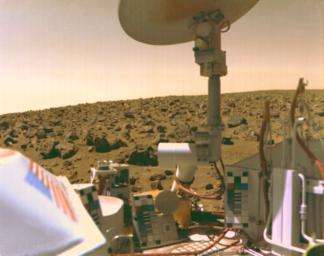
The boulder-strewn field of red rocks reaches to the horizon nearly two miles from Viking 2 on Mars' Utopian Plain. Scientists believe the colors of the Martian surface and sky in this photo represent their true colors. Fine particles of red dust have settled on spacecraft surfaces. The salmon color of the sky is caused by dust particles suspended in the atmosphere. Color calibration charts for the cameras are mounted at three locations on the spacecraft. Note the blue star field and red stripes of the flag. The circular structure at top is the high-gain antenna, pointed toward Earth. Viking 2 landed September 3,1976, some 4600 miles from its twin, Viking 1, which touched down on July 20. Image credit: NASA

Thirty years after the first successful landing on Mars by NASA's Viking spacecraft, the ambitious mission continues to evoke pride and enthusiasm for future space exploration.

NASA's Viking 1 and 2 missions to Mars, each consisting of an orbiter and a lander, became the first space probes to obtain high resolution images of the Martian surface; characterize the structure and composition of the atmosphere and surface; and conduct on-the-spot biological tests for life on another planet.

Viking 1 was launched Aug. 20, 1975, and arrived at Mars on June 19, 1976. On July 20, 1976, the Viking 1 lander separated from the orbiter and touched down at Chryse Planitia. Viking 2 was launched Sept. 9, 1975, and entered Mars orbit Aug. 7, 1976. The Viking 2 lander touched down at Utopia Planitia on Sept. 3, 1976.

"The Viking team didn't know the Martian atmosphere very well, we had almost no idea about the terrain or the rocks, and yet we had the temerity to try to soft land on the surface," recalled Gentry Lee, Solar System Exploration chief engineer at NASA's Jet Propulsion Laboratory, Pasadena, Calif. Lee was the science analysis and mission planning director for the Viking mission. "We were both terrified and exhilarated. All of us exploded with joy and pride when we saw that we had indeed landed safely."

"The Viking mission looms like a legendary giant, an incredible success against which all present and future missions will be measured," said Doug McCuiston, Mars Exploration Program director at NASA Headquarters in Washington.

Originally designed to function for 90 days, the Viking spacecraft continued collecting data for more than six years. The landers accumulated 4,500 up-close images of the Martian surface. The accompanying orbiters provided more than 50,000 images, mapping 97 percent of the planet.

Viking provided the first measurements of the atmosphere and surface of Mars. These measurements are still being analyzed and interpreted. The data suggested early Mars was very different from the present day planet. Viking performed the first successful entry, descent and landing on Mars. Derivations of a Viking-style thermal protection system and parachute have been used on every U.S. Mars lander mission, including Mars Pathfinder and the Mars Exploration Rovers, Spirit and Opportunity.

NASA's Langley Research Center, Hampton, Va., managed the Viking Program. NASA's Jet Propulsion Laboratory, managed by the California Institute of Technology in Pasadena, Calif., built the orbiters, provided the deep space network and managed the science mission. NASA's Glenn Research Center, Cleveland, designed the Titan/Centaur launch vehicles that propelled the spacecraft on their journey. NASA's Kennedy Space Center, Fla., provided the launch facility for the program. Scientists from across NASA served on the Viking science teams.

For more information about Viking, visit: http://www.nasa.gov/viking.

Source: NASA

2.1 /5 (10 votes)  

Rank 2.1 /5 (10 votes)
Tags

Related Stories
Relevant PhysicsForums posts
  • Never ending outer space.....
    created2 hours ago
  • Neutron Star fragments?
    created4 hours ago
  • stationary or not?
    created8 hours ago
  • Scale of the Universe
    createdFeb 10, 2012
  • Titan's lack of impact craters
    createdFeb 09, 2012
  • Real pictures of black hole eating a star?
    createdFeb 08, 2012
  • More from Physics Forums - General Astronomy

More news stories

Europe stakes billion-dollar bet on new rocket

A pencil-slim rocket is scheduled to lift into space from South America on Monday, carrying a billion-dollar bet that Europe can grab a juicy slice of the market to place satellites in low orbit.

Space & Earth / Space Exploration

created 15 hours ago | popularity 3.5 / 5 (2) | comments 0

Political leaders play key role in how worried Americans are by climate change: study

More than extreme weather events and the work of scientists, it is national political leaders who influence how much Americans worry about the threat of climate change, new research finds.

Space & Earth / Environment

created Feb 06, 2012 | popularity 5 / 5 (6) | comments 72

NASA budget will axe Mars deal with Europe: scientists

US President Barack Obama's budget proposal to be submitted next week for 2013 will cut NASA's budget by 20 percent and eliminate a major partnership with Europe on Mars exploration, scientists said Thursday.

Space & Earth / Space Exploration

created Feb 10, 2012 | popularity 5 / 5 (3) | comments 48

Humans may have helped the decline of African rainforests 3000 years ago

(PhysOrg.com) -- Large areas of rainforests in Central Africa mysteriously disappeared over three thousand years ago, to be replaced by savannas. The prevailing theory has been that the cause was a change ...

Space & Earth / Environment

created Feb 10, 2012 | popularity 4.1 / 5 (14) | comments 19 | with audio podcast report

Could Venus be shifting gear?

(PhysOrg.com) -- ESA’s Venus Express spacecraft has discovered that our cloud-covered neighbour spins a little slower than previously measured. Peering through the dense atmosphere in the infrared, the ...

Space & Earth / Space Exploration

created Feb 10, 2012 | popularity 5 / 5 (8) | comments 10 | with audio podcast


Walney offshore wind farm is world's biggest (for now)

(PhysOrg.com) -- The Walney wind farm on the Irish Sea--characterized by high tides, waves and windy weather--officially opened this week. The farm is treated in the press as a very big deal as the Walney ...

GPS court ruling leaves US phone tracking unclear

A US Supreme Court decision requiring a warrant to place a GPS device on the car of a criminal suspect leaves unresolved the bigger issue of police tracking using mobile phones, legal experts say.

Europeans protest controversial Internet pact

Tens of thousands of people marched in protests in more than a dozen European cities Saturday against a controversial anti-online piracy pact that critics say could curtail Internet freedom.

Study finds that anti-diabetic medication can prevent the long-term effects of maternal obesity

In a study to be presented today at the Society for Maternal-Fetal Medicine's annual meeting, The Pregnancy Meeting, in Dallas, Texas, researchers will report findings that show that short therapy with the anti-diabetic medication ...

Netflix settlement trims 14 pct off 4Q earnings

(AP) -- Netflix pressed the rewind button on its fourth-quarter earnings after settling allegations that the video subscription service violated a consumer-privacy law.

Navy to begin tests on electromagnetic railgun prototype launcher

The Office of Naval Research (ONR)'s Electromagnetic (EM) Railgun program will take an important step forward in the coming weeks when the first industry railgun prototype launcher is tested at a facility ...