Lady in Red: Andromeda Galaxy Shines in Spitzer's Eyes
October 14, 2005 Lady in Red: Andromeda Galaxy Shines in Spitzer's Eyes

NASA's Spitzer Space Telescope has captured a stunning infrared view of Messier 31, the famous spiral galaxy also known as Andromeda.

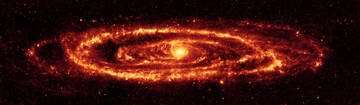
Image: The infrared Spitzer image reveals new insight into Andromeda's well-known ring of star formation. This ring appears to be split into two pieces, forming the hole to the lower right. These asymmetrical features may have been caused by interactions with satellite galaxies around Andromeda. Image credit: NASA/JPL-Caltech/Univ. of Arozona

Andromeda is the most-studied galaxy outside our own Milky Way, yet Spitzer's sensitive infrared eyes have detected captivating new features, including bright, aging stars and a spiral arc in the center of the galaxy. The infrared image also reveals an off-centered ring of star formation and a hole in the galaxy's spiral disk of arms. These asymmetrical features may have been caused by interactions with the several satellite galaxies that surround Andromeda.

"Occasionally small satellite galaxies run straight through bigger galaxies," said Dr. Karl Gordon of the Steward Observatory, University of Arizona, Tucson, lead investigator of the new observation. "It appears a little galaxy punched a hole through Andromeda's disk, much like a pebble breaks the surface of a pond."

Approximately 2.5 million light-years away, Andromeda is the closest spiral galaxy and is the only one visible to the naked eye. Unlike our Milky Way galaxy, which we view from the inside, Andromeda is studied from the outside. Astronomers believe that Andromeda and the Milky Way will eventually merge together.

Spitzer detects dust heated by stars in the galaxy. Its multiband imaging photometer's 24-micron detector recorded approximately 11,000 separate infrared snapshots over 18 hours to create the new comprehensive mosaic. This instrument's resolution and sensitivity is a vast improvement over previous infrared technologies, enabling scientists to trace the spiral structures within Andromeda to an unprecedented level of detail.

"In contrast to the smooth appearance of Andromeda at optical wavelengths, the Spitzer image reveals a well-defined nuclear bulge and a system of spiral arms," said Dr. Susan Stolovy, a co-investigator from the Spitzer Science Center at the California Institute of Technology, Pasadena.

The galaxy's central bulge glows in the light emitted by warm dust from old, giant stars. Just outside the bulge, a system of inner spiral arms can be seen, and outside this, a well-known prominent ring of star formation.

Source: NASA


print this article email this article download pdf blog this article bookmark this article     Stumble it Digg this share on Facebook retweet share on Reddit add to delicious
Rate this story - 3.3 /5 (4 votes)


October 14, 2005 all stories

Comments: 0

3.3 /5 (4 votes)
  • Stumble this up

  • Digg this

  • share this

  • hide
  • Related Stories

  • The Milky Way's tiny but tough galactic neighbor
    created Oct 14, 2009 | popularity not rated yet | comments 0
  • Swift makes best-ever ultraviolet portrait of Andromeda Galaxy
    created Sep 16, 2009 | popularity not rated yet | comments 0
  • Milky Way a Swifter Spinner, More Massive, New Measurements Show
    created Jan 05, 2009 | popularity not rated yet | comments 0
  • Hubble Space Telescope Spies Galaxy/Black Hole Evolution in Action
    created Jun 03, 2008 | popularity not rated yet | comments 0
  • Antennae Galaxies
    created May 19, 2008 | popularity not rated yet | comments 0


Other News

The shore of Deception Island in Antarctica, in 2008

Antarctic ice loss vaster, faster than thought: study

Space & Earth / Earth Sciences

created 7 hours ago | popularity 2.9 / 5 (10) | comments 8

The East Antarctic icesheet, once seen as largely unaffected by global warming, has lost billions of tonnes of ice since 2006 and could boost sea levels in the future, according to a new study.


Astronaut's baby daughter born as he circles Earth (AP)

Astronaut's baby daughter born as he circles Earth

Space & Earth / Space Exploration

created 7 hours ago | popularity 5 / 5 (1) | comments 0

(AP) -- Astronaut Randolph Bresnik jubilantly welcomed his new daughter into the world Sunday as he floated 220 miles above it.


Denmark: 65 world leaders for UN climate summit (AP)

Denmark: 65 world leaders for UN climate summit

Space & Earth / Environment

created 7 hours ago | popularity 1 / 5 (2) | comments 2

(AP) -- Sixty-five world leaders have said they will attend the Copenhagen climate summit in December, and several more have responded positively to invitations, Danish officials said Sunday.


Commuters wait on the platform shrouded by fog in London

Climate change not man-made, say majority of Britons: poll

Space & Earth / Environment

created Nov 15, 2009 | popularity 3.4 / 5 (16) | comments 46

Less than half of Britons believes that human activity is to blame for global warming, according to a poll carried out for The Times newspaper and published on Saturday.


Mysteriously warm times in Antarctica

Mysteriously warm times in Antarctica

Space & Earth / Earth Sciences

created Nov 18, 2009 | popularity 4.2 / 5 (21) | comments 31

(PhysOrg.com) -- A new study of Antarctica's past climate reveals that temperatures during the warm periods between ice ages (interglacials) may have been higher than previously thought. The latest analysis ...