Computer card game detects cognitive changes
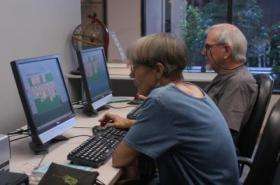
A popular, computer-based card game is helping Oregon Health & Science University researchers monitor cognitive changes in the elderly, a new study shows.
Scientists with the OHSU Oregon Center for Aging & Technology, or ORCATECH, found that a Solitaire-like game called FreeCell, when adapted with cognitive performance assessment algorithms, may be able to distinguish between persons with memory problems and cognitively healthy seniors.
People with mild cognitive impairment are at high risk of developing dementia, which is most commonly caused by Alzheimer's disease. The discovery could help doctors plan early treatment strategies by detecting subtle cognitive changes over time in the natural setting of an elder's home.
"We discovered that we can take an existing computer game that people already have found enjoyable and extract cognitive assessment measures from it," said ORCATECH investigator Holly Jimison, Ph.D., associate professor of medical informatics and clinical epidemiology, OHSU School of Medicine, and the study's lead author.
The study results are being presented today during a poster session at the 10th International Conference on Alzheimer's Disease and Related Disorders in Madrid.
In FreeCell, players are dealt 52 cards face up in eight columns, with four columns having seven cards and the others having six. The object is to move all the cards into four single-card free "cells" in four suit piles stacked from lowest to highest rank.
"It requires significant planning to play well, and planning is one measure that neuropsychologists attempt to test in clinical situations," Jimison said. "We're trying to replicate that, and we've been able to show that we can, at least in early studies with small numbers of people, show distinctions between cognitively healthy elders and those with even mild cognitive impairment."
Jimison and study co-author Misha Pavel, Ph.D., professor of biomedical engineering and computer science and electrical engineering at OHSU's OGI School of Science & Engineering, studied nine people with an average age of 80. All were regular computer users who played the FreeCell game frequently over a six-month period. Each participant was given a cognition score based on a brief battery of tests, and three were found to have mild cognitive impairment.
To measure cognitive performance, researchers compared each user's play efficiency to a game "solver" within the program that checks card layouts throughout a game and calculates the minimal number of moves to complete it. The solver is a "dynamic algorithm that is solving the game at every moment in time, and it knows the minimal number of steps you would need to complete it," Jimison said. "We compare this 'optimal slope' to how the individual users are doing."
The FreeCell study laid the groundwork for follow-up research, funded by the National Institute of Standards and Technology's Advanced Technology Program, or NIST ATP, examining games with "dynamic adaptability," a system that keeps games fun and challenging, but still able to simultaneously collect data. For example, scientists can program the FreeCell game to automatically adjust difficulty with each new card layout based on the user's performance on the previous game, and users also can receive hints, if they choose, along the way.
"In general, we're trying to keep people at a 75 percent win rate," said Jimison, who also serves as senior research scientist for Portland-based computer game developer and ORCATECH partner Spry Learning Co., which received the NIST ATP grant and helped adapt and test the FreeCell game. "We're trying to keep difficulty at a level that keeps them motivated. We want to challenge them to the point where they just start having trouble. We don't want it to be too easy or too hard."
Pavel believes that as the elderly population increases, the incidence of chronic illness - an estimated 80 percent of adults older than 65 report having at least one chronic illness, and half of all adults have at least two - such home monitoring technology will become a health care standard.
"In the near future, technology for unobtrusive monitoring, assessment and coaching will become a part of our everyday life, throughout the lifespan, much like telephones, credit cards, alarm watches and automobiles," he explained. "In infancy, early detection of dysfunctions will enable early treatment, development of special programs, and the like. In youth and adulthood, we will use the technology in sports, in alarms, reminders. So it will not be a drastic change for us to accept monitoring as we age. It is always a tradeoff between benefits and costs."
The FreeCell program is one of several "enabling technologies" under development at ORCATECH, said the center's director, Jeffrey Kaye, M.D., OHSU professor of neurology and biomedical engineering. The interdisciplinary center, established in 2004 as a National Institute on Aging Roybal Center for Aging & Technology, studies and develops technology to assess elders in their home environments. The goal is to help them retain independence by discretely collecting data that may indicate health changes long before quality of life is affected.
"It's a lot easier to treat someone when symptoms are just starting as opposed to when a full-blown crisis occurs," Kaye said. "These electronic and online methodologies help tell us early on when trouble's brewing. We're not suggesting we can make detailed diagnoses all remotely. What we're trying to do is identify trends that might tell use someone may be in trouble in the future."
Devin Williams, Spry Learning Co.'s chief executive officer, believes needs by the medical community to recognize and classify such trends will drive the development of products like the adapted FreeCell game and, as a result, "help identify early commercial applications for the technology." ORCATECH, she said, "is an excellent example of the benefits of such accelerated translational research."
Source: Oregon Health & Science University


