Figuring out function from bacteria's bewildering forms
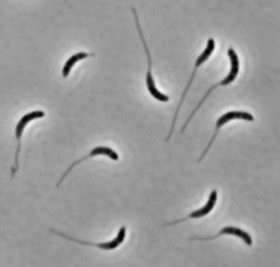
The constellation of shapes and sizes among bacteria is as remarkable as it is mysterious. Why should Spirochaeta halophila resemble a bedspring coil, Stella a star and Clostridium cocleatum a partly eaten donut? No one really knows.
A new report in the Proceedings of the National Academy of Sciences by Indiana University Bloomington scientists answers that form-and-function question for one bacterium, the aquatic Caulobacter crescentus, whose cells are anchored to solid objects by conspicuous and distinctive stalks.
"We've found the bacteria can take up nutrients with their stalks," said microbiologist Yves Brun, who led the study. "This is the first example that we know of in which a major feature of a bacterium's shape can be tied to a specific function."
Despite their tiny size and readiness for laboratory study, far less is known about the physiological utility of bacterial shapes than, say, the streamlined forms of fish, sharks and dolphins, or the elongated spires of pine and redwood trees.
Brun said C. crescentus' stalk acts as a sort of antenna that amplifies the uptake of organic phosphate from the surrounding environment. The narrow stalk adds little volume to the cell, and incoming nutrients diffuse toward the cell's main body, where nutrients are quickly assimilated by metabolic processes. Phosphate is an important molecule to all organisms. It is involved in DNA repair and duplication, the expression of DNA, the regulation of protein action, membrane synthesis and the transfer of energy within cells.
The scientists used fluorescence microscopy to see where organic phosphate enters C. crescentus cells. As a gram negative bacterium, C. crescentus has two membranes -- an outer membrane and an inner membrane, with a space called the "periplasm" in between. Experiments demonstrated initial entry of organic phosphate across the entire cell surface, including the stalk. Once across the outer membrane, the organic phosphate is converted to inorganic phosphate and diffuses from the stalk toward the periplasm. When the phosphate reaches the cell body periplasm, the phosphate is taken across the inner membrane and into the central part (cytoplasm) of the cell.
"The stalk essentially increases the cell's reach into the environment but without the cost of increasing the cell's volume and surface area, which would be expensive from an energetic standpoint," Brun said.
Using mathematical models, the scientists showed that absorption of a nutrient using an antenna was a far more efficient morphology for nutrient uptake than alternate cell shapes in which the stalk plays no special role. The models assume the bacteria encounter nutrients via diffusion from their surrounding medium.
"Our report makes the point that in calm aquatic environments where there is no mixing of the liquid and therefore the motion of nutrient molecules is dominated by diffusion, it is the cell's length that is the most important parameter for nutrient uptake," Brun said.
"Imagine the nutrient molecule as a tiny tennis ball undergoing diffusion, that is bouncing back and forth off other molecules in random directions. It is easy to imagine that the tennis ball will be just as likely to make contact with a baseball bat as it will a tennis racket. And the longer the baseball bat, the larger the number of diffusing tennis balls that will make contact. That's why the stalk seems to be so advantageous for the cell. This is in contrast to cases where there is mixing of the liquid and where total surface area -- not length -- becomes more important. The stalk shape is advantageous in both situations because it increases surface area with minimal increase in volume, and at the same time it can be 15 or more times longer than the cell body."
The implications of the group's discovery are two-fold, Brun said. If stalks improve the efficiency of the uptake of other nutrients, the structures and appropriate transport proteins could be added to bacteria commonly used in drug production and toxic spill clean-ups. Bacteria are often used as workhorses in the mass-conversion of one molecule to another. Improving the speed of uptake of a substrate molecule by the bacteria could hypothetically speed drug production. "If we could figure out how to get the bacteria used in bioremediation to make stalks, we could improve their ability to take up pollutants and up their efficiency," he said.
But Brun also says the discovery has ecological significance. "Bacteria with stalks and other prostheses are ubiquitous in all the earth's aquatic environments," he said. "Phosphorus is a limiting nutrient in determining the productivity of lakes and oceans. The stalked bacteria are central players in scavenging phosphorus in oceans and lakes, and reintroducing it into the food chain."
C. crescentus is an unusual bacterium whose lifespan encompasses two phases: a mobile "swarmer" phase, in which the cells have a single flagellum, and a sedentary "stalked" phase in which the cells shed their flagella, affix themselves to rocks or pebbles (or the sides of water pipes) with the help of a very sticky adhesive, and then grow a stalk.
In April, Brun and colleagues from Brown University reported in the Proceedings of the National Academy of Sciences that the polysaccharide adhesive C. crescentus uses to affix itself to solid objects appears to be the strongest glue produced in the natural world.
IU Bloomington biologists Jennifer Wagner, IUB physicist Sima Setayeshgar and IUB chemists James Reilly and Laura Sharon also contributed to the current PNAS report.
Source: Indiana University


