Bubbles go high-tech to fight tumors
Bubbles: You've bathed in them, popped them, endured bad song lyrics about them. Now, University of Michigan researchers hope to add a more sophisticated application to the list---gas bubbles used like corks to block oxygen flow to tumors, or to deliver drugs.
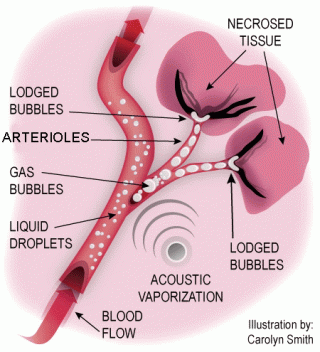
The process of blocking blood flow to a tumor is called embolization, and using gas bubbles is a new technique in embolotherapy. What makes it so promising is that the technique allows doctors to control exactly where the bubbles are formed, so blockage of blood flow to surrounding tissue is minimal, said Joseph Bull, assistant professor of biomedical engineering at U-M.
The research of Bull and collaborator Brian Fowlkes, an associate professor in the Department of Radiology in the U-M Medical School, is currently focused on the fundamental vaporization and transport topics that must first be understood in order to translate this developmental technique to the clinic.
In traditional embolotherapy techniques, the so-called cork that doctors use to block the blood flow---called an emboli---is solid. For instance, it could be a blood clot or a gel of some kind. A major difficulty with these approaches is restricting the emboli to the tumor to minimize destruction of surrounding tissue, without extremely invasive procedures, Bull said. The emboli must be delivered by a catheter placed into the body at the tumor site.
Gas bubbles, on the other hand, allow very precise delivery because their formation can be controlled and directed from the outside, by a focused high intensity ultrasound.
This envisioned technique is actually a two-step process, Bull said. First, a stream of encapsulated superheated perfluorocarbon liquid droplets goes into the body by way of an intravenous injection. The droplets are small enough that they don't lodge in vessels. Doctors image the droplets with standard ultrasound, and once the droplets reach their destination, scientists hit them with high intensity ultrasound. The ultrasound acts like a pin popping a water balloon. After the shell pops, the perfluorocarbon expands into a gas bubble that is approximately 125 times larger in volume than the droplet.
"If a bubble remained spherical its diameter would be much larger than that of the vessel," Bull said. "So it deforms into a long sausage-shaped bubble that lodges in the vessel like a cork. Two or three doses of bubbles will occlude most of the (blood) flow." Without blood flow, the tumor dies.
Because the bubble is so big, it's critical to get the right vessel in order not to damage it.
"How flexible the vessel is plays a very important role in where you do this," Bull said. That is the subject of a paper coming out on gas embolotherapy in the August issue of the Journal of Biomechanical Engineering.
Source: University of Michigan


