Scientists Develop SARS Vaccine with Common Poultry Virus
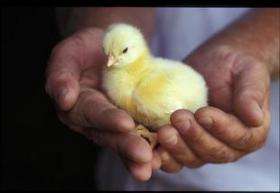
The genes of a common poultry virus may hold the key to giving humans immunity to diseases such as avian influenza and severe acute respiratory syndrome (SARS).
University of Maryland, College Park researchers have received a $4.1 million dollar National Institutes of Health contract to continue research on a vaccine that, in early NIH trials, successfully immunized monkeys against SARS and human parainfluenza viruses. Their future research will include a vaccine for the avian influenza H5N1 and other human viruses for which vaccines are currently not available.
The scientists, at the Virginia-Maryland Regional College of Veterinary Medicine (VMRCVM) in College Park, engineered a recombinant Newcastle Disease virus (NDV), an avian paramyxovirus, to create a vaccine that holds promise to protect humans against multiple diseases.
“The Newcastle Disease virus makes a very good vector for creating human vaccines,” says Siba Samal, the research team leader and associate dean of the VMRCVM at Maryland. “NDV replicates in species other than poultry, but not enough to cause disease. Also, there are nine types of paramyxoviruses and NDV is Serotype 1, so we can make similar vaccine vectors with other avian paramyxovirus types, which can be used to protect against more than one disease.”
Immunity in Monkeys
Dr. Samal’s team is collaborating with researchers at the NIH to develop such vaccines for humans. The results of the team’s first tests with the SARS vaccine on monkeys were presented last month at the International Conference on Negative Strand Viruses in Salamanca, Spain.
Samal’s team was the first to determine the complete genome sequence of NDV. Then, using a process called “reverse genetics” in Samal’s laboratory, the team developed a method of making infectious NDV from cloned DNA. “This method allows us to insert immunogenic genes from other pathogens into NDV,” says Samal. “By inserting a foreign gene, we can create whatever vaccine virus we want.”
In their first experiment, they inserted the human parainfluenza virus (PIV3) gene into NDV to determine if the recombinant NDV bearing the PIV3 gene could create immunity to the PIV3 virus. With partner scientists at NIH, they injected monkeys with the NDV vaccine. “We found that it worked,” says Samal. “The monkeys produced a protective immunity to PIV3.”
Success Against SARS
The researchers next inserted a SARS gene into the NDV sequence. They inoculated the monkeys, then exposed them to the SARS virus. The results were equally successful – the monkeys were protected from SARS.
The different varieties of avian paramyxoviruses offer potential for creating vaccines for different human diseases. “Once you use type 1 virus, for instance, you build immunity to that type,” says Samal. “But we can use another type and add a foreign gene of a different disease to create a different vaccine.”
Samal’s team will use the reverse genetics method with NDV, to develop a vaccine for H5N1, the avian influenza virus that is causing concern in the public health community.
Also on the research team are Drs. Subbiah Elankumaran, and Govindarajan Dhanasekaran and Subrat Rout. The corresponding NIH team members are
Drs. Brian Murphy, Peter Collins, Alexander Bukreyev and Josh DiNapoli.
Source: University of Maryland, College Park


