'Micro-boxes' of water used to study single molecules

July 20, 2006

Researchers at the National Institute of Standards and Technology have demonstrated the use of water droplets as minuscule "boxes" for small numbers of biomolecules. The unusually simple containment method may enable easier experiments on single molecule dynamics and perhaps lead to the development of molecule-sorting devices that might be used for medical screening or biotechnology research.

The work was reported in the July 3 issue of Applied Physics Letters.

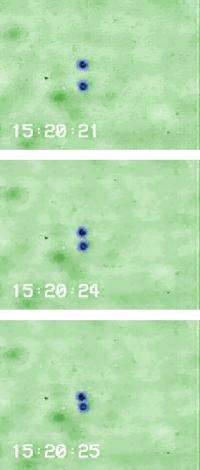
The NIST team creates the boxes by briefly shaking a mixture of water, the biomolecules to be studied, and a fluorocarbon medium. Water droplets form in the oily fluorocarbon and naturally encapsulate one to several biomolecules. The researchers then watch through a microscope while using infrared lasers as "optical tweezers" to manipulate and combine the droplets (dubbed "hydrosomes") inside a tiny chamber on a slide.
'Micro-boxes' of water used to study single molecules

Prodded by optical tweezers, two "hydrosomes" move together and fuse to mix their contents, in an experiment using water droplets as minuscule boxes for manipulating small numbers of biomolecules for nanobiochemistry. Credit: NIST

A green laser is then used to excite the molecules in individual droplets, and the light emissions over several seconds are analyzed to count the molecules and observe other phenomena. The researchers use two sets of optical tweezers to move droplets together to fuse them and mix their contents. The team demonstrated the technique by trapping and manipulating droplets encapsulating various molecules (including a delicate protein that survived the shaking process), detecting the fluorescence signal from dye and protein molecules, and observing the transfer of energy from one end of a specially treated DNA molecule to the other.

Water offers several advantages over other methods for containing single molecules, such as attaching them to surfaces or placing them inside liposomes (artificial cells). The water droplets can be held far from any surface that might interfere, can readily encapsulate biomolecules (which prefer being in water as opposed to the fluorocarbon medium), and can readily fuse together to mix molecules or rapidly change their chemical environment.

The water droplets currently average about 300 nanometers in diameter and contain volumes measured in quadrillionths of liters; research is continuing to improve methods for controlling droplet size for different applications.

Citation: J.E. Reiner, A.M. Crawford, R.B. Kishore, L.S. Goldner, K. Helmerson and M.K. Gilson. 2006. Optically trapped aqueous droplets for single molecule studies. Applied Physics Letters. July 3.

Source: National Institute of Standards and Technology


print this article email this article download pdf blog this article bookmark this article     Stumble it Digg this share on Facebook retweet share on Reddit add to delicious
Rate this story - 4.4 /5 (7 votes)


July 20, 2006 all stories

Comments: 0

4.4 /5 (7 votes)
  • Stumble this up

  • Digg this

  • share this

  • hide
  • Related Stories


  • hide
  • Relevant PhysicsForums posts

  • help with accelerometer
    created 1hour ago
  • Young's Double Slit - Fringe Width
    created 6 hours ago
  • Pressure exerted by a liquid is different to gas?
    created 6 hours ago
  • Work
    created 9 hours ago
  • More from Physics Forums - General Physics

Other News

Plasma-in-a-bag for sterilizing devices

Physics / General Physics

created 50 minutes ago | popularity not rated yet | comments 0

The practice of sterilizing medical tools and devices helped revolutionize health care in the 19th century because it dramatically reduced infections associated with surgery. Through the years, numerous ways of sterilization ...


The LHC tunnel

Peckish bird briefly downs big atom smasher

Physics / General Physics

created 10 hours ago | popularity 3.8 / 5 (9) | comments 11

A peckish bird briefly knocked out part of the world's biggest atom smasher by causing a chain reaction with a piece of bread, the European Organisation for Nuclear Research (CERN) said Monday.


First Bose-Einstein condensation of strontium

First Bose-Einstein condensation of strontium

Physics / Quantum Physics

created 3 hours ago | popularity 5 / 5 (4) | comments 0

In an international first, scientists from the Institute of Quantum Optics and Quantum Information (IQOQI, Austria) produced a Bose-Einstein condensate of the alkaline-earth element strontium, thus narrowly ...


Ginzburg helped develop the Soviet Union's hydrogen bomb in the late 1940s and early 1950s

Russian bomb physicist Ginzburg dead at 93

Physics / General Physics

created 11 hours ago | popularity 5 / 5 (3) | comments 0

Nobel Physics prize winner Vitaly Ginzburg, who helped develop the Soviet hydrogen bomb, has died at age 93, the Russian Academy of Sciences said Monday.


Stars Fueled by Dark Matter Could Hold Secrets to the Universe

Stars Fueled by Dark Matter Could Hold Secrets to the Universe

Physics / General Physics

created Nov 03, 2009 | popularity 4.5 / 5 (52) | comments 43

(PhysOrg.com) -- The first stars in the universe may have been very different from the stars we see today, yet they may hold clues to understanding some of the mysterious features of the universe. These "dark ...