Researchers develop new tool to watch real-time chemical activity in cells
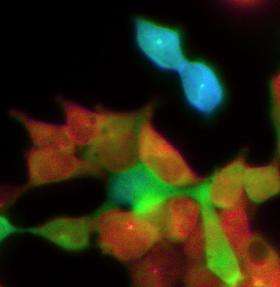
Attempts to identify potential drugs that interfere with the action of one particular enzyme linked to heart disease and similar health problems led scientists at Johns Hopkins to create a new tool and new experimental approach that allow them to see multiple, real-time chemical reactions in living cells. Their report on the work is published July 21 in the journal ACS Chemical Biology.
Most current drug development operations test chemicals on enzymes isolated from their normal environs and then take further steps to see if the chemical can get into the cell to do its work, and figure out how poisonous the chemical is to a cell.
"Living cells are critical to our work because they show us how and what is actually happening in a normal context and time span when a chemical is added," says Jin Zhang, Ph.D., an assistant professor of pharmacology and molecular sciences in Hopkins' Institute for Basic Biomedical Sciences.
Testing chemicals on enzymes in living cells provides the opportunity to find potential drugs that work in new ways. For example, using living cells allows researchers to "see" where in the cell chemicals do their work. Scientists could then design new drugs to go to specific places within cells to work more efficiently. Also, streamlining the one-at-a-time approach offers the chance to study - and rule out or in - many potentially useful chemicals at once.
What Zhang's team developed is a biosensor and simple testing procedure that tells if a particular enzyme - called PKA - that acts like a "switch" is "on" or "off" in a living cell. The group has been focused on trying to understand and interfere with this enzyme switch, because if the enzyme is turned on at the wrong time or at the wrong place within cells, it can lead to cells misbehaving, which ultimately can lead to heart disease.
In the course of their work, the team built a protein biosensor that indicates if an enzyme located nearby is turned on or off. The sensor is made from a protein that glows, originally isolated from jellyfish. When PKA is turned off, the biosensor glows blue. When PKA is turned on and is physically close to a biosensor, PKA itself changes the shape of the biosensor, causing it to glow green instead.
Manipulating the sensor allows the researchers to direct it to specific locales within cells. That allows the researchers to see where in the cell the active enzyme is located. So this PKA sensor not only indicates whether the enzyme is on or off, but also locates where PKA is being turned on or off within the cell. "Proteins aren't spread out evenly in cells," says Zhang, "but tend to cluster together in order to do specific jobs, and we now can see how different clusters are regulated differently."
When the researchers put their new sensor into living mammalian cells growing in the lab, they were able to test the effects of 160 different chemicals at once and see if any of these chemicals could turn on or off the PKA enzyme by looking for green or blue glowing cells.
Of the 160 chemicals tested, three caused cells to turn on the switch and two others caused cells to turn off the switch.
The 160 chemicals tested are from the Johns Hopkins Clinical Compound Library, a collection of about 3,300 chemicals. Most of them are drugs already approved by the U.S. Food and Drug Administration, while others are drugs approved by regulatory agencies in other countries or are other clinically relevant chemicals.
"If we can find a new activity for a known drug, this may lead to a new use or a new way of thinking about that drug," says Zhang, who hopes to test the rest of the chemicals in the collection soon for their ability to interfere with the enzyme tested in this study. Finding a drug that can tame this enzyme could lead to new treatments for heart disease, diabetes, memory disorders and certain cancers, for example.
Zhang says the "high throughput" potential of the sensor may have wide-reaching applications that could be adapted to testing various chemicals to test chemicals for their ability to interfere with other enzymes related to PKA - which as a family are known as kinases - that are widely implicated in diseases and an emerging class of drug targets.
Source: Johns Hopkins Medical Institutions


