Mars Mission Lasts Well Past Sell-By Date
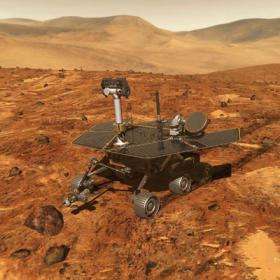
At this very moment, on an alien world millions of miles from Earth, two wheeled robots named Spirit and Opportunity are dutifully exploring Mars. But by all previous accounts, these Mars Exploration Rovers (MERs) should have stopped functioning ages ago. After all, their warranty was only good for 90 days.
"I expected the rovers to last 120 days on Mars," said Steven W. Squyres, professor of Astronomy at Cornell University and the scientific principal investigator for the Mars rovers.
"Maybe 150 to 180 days, if things went well. But we did not anticipate the wind gusts (which blew the planet's surface dust off the rovers' solar panels, their main source of power) and being able to tilt them to receive more energy from the Sun."
Now the rovers are approaching 900 days on that harsh globe and doing quite well overall, with no definite end in sight.
The unexpected longevity of these rovers has been a wonderful boon to the understanding of the fourth planet from the Sun, which in many respects resembles our Earth more than any other world we know.
The rovers have also shown that Mars, in other important aspects, is indeed a truly alien place.
Was Red Planet once blue?
Mars is a world twice as far from the Sun as Earth and half the size. It has a day and axial tilt nearly identical to our world (one full day on Mars is just 39 minutes and 35 seconds longer). Mars also has polar caps, though its snow is made of frozen carbon dioxide, or dry ice.
The planet's atmosphere at its surface, which is also made up mostly of the same molecules as the polar snows, is very thin: It is like being 20 miles above Earth's surface. These factors combine to make Mars a very intriguing place, if also a very cold and very dry one.
But was Mars always this way?
Early space probe missions revealed that the Red Planet is dominated by giant volcanoes, river channels, and a canyon the length of the United States — all evidence that Mars was once even more like Earth, perhaps enough so to have life of its own.
The Viking missions to Mars in the 1970s made the first direct attempt to determine whether any descendants of this presumed ancient native life still existed, but the results from the two immobile robot landers were ambiguous and subject to intense debates that are going on to this day.
They also made planetary scientists realize that if they wanted to know for certain if Mars had or has life, they needed to start at the beginning by searching for proof of one of the main ingredients for life on Earth and perhaps Mars and many other worlds: water.
Cornell and the rovers
To search for signs of water, the Mars Exploration Rovers were conceived and built to act as mobile robotic geologists, complete with a science package, designed at Cornell, named Athena. It includes a tool to scrape rocks, a microscopic imager to examine interesting specimens up close, and instruments to analyze what the surface and rocks are made of.
The rovers even sport small sundials on their backs conceived by Cornell alumnus and popular science promoter Bill Nye, who designed it in part to help students learn what Martian local time it is where the rovers are.
The sundials' design is also used to calibrate the colors of the images returned to Earth by the Pancam, or panoramic camera, the main set of "eyes" for the rovers standing 5 feet above the Martian surface at the top of the rovers' cylindrical white masts.
Launched from Cape Canaveral in Florida in the summer of 2003, Spirit and Opportunity arrived just weeks apart the following January, literally bouncing to the Martian surface at two promising sites more than 6,000 miles from each other. For Spirit, it was Gusev Crater, an impact region the size of the state of Connecticut with a river channel running into it.
Opportunity was given Meridiani Planum to explore, one of the flattest places on the Red Planet and composed of hematite, a mineral whose presence always indicates water — at least on Earth.
Though the main operations for the rovers began at the Jet Propulsion Laboratory (JPL) in Pasadena, Calif., which still plays a key role, much of the important planning and data and image processing now take place in Cornell's Space Sciences Building (SSB) five days a week.
"In the early months of the rover mission, team members were putting in 12- to 16-hour days," said Jim Bell, associate professor of astronomy at Cornell and lead scientist for the Pancam.
"Now our daily meetings last about 30 to 60 minutes between ourselves, the JPL controllers, and other team members around the world who are responsible for other devices on the rovers."
Each weekday around noon the Cornell MER team meets at the SSB to discuss the previous day's mission operations. They use the current data received to decide where the rovers will be exploring next.
"Cornell does the grunt work on the processes," Bell said. "JPL does final checks and integration sequences to transmit them to the rovers from NASA's Deep Space Network (DSN)."
Millions of miles away, the rovers carry out the command sequences sent to them and radio back the results to Earth through another probe in their vicinity named Mars Odyssey, which has been circling the Red Planet since October 2001.
A rotating number of Cornell graduate students spend from four to eight hours each day turning the raw rover data into amazing panoramas of the Martian surface, courtesy of their sapphire-encased cameras.
These images of the Martian landscape have never been seen so clearly before by any previous surface mission. Thanks to the mobility and longevity of the rovers, humanity has witnessed and learned things about Mars never captured before.
The most important goal for the rovers, that of finding solid evidence that Mars once had liquid water, was achieved early on for Opportunity, as the rover had landed in a small crater later named Eagle with a layer of bedrock sticking out along its rim. That bedrock contained the physical and chemical evidence that at least in the Meridiani region, Mars once had liquid water, though it contained mainly "sulfuric acid and salt," said Squyres — perhaps not the friendliest of environments for most life forms.
Spirit made similar discoveries as its twin in Gusev Crater, but this was only due to its ability to move and the long operating time it was blessed with.
The immediate landing site, rather than being the remains of a once water-filled basin as hoped, instead yielded only basalt from an ancient volcano.
But Spirit wheeled itself to the Columbia Hills, named for the astronauts killed in the space shuttle tragedy of early 2003, where it sent back images of the view and investigated rock outcrop dubbed Home Plate.
"Home Plate was formed by some explosive process, either from a volcanic eruption or a large meteorite impact," Squyres said. "The question is, where is the volcano that caused Home Plate, how extensive was the volcanic eruption, and are there other rock slabs like Home Plate around?"
Spirit has since moved on to a nearby scenic place called Low Ridge to help it survive the Martian winter. There it will continue to return science data, including "the biggest panorama ever of the Martian surface," exclaimed Squyres, referring to a signature photo called the McMurdo Pan.
Assuming the rover continues its longevity streak — despite the loss of function in one of its six wheels — Squyres says that Spirit could return to further examine Home Plate, or it could travel more than 2,600 feet to the southwest to a study a "completely different terrain nicknamed the 'Badlands,' which has an etched appearance."
Opportunity at Victoria
On the other side of the Red Planet, Opportunity continues its long trek to a 2,460-foot wide crater named Victoria, more than 4 miles from where it first landed in Eagle Crater on Jan. 24, 2004.
The width of almost seven football fields, Victoria Crater is six times larger than the next largest crater it explored, an interesting impact zone named Endurance that the rover drove about from May to December of 2004.
Scientists hope that Victoria will provide them with the best chance yet to study deep subsurface layers and the early history of geology on Mars that neither rover could ever attain by digging with its own equipment.
No definite plans have been devised for Opportunity after exploring Victoria. One reason is that the rover could "drop dead tomorrow," Squyres said. Another is that the region is dominated by flat dune fields for many square miles around.
Any truly interesting geological features are a long way off, even for this still well-functioning vehicle from Earth. In addition, Victoria will likely provide many months of important scientific data all by itself.
Beyond the Waters
Squyres emphasized that while obtaining the scientific goal of finding evidence of water on Mars was certainly a major highlight of the Mars Exploration Rover mission, the robots also demonstrated that the Red Planet is also a "unique place" and not just some ancient copy of Earth.
But the rovers have only explored two relatively small places on a planet that has the same amount of surface as Earth's land areas. There are many more questions to be answered about our neighboring world, including whether or not Earth is the only place in the Cosmos with life.
This article originally appeared in The Ithaca Journal July 18, 2006, and is published here with the permission of the author.
Copyright 2006 by Space Daily, Distributed United Press International


