Life In Deadly Conditions: Sequencing Genome of Master of Adaptation
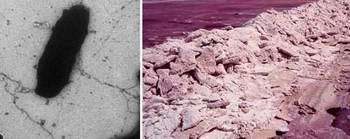
The genome of another micro-organism which lives under extreme conditions has been sequenced. Scientists at the Department of Membrane Biochemistry at the Max Planck Institute of Biochemistry have analysed the genome of Natronomonas pharaonis and uncovered the survival strategies with which the archaeon can best thrive in deadly environmental conditions. In the latest edition of the international journal Genome Research, Professor Dieter Oesterhelt and his colleagues present their research.
Image: Left, electron-microscopic images of the single-cell Natronomona pharaonis, which prospers in hostile salt-saturated lakes. Right, Lake Zuf in Wadi Natrun, Egypt, where the organism was found. With the sequencing of the genome, the micro-organism’s survival strategies can now be clarified. Credit: Max Planck Institute for Biochemistry (left); A.J. Scortland, Antiquity 77, No 296, June 2003 (right)
Archaea, small single-celled organisms, are particularly interesting for scientists because they are able to live under extreme environmental conditions, for instance under high salt concentrations, high pH-values, or high temperatures. Nature’s masters of adaptation, they are model organisms from which researchers can draw conclusions about the first organisms on earth. The scientists studied mechanisms that make survival possible for the single-celled organisms, which are rod-shaped and are only five hundredths of a millimetre in size. At the Department of Membrane Biochemistry, led by Professor Dieter Oesterhelt, Max Planck researchers have shown, using genomic and proteomic methods combined with physiological experiments, how to explain the amazing abilities of these extreme organisms.
Friedhelm Pfeiffer, the research group’s bioinformatics expert, created a database for halophile (Greek "salt-lovers") archaea, called HaloLex (see link below). Using the database, genetic and protein data about the organisms is tied to information about their structure and function. The newest genome on HaloLex is now that of Natronomonas pharaonis, whose genetic information was made available by Michaela Falb, Friedhelm Pfeiffer, Peter Palm, Karin Rodewald, Volker Hickmann, Jörg Tittor and Dieter Oesterhelt. This information is made of some 2.6 million base pairs (about one thousandth of the human genome), and encodes the synthesis of 2,843 proteins.
Natronomonas pharaonis has to deal with two different kinds of life-threatening conditions. It was found in pools which are strongly alkaline (pH-value of about 11) with an extremely high salt concentration (over 300 grams of salt per litre of water). The high pH-values are about the same as lye soap and the salt content that of the Dead Sea. As far as the salt content is concerned, Natronomonas pharaonis behaves like closely related organisms - for example, Halobacterium salinarum, the "house pet" of Dieter Oesterhelt’s department. In contrast to other salt-tolerant organisms, halophile archaea have an extremely high salt concentration inside of their cells. These levels of salt concentration cannot usually support proteins, the critical functional components of living cells. But the greater portion of amino-acid building blocks in the proteomes of halophile archaea make it possible for the proteins to remain stabile, even in high salt concentrations. To survive among the extremely high pH-values, Natronomonas pharaonis also has a moderately increased pH-value inside its cells.
The cellular components that are in direct contact with the brine around them need their own adaptation strategies. These components are the cell membrane and the proteins that have to function outside the cell. Michaela Falb discovered, using theoretical analysis as part of her doctoral thesis, that Natronomonas pharaonis has a particularly large number of proteins attached to lipid molecules, anchoring it to the cell membrane.
Important functions of the energy metabolism - for example, the respiratory chain - are embedded in the cell membrane and have to be adapted to the adverse external conditions. Despite a detailed bioinformatic analysis of the genome, it was still unclear whether Natronomonas pharaonis has a respiratory chain and which ions would play a role in its functioning. The bioinformatics expert Michaela Falb and biochemist Jörg Tittor thus designed additional experimental studies which showed that Natronomonas pharaonis does indeed have a functioning respiratory chain, which amazingly, and in contrast to other organisms that grow in alkaline conditions, functions with a "normal" proton. The Max Planck researchers could thus refute the paradigm, dominant until now, that organisms in alkaline conditions have to switch to other ions (for example, sodium, Na+).
A higher pH-value leads to the depletion of ammonium. Because ammonium nitrate is a key building block of amino acids, the tiny organism should have problems synthesising it. Michaela Falb discovered in the genome a number of ways that Natronomonas pharaonis can take optimal advantage of the low incidence of nitrogen: through the uptake and metabolism of nitrate and urea, as well as the efficient uptake of ammonia.
The co-operation of theoretically and experimentally-oriented researchers shed light on other questions. The bioinformatics experts were able to predict that Natronomonas pharaonis can by itself produce vitamins and amino acids. Thus, the growth medium for the culture of the single-celled organism could be significantly simplified.
Dieter Oesterhelt explains that "the comparison with other halophile archaea we have studied shows that these organisms have a high plasticity with which they can adapt to the varying, extreme environmental conditions. The frugality of Natronomonas pharaonis, with the possibility of simplifying the nutrient solution, opens new possibilities for experimentally investigating the metabolic network. The data we thus acquire make up an important foundation for developing and testing metabolic models in the framework of systemic biological studies and in interdisciplinary co-operation with mathematicians."
Source: Max Planck Institute of Biochemistry


