Developing Alternatives to Fossil Fuels
July 24th, 2006 Developing Alternatives to Fossil Fuels

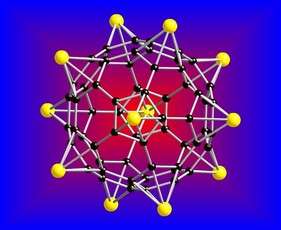
A lithium-coated fullerene, also known as a C60 cluster, as a potential material for hydrogen storage. Yellow represents lithium atoms, and black represents carbon atoms. Credit: Qiang Sun, Ph.D., and Puru Jena, Ph.D./VCU

Virginia Commonwealth University researchers have developed a new storage system to hold large quantities of hydrogen fuel that may one day power cars in a more cost-effective and consumer-friendly way.

This theoretical research moves scientists another step closer in the exploration of alternative fuel sources and methods to store hydrogen fuel.

“We are going to face an energy crisis at some point in the future. It’s not a question of if, but when. There is a high demand on oil, particularly due to a growing global population,” said lead author Puru Jena, Ph.D., a professor of physics at VCU.

“We need an energy source that is abundant, cost effective and renewable, burns clean and does not pollute,” he said. “Today, approximately 75 percent of the oil currently available is used for transportation alone. Any solution to the energy crisis has to take into account the amount of energy we spend on transportation.”

Hydrogen is the most abundant element in the universe and considered an ideal energy carrier. When hydrogen burns, it produces only water and thus, does not pollute the atmosphere. For this reason, it is considered an ideal alternative when discussing theoretical alternatives to fossil fuels.

In the Journal of the American Chemical Society, published online July 6, Jena and his team describe the theoretical composition of a material – a lithium-coated buckyball – that may have the potential to serve as a storage vessel for hydrogen atoms. A buckyball is a soccer ball-shaped nanoparticle containing 60 carbon atoms. Essentially, the lithium buckyballs absorb the hydrogen, which means that one lithium atom can store five hydrogen molecules. According to Jena, the theoretical buckyball, which was designed using computer modeling, has 12 lithium atoms and can store 60 hydrogen molecules.

“The biggest hurdle in a hydrogen economy is to find materials to store hydrogen,” Jena said. “The storage materials in question need to have the ability to store hydrogen and allow us to take it out, which means the system must be reversible and operate under moderate temperatures and pressures.”

Theoretical and experimental work by other researchers has proposed using titanium-coated buckyballs for hydrogen storage. However, those researchers observed that the titanium atoms had a tendency to react with each other and form clusters on the surface of the buckyball. Once clustering takes place, the properties of the buckyball are no longer effective for storing hydrogen in large quantities.

Industry standards require materials that store hydrogen to have a high gravimetric density of 9 weight percent, and high volumetric density of 70 grams/liter.

“The material that we have designed is capable of storing hydrogen at a gravimetric density of 13 weight percent – so it exceeds the industry target. Also, the volumetric density is approximately twice that of liquid hydrogen. This theoretical work has promise, provided one can make it in large enough quantities,” said Jena.

This research is part of the Hydrogen Fuel Initiative, which was set in motion by the U.S. government in 2003 to address the limited supply of fossil fuels and its rising demand and costs. Fossil fuels are known to have an adverse environmental effect in the form of CO2 emissions. Global warming has been the result of CO2 emissions – the effects of which are observed world wide.

Jena is currently collaborating with scientists who will conduct experiments to prove that hydrogen can be stored in the lithium buckyballs. Furthermore, these investigators will determine the necessary temperature and pressure conditions for storage and removal of hydrogen from the lithium buckyballs, and how to produce these materials in large quantities.

This research was supported by a grant from the U.S. Department of Energy. These findings will also appear in the August 2 print version of the journal.

Source: Virginia Commonwealth University


print this article email this article download pdf blog this article bookmark this article     Digg this Stumble it share on Facebook share on Reddit add to delicious save to Yahoo! bookmarks
4.1/5 after 40 votes


July 24th, 2006 all stories
Nanotechnology / Nanomaterials

Comments: 0
Rank: 4.1/5 after 40 votes

  • Stumble this up

  • Digg this

  • Share it:
  • share on Facebook
  • share on MySpace
  • share on Slashdot
  • rss-newsfeed
  • share on Google
  • share on Reddit
  • add to delicious
  • save to Yahoo! bookmarks
  • share on Windows Live
  • Add to Mixx!
Rating: 4.1/5 after 40 votes

  • Related Stories

  • Feather fibers fluff up hydrogen storage capacity
    created Jun 23, 2009 | popularity not rated yet | comments 0
  • Trans fats hinder multiple steps in blood flow regulation pathways
    created Jun 16, 2009 | popularity not rated yet | comments 0
  • Engineering Carbon for Impressive Hydrogen Storage
    created May 22, 2009 | popularity not rated yet | comments 0
  • High-pressure compound could be key to hydrogen-powered vehicles
    created May 11, 2009 | popularity not rated yet | comments 0
  • Revealing new applications for carbon nanomaterials in hydrogen storage
    created Mar 12, 2009 | popularity not rated yet | comments 0

Tags


  • Physicists Demonstrate Quantum Memory with Matter Qubits
    Physicists Demonstrate Quantum Memory with Matter Qubits
    Physics / General Physics
    created Jul 03, 2009 | popularity 4.4 / 5 (17) | comments 1
  • 'Holey' Nanosheets for Wastewater Dye Removal
    Nanotechnology / Nanomaterials
    created Jul 01, 2009 | popularity 5 / 5 (5) | comments 1
  • Jellyfish Robot Swims Like its Biological Counterpart
    Jellyfish Robot Swims Like its Biological Counterpart
    Electronics / Robotics
    created Jun 26, 2009 | popularity 4.4 / 5 (8) | comments 1
  • Could Maxwell's Demon Exist in Nanoscale Systems?
    Could Maxwell's Demon Exist in Nanoscale Systems?
    Physics / General Physics
    created Jun 24, 2009 | popularity 4.4 / 5 (18) | comments 29
  • Living Safely with Robots, Beyond Asimov's Laws
    Living Safely with Robots, Beyond Asimov's Laws
    Electronics / Robotics
    created Jun 22, 2009 | popularity 4.6 / 5 (54) | comments 40
  • Other News

    Physics research with atomic force microscope could lead to better health care

    Atomic force microscope research could lead to better health care

    Nanotechnology / Nanophysics

    created 4 hours ago | popularity 5 / 5 (1) | comments 0

    Where biology, chemistry and physics intersect, a Kansas State University professor expects to find applications to improve human health.


    Canadian researchers set to study impact of nanomaterials on aquatic ecosystems

    Nanotechnology / Bio & Medicine

    created 6 hours ago | popularity 5 / 5 (1) | comments 0

    A team of Canadian scientists and engineers, led by the University of Alberta and the National Research Council of Canada, will collaborate on a $3.39 million, three-year study to assess the potential effects of nanoparticles ...


    Nano Measurement in the 3rd Dimension

    Nano Measurement in the 3rd Dimension

    Nanotechnology / Nanophysics

    created 8 hours ago | popularity 3 / 5 (1) | comments 0

    From the motion sensor to the computer chip - in many products of daily life components are used whose functioning is based on smallest structures of the size of thousandths - or even millionths - of millimetres. ...


    A 'quantum of sol' -- how nanotechnology could hold the key to a solar-powered future

    A 'quantum of sol' -- how nanotechnology could hold the key to a solar-powered future

    Nanotechnology / Nanomaterials

    created Jun 30, 2009 | popularity 3.9 / 5 (16) | comments 17

    (PhysOrg.com) -- A new generation of 'nano-structured' millimetre-sized solar cells that could convert the sun's energy to electricity more than twice as efficiently as current technology, is the subject of ...


    Australian researchers are set to begin human trials of a tiny nano-cell that acts as a "Trojan horse" against cancer

    Hi-tech 'Trojan horse' can kill cancer cells: researchers

    Nanotechnology / Bio & Medicine

    created Jun 29, 2009 | popularity 4.7 / 5 (12) | comments 7

    Australian researchers are set to begin human trials of a tiny nano-cell that acts as a "Trojan horse" against cancer cells, a breakthrough they say may curb the need for debilitating chemotherapy.