Mars' climate in flux: Mid-latitude glaciers
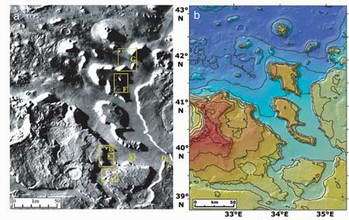
October 17th, 2005 The fretted channel and lineated valleys of the central Deuteronilus-Protonilus Mensae region.

New high-resolution images of mid-latitude Mars are revealing glacier-formed landscapes far from the Martian poles, says a leading Mars researcher.

Image: The fretted channel and lineated valleys of the central Deuteronilus-Protonilus Mensae region.

Conspicuous trains of debris in valleys, arcs of debris on steep slopes and other features far from the polar ice caps bear striking similarities to glacial landscapes of Earth, says Brown University's James Head III. When combined with the latest climate models and orbital calculation for Mars, the geological features make a compelling case for Mars having ongoing climate shifts that allow ice to leave the poles and accumulate at lower latitudes.

"The exciting thing is a real convergence of these things," said Head, who presented the latest Mars climate discoveries on Sunday, 16 October, at the Annual Meeting of the Geological Society of America in Salt Lake City.

"For decades people have been saying that deposits at mid and equatorial latitudes look like they are ice-created," said Head. But without better images, elevation data and some way of explaining it, ice outside of Mars' polar regions was a hard sell.

Now high-resolution images from the Mars Odyssey spacecraft's Thermal Emission Imaging System combined with images from the Mars Global Surveyor spacecraft's Mars Orbiter Camera and Mars Orbiter Laser Altimeter can be compared directly with glacier features in mountain and polar regions of Earth. The likenesses are hard to ignore.

For instance, consider what Head calls "lineated valley fill." These are lines of debris on valley floors that run downhill and parallel to the valley walls, as if they mark some sort of past flow. The same sorts of lines of debris are seen in aerial images of Earth glaciers. The difference is that on Mars the water ice sublimes away (goes directly from solid ice to gas, without any liquid phase between) and leaves the debris lines intact. On Earth the lines of debris are usually washed away as a glacier melts.

The lines of debris on Mars continue down valleys and converges with other lines of debris - again, just like what's seen on Earth where glaciers converge.

"There's so much topography and the debris is so thick (on Mars) that it's possible some of the ice might still be there," said Head. The evidence for present day ice includes unusually degraded recent impact craters in these areas - just what you'd expect to see if a lot of the material ejected from the impact was ice that quickly sublimed away.

Another peculiarly glacier-like feature seen in Martian mid-latitudes are concentric arcs of debris breaking away from steep mountain alcoves - just as they do at the heads of glaciers on Earth.

As for how ice could reach Mars lower latitudes, orbital calculations indicate that Mars may slowly wobble on its spin axis far more than Earth does (the Moon minimizes Earth's wobble). This means that as Mars' axis tilted to the extremes - up to 60 degrees from the plane of Mars' orbit - the Martian poles get a whole lot more sunshine in the summertime than they do now. That extra sun would likely sublime water from the polar ice caps, explains Head.

"When you do that you are mobilizing a lot of ice and redistributing it to the equator," Head said. "The climate models are saying it's possible."

It's pure chance that we happen to be exploring Mars when its axis is at a lesser, more Earth-like tilt. This has led to the false impression of Mars being a place that's geologically and climatically dead. In fact, says Head, Mars is turning out to be a place that is constantly changing.

Source: Geological Society of America


print this article email this article download pdf blog this article bookmark this article     Digg this Stumble it share on Facebook share on Reddit add to delicious save to Yahoo! bookmarks
5/5 after 2 votes


October 17th, 2005 all stories
Space & Earth /

Comments: 0
Rank: 5/5 after 2 votes

  • Stumble this up

  • Digg this

  • Share it:
  • share on Facebook
  • share on MySpace
  • share on Slashdot
  • rss-newsfeed
  • share on Google
  • share on Reddit
  • add to delicious
  • save to Yahoo! bookmarks
  • share on Windows Live
  • Add to Mixx!
Rating: 5/5 after 2 votes

  • Related Stories

  • Geological landforms indicate 'recent' warm weather on Mars
    created Jun 29, 2009 | popularity not rated yet | comments 0
  • Evidence of vast frozen water reserves on Mars: scientists
    created Nov 20, 2008 | popularity not rated yet | comments 0
  • Gamma-Ray Evidence Suggests Ancient Mars Had Oceans
    created Nov 17, 2008 | popularity not rated yet | comments 0
  • Antarctic research helps shed light on climate change on Mars
    created Aug 28, 2008 | popularity not rated yet | comments 0
  • Moon water discovered: Dampens Moon-formation theory
    created Jul 09, 2008 | popularity not rated yet | comments 0

Tags


  • Physicists Demonstrate Quantum Memory with Matter Qubits
    Physicists Demonstrate Quantum Memory with Matter Qubits
    Physics / General Physics
    created Jul 03, 2009 | popularity 4.4 / 5 (17) | comments 1
  • 'Holey' Nanosheets for Wastewater Dye Removal
    Nanotechnology / Nanomaterials
    created Jul 01, 2009 | popularity 5 / 5 (5) | comments 1
  • Jellyfish Robot Swims Like its Biological Counterpart
    Jellyfish Robot Swims Like its Biological Counterpart
    Electronics / Robotics
    created Jun 26, 2009 | popularity 4.4 / 5 (8) | comments 1
  • Could Maxwell's Demon Exist in Nanoscale Systems?
    Could Maxwell's Demon Exist in Nanoscale Systems?
    Physics / General Physics
    created Jun 24, 2009 | popularity 4.4 / 5 (18) | comments 29
  • Living Safely with Robots, Beyond Asimov's Laws
    Living Safely with Robots, Beyond Asimov's Laws
    Electronics / Robotics
    created Jun 22, 2009 | popularity 4.6 / 5 (52) | comments 40
  • Other News

    Forty years ago man first walked on the moon

    Space & Earth / Space Exploration

    created 7 hours ago | popularity 5 / 5 (2) | comments 0

    Forty years ago on July 20, 1969, American astronaut Neil Armstrong realized the oldest dream of human civilizations when he became the first man to walk on the moon.


    The least sea ice in 800 years

    The least sea ice in 800 years

    Space & Earth / Earth Sciences

    created Jul 01, 2009 | popularity 4.3 / 5 (59) | comments 52

    New research, which reconstructs the extent of ice in the sea between Greenland and Svalbard from the 13th century to the present indicates that there has never been so little sea ice as there is now. The ...


    Gas around young galaxy

    Intense heat killed the Universe's would-be galaxies, researchers say

    Space & Earth / Astronomy

    created Jul 01, 2009 | popularity 3.2 / 5 (19) | comments 25

    (PhysOrg.com) -- Our Milky Way galaxy only survived because it was already immersed in a large clump of dark matter which trapped gases inside it, scientists led by Durham University's Institute for Computational ...


    Scientists' Drill Hits Magma: Only Third Time on Record

    Scientists' Drill Hits Magma: Only Third Time on Record

    Space & Earth / Earth Sciences

    created Jun 29, 2009 | popularity 4.7 / 5 (20) | comments 19

    (PhysOrg.com) -- Scientists drilling a borehole deep into Iceland’s rocky crust to explore new methods of using geothermal energy hit a major roadblock on Thursday: Their drill ran into molten rock at a depth ...


    NASA manager pitches a cheaper return-to-moon plan

    Space & Earth / Space Exploration

    created Jun 30, 2009 | popularity 4 / 5 (7) | comments 18

    (AP) -- Like a car salesman pushing a luxury vehicle that the customer no longer can afford, NASA has pulled out of its back pocket a deal for a cheaper ride to the moon.