Cassini finds evidence for hydrocarbon lakes on Titan
July 25, 2006 Cassini finds evidence for hydrocarbon lakes on Titan

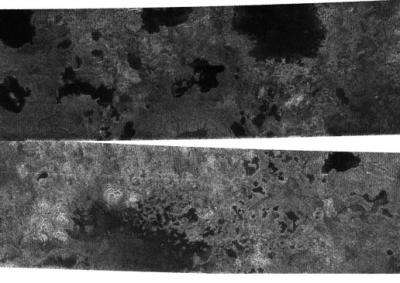
The Cassini spacecraft, using its radar system, has discovered very strong evidence for hydrocarbon lakes on Titan. Dark patches, which resemble terrestrial lakes, seem to be sprinkled all over the high latitudes surrounding Titan's north pole.

Scientists have speculated that liquid methane or ethane might form lakes on Titan, particularly near the somewhat colder polar regions. In the images, a variety of dark patches, some with channels leading in or out of them, appear. The channels have a shape that strongly implies they were carved by liquid. Some of the dark patches and connecting channels are completely black, that is, they reflect back essentially no radar signal, and hence must be extremely smooth.

In some cases rims can be seen around the dark patches, suggesting deposits that might form as liquid evaporates. The abundant methane in Titan's atmosphere is stable as a liquid under Titan conditions, as is its abundant chemical product, ethane, but liquid water is not. For all these reasons, scientists interpret the dark areas as lakes of liquid methane or ethane, making Titan the only body in the solar system besides Earth known to possess lakes. Because such lakes may wax and wane over time, and winds may alter the roughness of their surfaces. Repeat coverage of these areas should test whether indeed these are bodies of liquid.

These two radar images were acquired by the Cassini radar instrument in synthetic aperture mode on July 21, 2006. The top image centered near 80 degrees north, 92 degrees west measures about 420 kilometers by 150 kilometers (260 miles by 93 miles). The lower image centered near 78 degrees north, 18 degrees west measures about 475 kilometers by 150 kilometers (295 miles by 93 miles). Smallest details in this image are about 500 meters (1,640 feet) across.

The Cassini-Huygens mission is a cooperative project of NASA, the European Space Agency and the Italian Space Agency. The Jet Propulsion Laboratory, a division of the California Institute of Technology in Pasadena, manages the mission for NASA's Science Mission Directorate, Washington, D.C. The Cassini orbiter was designed, developed and assembled at JPL. The radar instrument was built by JPL and the Italian Space Agency, working with team members from the United States and several European countries.

Source: NASA


print this article email this article download pdf blog this article bookmark this article     Stumble it Digg this share on Facebook retweet share on Reddit add to delicious
Rate this story - 4.8 /5 (29 votes)


July 25, 2006 all stories

Comments: 0

4.8 /5 (29 votes)
  • Stumble this up

  • Digg this

  • share this

  • hide
  • Related Stories


  • hide
  • Relevant PhysicsForums posts

  • Question about 2-body gravity
    created 5 hours ago
  • life on Mars
    created 8 hours ago
  • Semi-major axis from cartesian co-ordinates
    created 20 hours ago
  • Primary Mirror grinding
    created 22 hours ago
  • More from Physics Forums - General Astronomy

Other News

The drying shores of the Dead Sea

Dead Sea needs world help to stay alive

Space & Earth / Environment

created 20 minutes ago | popularity not rated yet | comments 0

The Dead Sea may soon shrink to a lifeless pond as Middle East political strife blocks vital measures needed to halt the decay of the world's lowest and saltiest body of water, experts say.


Shuttle, station crews seal hatches for departure (AP)

Shuttle, station crews seal hatches for departure

Space & Earth / Space Exploration

created 8 minutes ago | popularity not rated yet | comments 0

(AP) -- After nearly a week together, the crews of shuttle Atlantis and the International Space Station said goodbye Tuesday and closed the hatches between them.


LSU gets to the bottom of things -- in Antarctica

Space & Earth / Earth Sciences

created 28 minutes ago | popularity not rated yet | comments 0

Antarctica has long held secrets of the earth's history locked in its icy depths, and until recently, there has been very little information on the environments that have been sealed beneath miles of ice for millions of years. ...


First black holes may have incubated in giant, starlike cocoons, says CU-Boulder study

First black holes may have incubated in giant, starlike cocoons

Space & Earth / Astronomy

created 1hour ago | popularity 5 / 5 (1) | comments 6

(PhysOrg.com) -- The first large black holes in the universe likely formed and grew deep inside gigantic, starlike cocoons that smothered their powerful x-ray radiation and prevented surrounding gases from ...


Researchers Establish Common Seasonal Patterns Among Bacterial Communities in Arctic Rivers

Researchers Establish Common Seasonal Patterns Among Bacterial Communities in Arctic Rivers

Space & Earth / Earth Sciences

created 3 hours ago | popularity not rated yet | comments 0

(PhysOrg.com) -- New research on bacterial communities throughout six large Arctic river ecosystems reveals predictable temporal patterns, suggesting that scientists could use these communities as markers ...