Scientists Discern Shape of Important Protein
July 25, 2006
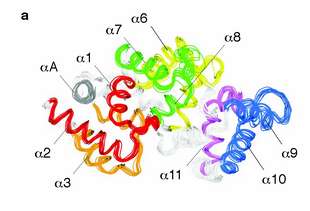
Using nuclear magnetic resonance, NC State University scientists characterized the structure of calbindin-D28K , a flexible protein linked to the prevention of neurodegenerative diseases.
Scientists at North Carolina State University have effectively lifted the veil from an important protein that is linked to the prevention of neurodegenerative diseases like Alzheimer’s and Huntington’s.
Dr. John Cavanagh, professor of molecular and structural biochemistry, teamed with colleagues from the Mayo Clinic and Duke University to describe the shape of the protein, calbindin-D28K. Understanding a protein’s structure allows researchers to learn more about how it functions and interacts with other proteins, which, in this case, may provide clues to developing drugs to halt the diseases.
The research appears in the July 2006 edition of Nature Structural and Molecular Biology.
Calbindin-D28K is a protein that either grabs calcium from areas that have too much or serves as an on/off switch for further chemical reactions. It is known for its flexibility; it is found in the kidneys, pancreas, ocular nerve and in abundant quantities in the brain. Recent studies show, Cavanagh says, that it acts as a bodyguard in the brain, binding to and inhibiting caspase-3, a protein that stimulates plaque formation and tangle formation, which are hallmark characteristics of neurodegenerative disease. Until now, however, the structure of calbindin-D28K remained a mystery.
“If you don’t know the shape of the protein, you can’t figure out how it works,” Cavanagh says. “It took a long time – about five years – but we’ve characterized the structure of this protein and found where it binds caspase-3. Insight into how it binds to caspase-3 might lead to a way of exploiting those interactions to develop therapeutics.”
It took a long time to characterize calbindin-D28K, Cavanagh says, because it was initially a challenge to force cells to make enough protein in order to do the requisite studies. Additionally, many parts of the protein are very similar and so are extremely difficult to distinguish from each other.
The research team used nuclear magnetic resonance to get a high-resolution picture of what the protein looks like. In this painstaking technique – occurring inside machines that have magnetic fields several hundred times greater than the Earth’s magnetic pull – radio waves are bounced off the approximately 5,000 nuclei in the protein.
“When you hit a nucleus with a radiofrequency pulse, it resonates, sort of making its own little noise, like a tuning fork,” Cavanagh says. “The frequency at which the nuclei resonate after being hit with a pulse is very specific to their specific position in the protein. So after we hit all of them with a pulse, it’s like hitting all the keys of a piano at the same time and it’s just an awful mess. And remember, we’re doing this for 5,000 separate keys. Yet, we’re able to untangle this mess to find the specific frequency of each nucleus and relate that to where it lies in the protein.”
Cavanagh isn’t satisfied with this knowledge, however. He says the shape-shifting protein sometimes contains no calcium. When it grabs calcium, it changes its shape.
“This could be why the protein plays so many different roles,” Cavanagh says. “Proteins that change shape usually serve as on/off switches, but this protein also grabs calcium and takes it elsewhere. Now we’re working to determine the structure of this protein when it has no calcium.”
Source: North Carolina State University
-
Multiple malaria vaccine offers protection to people most at risk
Oct 26, 2011 |
not rated yet |
1
-
Scans show immune cells intercepting parasites
Dec 10, 2008 |
4.3 / 5 (3) |
0
-
Scientists Present 'Moving' Theory Behind Bacterial Decision-Making
Nov 21, 2008 |
4.4 / 5 (7) |
0
-
Rothman at Jefferson research suggests abandon convention in diagnosing periprosthetic joint infection
16 hours ago |
not rated yet |
0
-
Study adds timing capability to living cell sensors
11 hours ago |
not rated yet |
0
-
Engineers build first sub-10-nm carbon nanotube transistor
Feb 01, 2012 |
4.9 / 5 (31) |
30
-
Something old, something new: Evolution and the structural divergence of duplicate genes
Jan 31, 2012 |
4.6 / 5 (7) |
1
-
The hidden nanoworld of ice crystals: Revealing the dynamic behavior of quasi-liquid layers
Jan 30, 2012 |
5 / 5 (3) |
1
-
Stock market network reveals investor clustering
Jan 27, 2012 |
3.9 / 5 (23) |
8
-
Of microchemistry and molecules: Electronic microfluidic device synthesizes biocompatible probes
Jan 26, 2012 |
5 / 5 (1) |
0
More news stories
Entire genome of extinct human decoded from fossil
(PhysOrg.com) -- In 2010, Svante Pääbo and his colleagues presented a draft version of the genome from a small fragment of a human finger bone discovered in Denisova Cave in southern Siberia. The ...
Feb 07, 2012 |
4.7 / 5 (58) |
44
|
Why are there so few fish in the Earth's oceans?
(PhysOrg.com) -- A Stony Brook University researcher has found that, contrary to popular belief, there are not plenty of fish in the sea.
Feb 08, 2012 |
4.3 / 5 (17) |
25
|
Miami battling invasion of giant African snails
No one knows how they got there. But an invasion of African giant snails has southern Florida in a panic over potential crop damage, disease and general yuckiness surrounding the slimy gastropods.
Feb 10, 2012 |
4.5 / 5 (2) |
5
The power of estrogen -- male snakes attract other males
A new study has shown that boosting the estrogen levels of male garter snakes causes them to secrete the same pheromones that females use to attract suitors, and turned the males into just about the sexiest ...
Feb 10, 2012 |
4.8 / 5 (6) |
2
|
Deciding to go left or right: Researchers use device to determine that lower animals can navigate too
For decades, scientists have associated binary decision making opting to go left or right with higher-ranking animals, including humans. A team of Harvard researchers, however, is rewriting that ...
Feb 09, 2012 |
4 / 5 (1) |
4
|
Walney offshore wind farm is world's biggest (for now)
(PhysOrg.com) -- The Walney wind farm on the Irish Sea--characterized by high tides, waves and windy weather--officially opened this week. The farm is treated in the press as a very big deal as the Walney ...
GPS court ruling leaves US phone tracking unclear
A US Supreme Court decision requiring a warrant to place a GPS device on the car of a criminal suspect leaves unresolved the bigger issue of police tracking using mobile phones, legal experts say.
Europeans protest controversial Internet pact
Tens of thousands of people marched in protests in more than a dozen European cities Saturday against a controversial anti-online piracy pact that critics say could curtail Internet freedom.
Europe stakes billion-dollar bet on new rocket
A pencil-slim rocket is scheduled to lift into space from South America on Monday, carrying a billion-dollar bet that Europe can grab a juicy slice of the market to place satellites in low orbit.
Study finds that anti-diabetic medication can prevent the long-term effects of maternal obesity
In a study to be presented today at the Society for Maternal-Fetal Medicine's annual meeting, The Pregnancy Meeting, in Dallas, Texas, researchers will report findings that show that short therapy with the anti-diabetic medication ...
Netflix settlement trims 14 pct off 4Q earnings
(AP) -- Netflix pressed the rewind button on its fourth-quarter earnings after settling allegations that the video subscription service violated a consumer-privacy law.