Carbon nanotubes offer 'green' technology for perchlorate removal
July 25, 2006 Carbon nanotubes offer 'green' technology for perchlorate removal

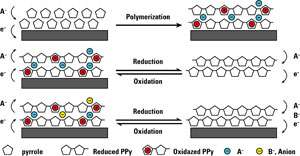
Schematic illustration of the PNNL perchlorate removal process. The technology also can be used to capture cesium and chromium.

Researchers at Pacific Northwest National Laboratory have demonstrated a new, environmentally friendly process for treating water contaminated by perchlorate, a toxic chemical that has been found in drinking water in 35 states.

Perchlorate is used in rocket fuel, fireworks and defense manufacturing, and groundwater contaminated by the chemical is difficult to treat. High levels of perchlorate have been associated with thyroid disease, plus the possibility of cancer and other health problems. Contamination is especially widespread in California, where there are many U.S. military bases.

The conventional method for treating perchlorate-contaminated water employs an ion exchange resin. Regenerating the resin requires flushing with an acidic solution, which results in large quantities of secondary waste.

The PNNL method is an electrically controlled anion exchange process. “The technology is unique in that it uses an electric current to regenerate the resin and release the perchlorate without producing a lot of secondary waste,” said Yuehe Lin, lead scientist for the research, adding that the process is “green” because it produces so little waste.

The technology is available for licensing and joint research opportunities through Battelle, which operates PNNL for the Department of Energy and facilitates the transfer of lab-created technologies to the marketplace.

To create the new process, Lin and his colleagues induced a positive charge to an electrically conducting polymer, such as a polypyrrole, that selectively attracts the negatively charged perchlorate ions. Application of an electric current releases the trapped perchlorate ions for disposal. Now neutral, the polymer can be reverted to a positively charged surface and re-used.

The scientists increased the amount of perchlorate that can be captured by depositing the polymer as a polypyrrole thin film on a matrix of carbon nanotubes, creating a porous conductive nanocomposite.

“The high surface area of the carbon nanotubes provides an ideal matrix for the polymer,” Lin said, noting that the polymer is electrodeposited on the carbon nanotubes through in situ polymerization.

The porous surface created by the carbon nanotubes also gives the technology a longer life cycle because the polymer is more stable on the nanotube matrix than it would be on a flat, conducting substrate.

The electrically controlled anion exchange technology can be used to remove other contaminants, such as cesium and chromium. A radioactive material common to nuclear waste sites, cesium could be used by terrorists to build dirty bombs or contaminate drinking water. Chromate is a toxic form of chromium that is readily absorbed by the body.

Source: PNNL


print this article email this article download pdf blog this article bookmark this article     Stumble it Digg this share on Facebook retweet share on Reddit add to delicious
Rate this story - 4.1 /5 (9 votes)


July 25, 2006 all stories

Comments: 0

4.1 /5 (9 votes)
  • Stumble this up

  • Digg this

  • share this

  • hide
  • Related Stories


  • hide
  • Relevant PhysicsForums posts

  • Polymer Properties Question
    created 16 hours ago
  • Fatigue Properties of Chinese steel
    created Nov 04, 2009
  • Finding Hardness values
    created Nov 04, 2009
  • Fluid flow, pressure drop simulation in Comsol
    created Nov 04, 2009
  • More from Physics Forums - Materials & Chemical Engineering

Other News

New transparent insulating film could enable energy-efficient displays

New transparent insulating film could enable energy-efficient displays

Nanotechnology / Nanomaterials

created 1hour ago | popularity 5 / 5 (2) | comments 0

Johns Hopkins materials scientists have found a new use for a chemical compound that has traditionally been viewed as an electrical conductor, a substance that allows electricity to flow through it. By orienting ...


Ideal nanoparticle cancer therapies surf the bloodstream

Nanotechnology / Bio & Medicine

created 1hour ago | popularity 5 / 5 (1) | comments 0

Eric Shaqfeh studies blood at Stanford University, using computer models that simulate how the fluid and the cells it contains move around. On November 11 at a meeting of the scientific society AVS, he will present his latest ...


New Digital 'Electronics' Concept May Continue Moore's Law

New Digital 'Electronics' Concept May Continue Moore's Law

Nanotechnology / Nanophysics

created Nov 05, 2009 | popularity 4.6 / 5 (56) | comments 9

(PhysOrg.com) -- Computers of the future could be operating not on electrons, but on tiny waves traveling through an electron "fluid," if a new proposal is successful. The new circuit design, recently introduced ...


Findings show nanomedicine promising for treating spinal cord injuries

Findings show nanomedicine promising for treating spinal cord injuries

Nanotechnology / Bio & Medicine

created Nov 08, 2009 | popularity 4.5 / 5 (4) | comments 0

(PhysOrg.com) -- Researchers at Purdue University have discovered a new approach for repairing damaged nerve fibers in spinal cord injuries using nano-spheres that could be injected into the blood shortly ...


Nanoparticles for gene therapy improve

Nanoparticles for gene therapy improve

Nanotechnology / Bio & Medicine

created Nov 06, 2009 | popularity 5 / 5 (5) | comments 3

(PhysOrg.com) -- About five years ago, Professor Janet Sawicki at the Lankenau Institute in Pennsylvania read an article about nanoparticles developed by MIT's Robert Langer for gene therapy, the insertion ...