Island Universes with a twist
July 26th, 2006 Island Universes with a twist

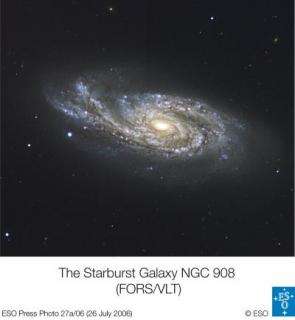
ESO PR Photo 27a/06 is based on data obtained with FORS2 on ESO's Very Large Telescope in the night of 13 to 14 August 2000, using images through B, V, and R filters, for a total exposure time of 4 minutes only. North is up and East is to the left. The data were extracted from the ESO Science Archive and further processed by Henri Boffin (ESO). Credit: ESO

If life is like a box of chocolates – you never know what you will get – the Universe, with its immensely large variety of galaxies, must be a real candy store! ESO's Very Large Telescope has taken images of three different 'Island Universes', each amazing in their own way, whose curious shapes testify of a troubled past, and for one, of a foreseeable doomed future.

The first galaxy pictured is NGC 908, located 65 million light-years towards the constellation of Cetus (the Whale). This spiral galaxy, discovered in 1786 by William Herschel, is a so-called starburst galaxy, that is, a galaxy undergoing a phase where it spawns stars at a frantic rate. Clusters of young and massive stars can be seen in the spiral arms. Two supernovae, the explosions of massive stars, have been recorded in the near past: one in 1994 and another in May of this year. The galaxy, which is about 75 000 light-years long, also clearly presents uneven and thick spiral arms, the one on the left appearing to go upwards, forming a kind of ribbon. These properties indicate that NGC 908 most probably suffered a close encounter with another galaxy, even though none is visible at present.

The second galaxy featured constitutes another wonderful sight yet of a more timid nature: it does not belong to the NGC catalogue, like so many of its more famous brethren. Its less well-known designation, ESO 269-G57, refers to the ESO/Uppsala Survey of the Southern Sky in the 1970's during which over 15,000 southern galaxies were found with the ESO Schmidt telescope and catalogued.

Located about 155 million light-years away towards the southern constellation Centaurus (the Centaur), ESO 269-G57 is a spectacular spiral galaxy of symmetrical shape that belongs to a well-known cluster of galaxies seen in this direction. An inner 'ring', of several tightly wound spiral arms, surrounded by two outer ones that appear to split into several branches, are clearly visible. Many blue and diffuse objects are seen - most are star-forming regions. ESO 269-G57 extends over about 4 arc minutes in the sky, corresponding to nearly 200,000 light-years across. Resembling a large fleet of spaceships, many other faint, distant galaxies are visible in the background.

Finally, ESO 27c/06 provides a view of a more tormented organism, a so-called irregular galaxy, known as NGC 1427A. Located about 60 million light-years away, in the direction of the constellation Fornax (the Furnace), NGC 1427A is about 20,000 light-years long and shares some resemblances with our neighbouring Large Magellanic Cloud. NGC 1427A is in fact plunging into the Fornax cluster of galaxies at a speed of 600 km/s, and takes an arrowhead shape. Moving so rapidly, the galaxy is compressed by the intracluster gas, and this compression gives birth to many new stars.

Using these and other VLT observations, astronomer Iskren Y. Georgiev from the Argelander Institute for Astronomy at Bonn (Germany) and his colleagues were able to find 38 candidates globular clusters that are about 10 billion years old. The scientists also inferred that NGC 1427A is about 10 million light-years in front of the central dominant elliptical galaxy in the Fornax cluster of galaxies, NGC 1399. It seems certain that under such circumstances, the future of NGC 1427A looks bleak, as the galaxy will finally be disrupted, dispersing its content of gas and stars in the intracluster regions. Just next to NGC 1427A, but 25 times further away, a more typical, beautiful face-on spiral galaxy is looking rather unperturbed at the dramatic spectacle.

The multi-mode FORS instrument, on ESO's Very Large Telescope, was used to take the images of these three galaxies.

Source: European Southern Observatory (ESO)


print this article email this article download pdf blog this article bookmark this article     Digg this Stumble it share on Facebook share on Reddit add to delicious save to Yahoo! bookmarks
4.1/5 after 20 votes


July 26th, 2006 all stories
Space & Earth / Astronomy

Comments: 0
Rank: 4.1/5 after 20 votes

  • Stumble this up

  • Digg this

  • Share it:
  • share on Facebook
  • share on MySpace
  • share on Slashdot
  • rss-newsfeed
  • share on Google
  • share on Reddit
  • add to delicious
  • save to Yahoo! bookmarks
  • share on Windows Live
  • Add to Mixx!
Rating: 4.1/5 after 20 votes

  • Related Stories

  • Radio telescopes extend astronomy's best 'yardstick'
    created Jun 08, 2009 | popularity not rated yet | comments 0
  • Refined Hubble Constant narrows explanations for dark energy
    created May 07, 2009 | popularity not rated yet | comments 0
  • Starbursts in Dwarf Galaxies are a Global Affair
    created Apr 30, 2009 | popularity not rated yet | comments 0
  • Dramatically backlit dust in giant galaxy
    created Apr 07, 2009 | popularity not rated yet | comments 0
  • Galaxy Cores to Crash in a Few Million Years
    created Mar 16, 2009 | popularity not rated yet | comments 0

Tags


  • Physicists Demonstrate Quantum Memory with Matter Qubits
    Physicists Demonstrate Quantum Memory with Matter Qubits
    Physics / General Physics
    created Jul 03, 2009 | popularity 4.4 / 5 (17) | comments 1
  • 'Holey' Nanosheets for Wastewater Dye Removal
    Nanotechnology / Nanomaterials
    created Jul 01, 2009 | popularity 5 / 5 (5) | comments 1
  • Jellyfish Robot Swims Like its Biological Counterpart
    Jellyfish Robot Swims Like its Biological Counterpart
    Electronics / Robotics
    created Jun 26, 2009 | popularity 4.4 / 5 (8) | comments 1
  • Could Maxwell's Demon Exist in Nanoscale Systems?
    Could Maxwell's Demon Exist in Nanoscale Systems?
    Physics / General Physics
    created Jun 24, 2009 | popularity 4.4 / 5 (18) | comments 29
  • Living Safely with Robots, Beyond Asimov's Laws
    Living Safely with Robots, Beyond Asimov's Laws
    Electronics / Robotics
    created Jun 22, 2009 | popularity 4.6 / 5 (52) | comments 40
  • Other News

    Forty years ago man first walked on the moon

    Space & Earth / Space Exploration

    created 11 hours ago | popularity 5 / 5 (2) | comments 1

    Forty years ago on July 20, 1969, American astronaut Neil Armstrong realized the oldest dream of human civilizations when he became the first man to walk on the moon.


    The least sea ice in 800 years

    The least sea ice in 800 years

    Space & Earth / Earth Sciences

    created Jul 01, 2009 | popularity 4.3 / 5 (59) | comments 52

    New research, which reconstructs the extent of ice in the sea between Greenland and Svalbard from the 13th century to the present indicates that there has never been so little sea ice as there is now. The ...


    Gas around young galaxy

    Intense heat killed the Universe's would-be galaxies, researchers say

    Space & Earth / Astronomy

    created Jul 01, 2009 | popularity 3.2 / 5 (19) | comments 27

    (PhysOrg.com) -- Our Milky Way galaxy only survived because it was already immersed in a large clump of dark matter which trapped gases inside it, scientists led by Durham University's Institute for Computational ...


    Scientists' Drill Hits Magma: Only Third Time on Record

    Scientists' Drill Hits Magma: Only Third Time on Record

    Space & Earth / Earth Sciences

    created Jun 29, 2009 | popularity 4.7 / 5 (21) | comments 19

    (PhysOrg.com) -- Scientists drilling a borehole deep into Iceland’s rocky crust to explore new methods of using geothermal energy hit a major roadblock on Thursday: Their drill ran into molten rock at a depth ...


    NASA manager pitches a cheaper return-to-moon plan

    Space & Earth / Space Exploration

    created Jun 30, 2009 | popularity 4 / 5 (7) | comments 18

    (AP) -- Like a car salesman pushing a luxury vehicle that the customer no longer can afford, NASA has pulled out of its back pocket a deal for a cheaper ride to the moon.