There's a change in rain around desert cities
July 26, 2006 There's a change in rain around desert cities

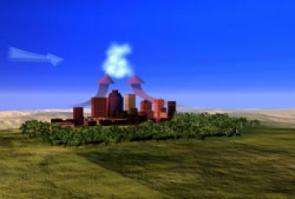
This image shows warm air rising from an urban area, and subsequent cloud formation. Cities tend to be one to 10 degrees Fahrenheit (.56 to 5.6 Celsius) warmer than surrounding suburbs and rural areas and the added heat can destabilize the atmosphere and change the way air circulates around cities. Added heat creates wind circulations and rising air that can produce or enhance existing clouds. Under the right conditions, these clouds can evolve into rain-producers or storms. It is suspected that converging air due to city surfaces of varying heights, like buildings, also promotes rising air needed to produce clouds and rainfall. Winds can carry these clouds to the east of the cities. Credit: Susan Gonnelli Byrne, NASA GSFC

Urban areas with high concentrations of buildings, roads and other artificial surface soak up heat, lead to warmer surrounding temperatures, and create "urban heat-islands." This increased heat may promote rising air and alter the weather around cities. Human activities such as land use, additional aerosols and irrigation in these arid urban environments also affect the entire water cycle as well.

Although the urban heat-island effect has been known to affect large cities such as Atlanta and Houston, effects on arid cities such as Phoenix, Ariz. and Riyadh, Saudi Arabia were relatively unknown. These cities both experienced explosive population growth.

A study by J. Marshall Shepherd, a climatologist at the University of Georgia, Athens, used a unique 108-year-old data record and data from NASA's Tropical Rainfall Measuring Mission (TRMM) satellite, to examine arid cities' rainfall patterns.

Shepherd found a 12-14 percent increase in rainfall in the northeast suburbs of Phoenix from the pre-urban (1895-1949) to post-urban (1950-2003) periods. This increase in rainfall is likely related to changes in the city and the lands within the city, such as more roadways and buildings in place of open natural area. The increase may also be related to changes in irrigation. However, the role of irrigation in changing the weather of cities in arid areas requires more study, Shepherd said.

"We think that human activities, such as changing the landscape, can affect the flow of the winds associated with the U.S. southwest's monsoon and rising air and building storms on the east side of mountains," said Shepherd. The weather in Phoenix, in fact, is affected by both, and that can change where the rains fall.

The city of Riyadh has also grown quickly in the past few decades, and its weather has been affected by the urban heat-island effect, although the causes are less clear than they are in Phoenix. Weather stations on the ground have confirmed a recent significant increase in rainfall around the city Riyadh.

Shepherd used satellite images from the Landsat satellite and the Advanced Spaceborne Thermal Emission and Reflection Radiometer instrument aboard NASA's Terra satellite to determine expansion characteristics. He used the TRMM satellite's rainfall data to pinpoint precipitation areas. This study shows the importance of satellite data in regions like the Middle East, where traditional measurements are sparse or inaccessible.

"Many of the fastest-growing urban areas are in arid regimes," said Marshall Shepherd, author of the report just published in the online edition of the Journal of Arid Environments. "Because their total rainfall is low, these areas have been largely ignored in studies on how human activities affect the water cycle. But these cities are particularly sensitive to such changes, since the water supply is so critical."

Cities in arid areas or desert cities have shown great growth only in the last 30-50 years because of new methods of irrigation and ways to obtain water for daily use. Shepherd had access to a unique 108-year-old data record for Phoenix, and for the first time confirmed a significant change in rainfall took place in certain areas of the city from the late 1890s to the present.

Understanding rainfall changes in arid cities is very important. One United Nations estimate projects that 60 to 70 percent of all people will live in cities by 2025, and many of the fastest-growing areas for city growth are in arid areas.

"The results showed us just how sensitive the water cycle can be to human-induced changes, even under arid or drought conditions," Shepherd said. These findings have real implications for water resource management, agricultural efficiency and urban planning.

Source: NASA/Goddard Space Flight Center


Rate this story - 3.8 /5 (9 votes)


July 26, 2006 all stories

Comments: 0

3.8 /5 (9 votes)

  • hide
  • Related Stories

  • Water supply shifts as global climate changes
    created Jun 15, 2009 | popularity not rated yet | comments 0
  • Probing Question: Are water wars in our future?
    created Jun 05, 2008 | popularity not rated yet | comments 0
  • MIT team describes unique desert cloud forest
    created Sep 06, 2006 | popularity not rated yet | comments 0
  • Human activities can affect rainfall
    created Jun 20, 2006 | popularity not rated yet | comments 0
  • Study Fumes Over City Park Grass
    created Jan 28, 2010 | popularity not rated yet | comments 0


  • hide
  • Relevant PhysicsForums posts

  • Carbon Dioxide emissions question
    created Feb 08, 2010
  • Photosynthesis vs. carbonization
    created Feb 07, 2010
  • Sheep's footprints
    created Feb 05, 2010
  • How did Victorians estimate the ages of fossils?
    created Feb 03, 2010
  • More from Physics Forums - Earth

Other News

Space shuttle Endeavour pulls in at space station (AP)

Space shuttle Endeavour pulls in at space station

Space & Earth / Space Exploration

created 2 hours ago | popularity not rated yet | comments 0

(AP) -- Shuttle Endeavour arrived to a warm welcome at the International Space Station early Wednesday, delivering a new room and observation deck that will come close to completing construction 200 miles ...


Rho Ophiuchus cloud

Professor: We have a 'moral obligation' to seed universe with life

Space & Earth / Astronomy

created 23 hours ago | popularity 3.1 / 5 (27) | comments 55 | with audio podcast report

(PhysOrg.com) -- Eventually, the day will come when life on Earth ends. Whether that’s tomorrow or five billion years from now, whether by nuclear war, climate change, or the Sun burning up its fuel, the last ...


Climate 'Tipping Points' May Arrive Without Warning, Says Top Forecaster

Space & Earth / Environment

created 12 hours ago | popularity 3 / 5 (8) | comments 8 | with audio podcast

(PhysOrg.com) -- A new University of California, Davis, study by a top ecological forecaster says it is harder than experts thought to predict when sudden shifts in Earth's natural systems will occur -- a worrisome finding ...


38 percent of world's surface in danger of desertification

38 percent of world's surface in danger of desertification

Space & Earth / Environment

created 9 hours ago | popularity 2.3 / 5 (3) | comments 5

A team of Spanish researchers has measured the degradation of the planet's soil using the Life Cycle Assessment (LCA), a scientific methodology that analyses the environmental impact of human activities, and ...


A new 3-D map of the interstellar gas within 300 parsecs from the sun

A new 3D map of the interstellar gas within 300 parsecs from the Sun

Space & Earth / Astronomy

created 15 hours ago | popularity 5 / 5 (5) | comments 0 | with audio podcast

(PhysOrg.com) -- Astronomy & Astrophysics is publishing new 3D maps of the interstellar gas in the local area around our Sun. A French-American team of astronomers presents new absorption measurements toward ...