Device determines how well wind turbines operate
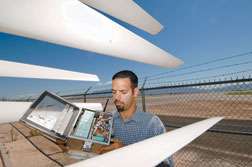
In West Texas, New Mexico, and other places around the world, wind turbines are used to generate electricity. But how can engineers determine their efficiency and health?
Sandia's Wind Energy Technology Department has developed a device, the Accurate Time Linked data Acquisition System (ATLAS II), which answers that question and can provide all of the information necessary to understand how well a machine is performing.
Housed in an environmentally protected aluminum box, ATLAS II is capable of sampling a large number of signals at once to characterize the inflow, the operational state, and the structural response of a wind turbine.
The ATLAS II has several key attributes that make it particularly attractive for wind turbine deployment. It is small, highly reliable, can operate continuously, uses off-the-shelf components, and has lightning protection on all channels.
Sandia is a National Nuclear Security Administration laboratory.
"The system provides us with sufficient data to help us understand how our turbine blade designs perform in real-world conditions, allowing us to improve on the original design and our design codes," says Jose Zayas, the project lead, who has been working on ATLAS II since its inception in 1999.
Last year the ATLAS II team completed a project with GE Energy and the National Renewable Energy Laboratory (NREL) to monitor the performance of a GE wind turbine in a Great Plains site about 30 miles south of Lamar, Colo., and will soon start monitoring a new work-for-others (WFO) project with Texas Tech University.
The GE Energy/NREL/Sandia collaboration involved testing a 1.5-megawatt, 80-meter-tall turbine with a rotor diameter of 70.6 meters. GE Energy is the largest wind turbine manufacturer in the US and sells them to developers -- such as Florida Power & Light -- all over the world. Wind plant operators sell the electricity to utilities such as the Public Service Company of New Mexico.
The GE turbine was equipped with four ATLAS II units, collecting a total of 67 measurements, including 12 to characterize the inflow, eight to characterize the operational state of the turbine, and 24 to characterize the structural response.
The system collected data continuously, 24 hours a day, seven days a week. The four units were placed at various locations on the turbine, and a GPS time stamp was used to maintain synchronization between the units. All data streams from the different units were merged into a single data stream at the base of the turbine where the ATLAS II software compressed the data and stored them onto a local computer.
Data collection efforts began Sept. 14, 2004, and ended Jan. 19, 2005. During that time, more than 17,000 data records were collected, for a total of 285 Gb of data.
Because the turbine was located at a remote site, the data was transmitted to NREL via a satellite link and later transmitted to Sandia. In places where there is access to the Internet, the data can be monitored in real time.
The Texas Tech project will start in August with an environmental monitoring box being placed on a 200-meter meteorological tower at a test site near the campus in Lubbock. The university is expected to eventually erect a utility-size wind turbine. The ATLAS II will be used to collect data from the machine.
Sandia also is planning three experiments, using the ATLAS II to monitor the performance of three advanced blade designs on a test turbine it operates in conjunction with the US Department of Agriculture's research station in Bushland, Tex.
Sandia is a multiprogram laboratory operated by Sandia Corporation, a Lockheed Martin company, for the U.S. Department of Energy's National Nuclear Security Administration. With main facilities in Albuquerque, N.M., and Livermore, Calif., Sandia has major R&D responsibilities in national security, energy and environmental technologies, and economic competitiveness.
Source: Sandia National Laboratories


