Scientists design simpler, more accurate nanothermometer
July 26, 2006 Scientists design simpler, more accurate nanothermometer

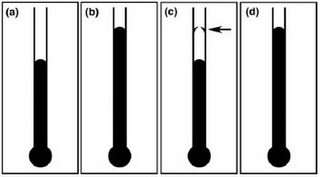
This drawing shows the oxidation process of temperature measurement using gallium-filled carbon nanotubes: (a) shows the nanotube before temperature measurement; in (b), the rising temperature causes the gallium to expand and rise, where the top of the gallium becomes oxidized; in (c), the falling temperature causes the gallium to contract, leaving the oxidized marker; and in (d), the original temperature is measured by reheating the nanotube up to the marker. Photo credit: Zongwen Liu, et al.

By using carbon nanotubes containing gallium for measuring temperature at the nanoscale, scientists have invented a new nanothermometer that works simply by heating and cooling the tubes.

As technology shrinks into the nanoscale range, the accessories of nanotechnology must also shrink – among these extra tools is a way to measure temperatures of the spaces surrounding nanoscale devices. Conventional (i.e. mercury) thermometers can only measure temperatures at the macroscopic scale (in the range of millimeters). Devices called thermocouples can measure temperatures at the microscale, but taking measurements at the nanoscale requires an all-together different tool.

A team of scientists from Australia and Japan, Zongwen Liu, et al., has recently improved upon a method for nano temperature measurement using nanothermometers consisting of carbon nanotubes filled with liquid gallium to develop a one-step measuring procedure. The nanotubes, which have diameters as small as 20 nanometers, can effectively measure temperatures of 175-660 degrees Fahrenheit.

“Due to the continuing miniaturization of existing technologies, it is becoming ever more important to know the temperature of current microelectronics and future nano-electronic and optoelectronic devices,” Liu told PhysOrg.com. “Each of these devices has its own optimal working temperature limit. Below this limit each device works efficiently. However, if the temperature exceeds the limit, not only are efficiency and proper operation impaired, but the device can be damaged. In fact, close to three quarters of all failures is due to thermal overload.”
Scientists design simpler, more accurate nanothermometer

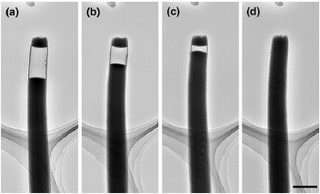
In this series of transmission electron microscope images, an oxidation mark at the top of the carbon nanotube shows the gallium level at the measured temperature of 150 degrees C, and the gallium rising as the temperature climbs from 21, 70, 120 and 145 degrees in (a) through (d), respectively. Photo credit: Zongwen Liu, et al.

Carbon nanotubes, discovered in the early ‘90s, are tiny, hollow cylindrical structures made of carbon molecules that are typically known for their strength and unique electrical properties. In 2002, scientists – including Yoshio Bando, coauthor of the current study – accidentally discovered that these carbon nanotubes can also act as tubes for measuring temperature when filled with gallium, much like a conventional mercury thermometer. In that study, the gallium expanded and contracted in response to temperature, and the initial temperature-height association was calibrated to estimate the temperature based on the gallium volume expansion.

Now, Liu, Bando and their colleagues have used a slightly different approach to simplify this method. When a carbon nanotube that contains gallium and has one open end is heated in air, the scientists found that the gallium will expand until the temperature is stable, at which time the gallium will begin to oxidize, starting at the top. The oxidation causes the formation of solid gallium oxide. When cooled, most of the gallium will contract, leaving behind a thin solid marker at the highest point. By reheating the tube under a microscope (transmission electron or scanning electron), the gallium will expand to the marker, revealing the original temperature of the tiny area of interest.

The oxidation-assisted technique improves upon the previous method in several areas. For one thing, the process is simplified because no calibration is required to record the original level of gallium. Also, several nanothermometers can easily be used in this case to verify temperature and bypass the previous risks of damage or loss when relying on a single thermometer. Finally, this technique demonstrated improved accuracy (better than 5%) over the original method.

“Many instruments and devices are sensitive to operating temperature and often work close to their critical thermal limits,” said Liu. “Among the applications that require precise temperature measurement at the nanoscale are polymer-based fuel cells and the microprocessors in
modern computers.”

Citation: Liu, Zongwen, Bando, Yoshio, Hu Junqing, Ratinac, Kyle and Ringer, Simon P. “A novel method for practical temperature measurement with carbon nanotube nanothermometers.” Nanotechnology 17 (2006) 3681-3684.

By Lisa Zyga, Copyright 2006 PhysOrg.com


print this article email this article download pdf blog this article bookmark this article     Stumble it Digg this share on Facebook retweet share on Reddit add to delicious
Rate this story - 4.3 /5 (39 votes)


July 26, 2006 all stories

Comments: 0

4.3 /5 (39 votes)
  • Stumble this up

  • Digg this

  • share this

  • hide
  • Related Stories

  • Bilayer graphene gets a bandgap
    created Jun 10, 2009 | popularity not rated yet | comments 0
  • Scientists print dense lattice of transparent nanotube transistors on flexible base
    created Dec 16, 2008 | popularity not rated yet | comments 0
  • IBM Research Unveils Breakthrough In Solar Farm Technology
    created May 15, 2008 | popularity not rated yet | comments 0
  • New aluminum-rich alloy produces hydrogen on-demand for large-scale uses
    created Feb 19, 2008 | popularity not rated yet | comments 0
  • Graphene makes movement easy for electrons
    created Jan 08, 2008 | popularity not rated yet | comments 0


  • hide
  • Relevant PhysicsForums posts

  • Polymer Properties Question
    created 10 hours ago
  • Fatigue Properties of Chinese steel
    created Nov 04, 2009
  • Finding Hardness values
    created Nov 04, 2009
  • Fluid flow, pressure drop simulation in Comsol
    created Nov 04, 2009
  • units of vickers,brinell and rockwell . . .
    created Nov 04, 2009
  • Slip in a single crystal
    created Nov 02, 2009
  • More from Physics Forums - Materials & Chemical Engineering

Other News

Findings show nanomedicine promising for treating spinal cord injuries

Findings show nanomedicine promising for treating spinal cord injuries

Nanotechnology / Bio & Medicine

created 18 hours ago | popularity 4.5 / 5 (4) | comments 0

(PhysOrg.com) -- Researchers at Purdue University have discovered a new approach for repairing damaged nerve fibers in spinal cord injuries using nano-spheres that could be injected into the blood shortly ...


New Digital 'Electronics' Concept May Continue Moore's Law

New Digital 'Electronics' Concept May Continue Moore's Law

Nanotechnology / Nanophysics

created Nov 05, 2009 | popularity 4.6 / 5 (55) | comments 9

(PhysOrg.com) -- Computers of the future could be operating not on electrons, but on tiny waves traveling through an electron "fluid," if a new proposal is successful. The new circuit design, recently introduced ...


Nanoparticles for gene therapy improve

Nanoparticles for gene therapy improve

Nanotechnology / Bio & Medicine

created Nov 06, 2009 | popularity 5 / 5 (4) | comments 3

(PhysOrg.com) -- About five years ago, Professor Janet Sawicki at the Lankenau Institute in Pennsylvania read an article about nanoparticles developed by MIT's Robert Langer for gene therapy, the insertion ...


Breakthrough in industrial-scale nanotube processing

Breakthrough in industrial-scale nanotube processing

Nanotechnology / Nanomaterials

created Nov 02, 2009 | popularity 4.9 / 5 (20) | comments 3

(PhysOrg.com) -- Rice University scientists today unveiled a method for the industrial-scale processing of pure carbon-nanotube fibers that could lead to revolutionary advances in materials science, power ...


Nanoparticles may cause DNA damage across a cellular barrier

Nanoparticles may cause DNA damage across a cellular barrier

Nanotechnology / Bio & Medicine

created Nov 05, 2009 | popularity 4.3 / 5 (9) | comments 1

(PhysOrg.com) -- Scientists have shown in the laboratory that metal nanoparticles damaged the DNA in cells on the other side of a cellular barrier. The research, by the University of Bristol, is published ...