Space Station Set for Expansion
July 26, 2006 Space Station Set for Expansion

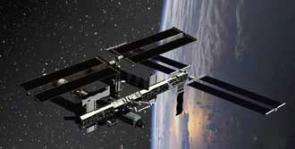
This illustration shows how the P3/P4 (with its solar arrays extended) will expand the International Space Station. The new truss segment and solar wings are visible on the right side of the station. Image credit: NASA

The next part of the International Space Station might resemble a cocoon when tucked inside Space Shuttle Atlantis for flight. But by the time it's deployed in space, the segment that will provide a quarter of the completed station's power capability will look more like an extremely large butterfly.

The port three and four (P3/P4) integrated truss segment is the prime payload of the STS-115 mission, scheduled to lift off from Launch Pad 39B at Kennedy Space Center, Fla., in late August or early September.

"The truss in its launch configuration is about 45 feet long, but once on orbit with the solar arrays deployed, it will have a wingspan of almost 240 feet," says Robbie Ashley, space station mission manager for the STS-115 mission.

The mission's main objective is to resume space station construction by installing and activating the segment during three scheduled spacewalks. The trusses are part of the 11-segment structure that will eventually span more than 300 feet when the station is completed.
Space Station Set for Expansion

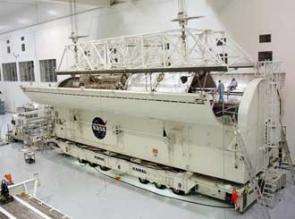
An overhead crane lowers the integrated truss segment into the waiting payload canister for transportation to Launch Pad 39B, where it will be loaded into Atlantis' cargo bay. Photo credit: NASA/Troy Cryder

"The P3/P4 element will be installed on what is now the end of the P1 port truss segment already on orbit," explains Ashley. "It's going to provide two primary capabilities, the first being power. The power module will provide the capability to generate, store, distribute and regulate power for the space station. It's going to supplement the capability that is up there now with the P6 element. In addition, the P3 half of the truss has a mechanism that's going to rotate all of the outboard truss segments, including the solar arrays, to allow them to stay pointed at the sun for optimal power-generation capability."

On Earth, the P3/P4 segment weighs almost 35,000 pounds -- one of the heaviest station payloads. It will be weightless in orbit, allowing the astronauts to remove the segment from Atlantis' payload bay using the shuttle's remote arm and hand it off to the space station's remote arm. The astronauts will then maneuver the segment into place before attaching it to the P1 segment. The astronauts will need three spacewalks for the entire process.

A major spacewalk task will be deployment of the two solar wings. When extended, each solar wing will be 115 feet by 38 feet. They are deployed in opposite directions and each is made up of a center mast supporting a solar "blanket" on either side. Each wing uses nearly 33,000 solar cells and on Earth would weigh more than 2,400 pounds. The two new wings are capable of generating enough power to meet the needs of 30 average homes, based on consumption of 2 kilowatts of power each.

The P3/P4 truss segment will be moved from the Space Station Processing Facility to Launch Pad 39B in a payload canister. It will then be transferred to the payload bay of Atlantis for launch on the STS-115 mission.

Source: By Cheryl L. Mansfield, NASA's John F. Kennedy Space Center


print this article email this article download pdf blog this article bookmark this article     Stumble it Digg this share on Facebook retweet share on Reddit add to delicious
Rate this story - 4.8 /5 (9 votes)


July 26, 2006 all stories

Comments: 0

4.8 /5 (9 votes)
  • Stumble this up

  • Digg this

  • share this

  • hide
  • Related Stories

  • Goddard Team Develops New Carriers for ISS
    created Nov 13, 2009 | popularity not rated yet | comments 0
  • NASA Tests Load Limits for Ares I Rocket Main Parachute
    created Oct 09, 2009 | popularity not rated yet | comments 0
  • NASA Invites Young People to Take Virtual Space Station Spacewalks
    created Oct 06, 2009 | popularity not rated yet | comments 0
  • Ground segment declared ready for CryoSat-2 launch
    created Aug 07, 2009 | popularity not rated yet | comments 0
  • All 13 astronauts enjoy first day off in 11 days
    created Jul 26, 2009 | popularity not rated yet | comments 0


  • hide
  • Relevant PhysicsForums posts

  • Some help with a X-Ray astronomy question please!
    created 8 hours ago
  • Help with Images and Optical Instrument Question..
    created 20 hours ago
  • Redshift as a distance indicator
    created Nov 26, 2009
  • Question about 2-body gravity
    created Nov 24, 2009
  • More from Physics Forums - General Astronomy

Other News

Fermi Telescope Peers Deep into Microquasar

Fermi Telescope Peers Deep into Microquasar (w/ Video)

Space & Earth / Astronomy

created 2 hours ago | popularity 5 / 5 (1) | comments 0

(PhysOrg.com) -- NASA's Fermi Gamma-ray Space Telescope has made the first unambiguous detection of high-energy gamma-rays from an enigmatic binary system known as Cygnus X-3. The system pairs a hot, massive ...


The Energy Sources of Ultraluminous Galaxies

The Energy Sources of Ultraluminous Galaxies

Space & Earth / Astronomy

created 2 hours ago | popularity 5 / 5 (1) | comments 0

(PhysOrg.com) -- Ultraluminous infrared galaxies ((ULIRGs) are galaxies whose luminosity exceeds that of a trillion suns; for comparison, the Milky Way galaxy has a typical (and much more modest) luminosity ...


Space shuttle Atlantis, 7 astronauts back on Earth (AP)

Space shuttle Atlantis, 7 astronauts back on Earth

Space & Earth / Space Exploration

created 3 hours ago | popularity not rated yet | comments 0

(AP) -- Space shuttle Atlantis and its seven astronauts returned to Earth with a smooth touchdown Friday to end an 11-day flight that resupplied the International Space Station.


Herschel takes a peek at the ingredients of the galaxies

Herschel takes a peek at the ingredients of the galaxies

Space & Earth / Astronomy

created 1hour ago | popularity not rated yet | comments 0

(PhysOrg.com) -- The European Space Agency has today released spectacular new observations from the Herschel Space Observatory, including the UK-led SPIRE instrument. Spectrometers on board all three Hershel ...


China is set to launch its second moon orbiter next October, state media have reported

China to launch second lunar probe: state media

Space & Earth / Space Exploration

created 7 hours ago | popularity 5 / 5 (3) | comments 0

China will launch its second moon orbiter next October, state media reported Friday, as it powers ahead with a space programme that has sparked concerns abroad.