How Much the Eye Tells the Brain
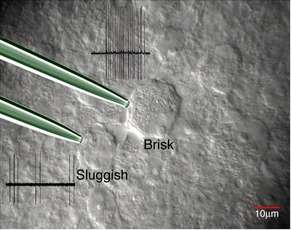
Researchers at the University of Pennsylvania School of Medicine estimate that the human retina can transmit visual input at about the same rate as an Ethernet connection, one of the most common local area network systems used today. They present their findings in the July issue of Current Biology. This line of scientific questioning points to ways in which neural systems compare to artificial ones, and can ultimately inform the design of artificial visual systems.
Much research on the basic science of vision asks what types of information the brain receives; this study instead asked how much. Using an intact retina from a guinea pig, the researchers recorded spikes of electrical impulses from ganglion cells using a miniature multi-electrode array. The investigators calculate that the human retina can transmit data at roughly 10 million bits per second. By comparison, an Ethernet can transmit information between computers at speeds of 10 to 100 million bits per second.
The retina is actually a piece of the brain that has grown into the eye and processes neural signals when it detects light. Ganglion cells carry information from the retina to the higher brain centers; other nerve cells within the retina perform the first stages of analysis of the visual world. The axons of the retinal ganglion cells, with the support of other types of cells, form the optic nerve and carry these signals to the brain.
Investigators have known for decades that there are 10 to 15 ganglion cell types in the retina that are adapted for picking up different movements and then work together to send a full picture to the brain. The study estimated the amount of information that is carried to the brain by seven of these ganglion cell types.
The guinea pig retina was placed in a dish and then presented with movies containing four types of biological motion, for example a salamander swimming in a tank to represent an object-motion stimulus. After recording electrical spikes on an array of electrodes, the researchers classified each cell into one of two broad classes: “brisk” or “sluggish,” so named because of their speed.
The researchers found that the electrical spike patterns differed between cell types. For example, the larger, brisk cells fired many spikes per second and their response was highly reproducible. In contrast, the smaller, sluggish cells fired fewer spikes per second and their responses were less reproducible.
But, what’s the relationship between these spikes and information being sent? “It’s the combinations and patterns of spikes that are sending the information. The patterns have various meanings,” says co-author Vijay Balasubramanian, PhD, Professor of Physics at Penn. “We quantify the patterns and work out how much information they convey, measured in bits per second.”
Calculating the proportions of each cell type in the retina, the team estimated that about 100,000 guinea pig ganglion cells transmit about 875,000 bits of information per second. Because sluggish cells are more numerous, they account for most of the information. With about 1,000,000 ganglion cells, the human retina would transmit data at roughly the rate of an Ethernet connection, or 10 million bits per second.
“Spikes are metabolically expensive to produce,” says lead author Kristin Koch, a PhD student in the lab of senior author Peter Sterling, PhD, Professor of Neuroscience. “Our findings hint that sluggish cells might be ‘cheaper,’ metabolically speaking, because they send more information per spike. If a message must be sent at a high rate, the brain uses the brisk channels. But if a message can afford to be sent more slowly, the brain uses the sluggish channels and pays a lower metabolic cost.”
“In terms of sending visual information to the brain, these brisk cells are the Fedex of the optic system, versus the sluggish cells, which are the equivalent of the U.S. mail,” notes Sterling. “Sluggish cells have not been studied that closely until now. The amazing thing is that when it’s all said and done, the sluggish cells turned out to be the most important in terms of the amount of information sent.”
Study co-authors are Judith McLean and Michael A. Freed, from Penn, and Ronen Segev and Michael J. Berry III, from Princeton University. The research was supported by grants from the National Institutes of Health and the National Science Foundation.
Source: University of Pennsylvania School of Medicine


