Purdue creates new low-cost system to detect bacteria
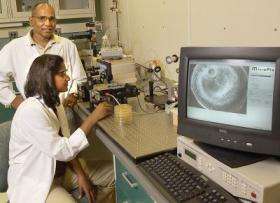
Researchers at Purdue University have developed a new low-cost system that analyzes scattered laser light to quickly identify bacteria for applications in medicine, food processing and homeland security at one-tenth the cost of conventional technologies.
The technique - Bacteria Rapid Detection Using Optical Scattering Technology - works by shining a laser through a petri dish containing bacterial colonies growing in a nutrient medium.
"Unlike conventional methods, we don't have to do any biochemical staining, DNA analysis or other types of manipulation," said Bartek Rajwa, a staff scientist at the Bindley Bioscience Center in Purdue's Discovery Park, the university's hub for interdisciplinary research.
Particles of light, called photons, bounce off of the colony, and the pattern of scattered light is projected onto a screen behind the petri dish. This "light-scatter pattern" is recorded with a digital camera and analyzed with sophisticated software to identify the types of bacteria growing in colonies.
"There are potentially thousands of applications for this new technology, from identifying stem cells to drug-resistant staph infections to pathogens on the battlefield." said J. Paul Robinson, a researcher at the Bindley Center and a professor in the Weldon School of Biomedical Engineering and the School of Veterinary Medicine.
The work was initiated by Arun Bhunia, a professor of food microbiology in the Department of Food Science; and E. Daniel Hirleman, a professor and William E. and Florence E. Perry Head of Purdue's School of Mechanical Engineering. Findings are detailed in a research paper appearing this month in the Journal of Biomedical Optics.
Hirleman has specialized in research to develop new types of sensors that work by analyzing light scattering off objects for applications such as detecting impurities on silicon wafers in computer chip manufacturing and measuring the size and speed of fuel droplets in jet engines.
"We adapted some ideas from that research to build a scatterometer for food safety, and now we're using the second generation of that instrument," Hirleman said.
A major motivation for the research is to reduce the time it takes for industry to identify harmful organisms in food processing. Scientists in food-processing plants routinely grow cultures to test for dangerous pathogens.
"The dairy industry, for example, grows bacteria on petri dishes to make sure products are safe, but industry is trying to develop technologies that will very quickly identify organisms," Robinson said. "The same sort of thing holds true for clinical microbiology and other laboratories. With our light-scattering method, it takes less than five minutes to identify harmful organisms after they have grown in a petri dish. The analysis is faster than any other methods in existence, and it's simple."
The technique might be used to identify staph infections that are resistant to antibiotics.
"This is an extremely dangerous infection, and you want to catch it as early as possible," Robinson said.
A mass-produced system based on the technology would consist of inexpensive, off-the-shelf hardware, such as red lasers and low-resolution digital cameras available at consumer electronics stores, and likely would cost less than $1,000, Hirleman said.
A critical part of the technique was made possible by adapting a mathematical method created in 1934 by Dutch physicist Fritz Zernike, who created a set of mathematical "descriptors" subsequently called radial Zernike polynomials. These descriptors can be used to analyze how light-wave patterns are distorted after passing through lenses having complex flaws or aberrations.
Individual bacterial colonies growing in a petri dish also distort light passing through them, just as a lens changes light-wave patterns.
"Therefore, we can treat the colonies as lenses and use Zernike polynomials," Rajwa said.
Factors such as the shape of bacteria, their refractive indexes - or how much they bend light - the types of substances secreted by a particular bacterium and the distance between individual bacteria in a colony, all contribute to how a colony distorts light. The procedure identifies a bacterial colony by comparing an image of its scatter pattern against a template that contains 120 features described by Zernike polynomials.
"A good analogy is the method used by law enforcement to identify a person's face using specialized recognition software," Rajwa said. "You could describe the face as being made up of a combination of geometric shapes, like ovals, squares and triangles, but each face has a unique blend of these shapes. We did something similar. We reduced complicated scatter patterns to 120 numbers based on Zernike polynomials."
This reduced collection of numbers describes how well the colony fits the template, and then pattern recognition software is used to classify the bacteria.
"One of the most important developments is being able to convert images to numbers, which makes it possible to classify the patterns," Rajwa said. "We are able to take images and convert them to numbers that uniquely describe every picture."
The researchers used the new system to classify six species of listeria, only one of which is a dangerous food-borne pathogen for humans.
"If you have a mixture of different listeria, you would like to know which is the one that can kill you," Rajwa said. "We took pictures of the scatter patterns from different listeria, and we were able to classify all of them accurately."
The system also was able to accurately identify other types of bacterial colonies, including salmonella, vibrio, E. coli and bacillus.
"We were able to classify bacterial colonies with greater than a 90 percent probability of being correct, which is as good as you could do with equipment costing more than $100,000, " Rajwa said. "And, unlike conventional systems, our method is 100 percent non-invasive, which means we can carry out the procedure without staining, manipulating or killing the biological samples.
"The power of this technology is that it does not require complicated lab equipment, and it could be designed so that it wouldn't require someone with a doctoral degree to operate. The whole beauty of the system is you don't invade the biological environment that you want to measure," Rajwa said. "If you are working with stem cells, you don't want to stain them to see if they are stem cells. You want to be able to look at colonies on a petri dish without touching the colonies, without staining or destroying the colonies."
The research has recently received funding from the U.S. Department of Agriculture through Purdue's Center for Food Safety Engineering.
Further work will include research to develop a graphical user interface.
"Now it requires a qualified, trained person to do all the recognition," Rajwa said. "We want a system where you can actually put a petri dish or some other container into the system, you press enter and the computer says, 'This is salmonella of this type and this strain, ' and it does this quickly in real time. There is absolutely no fundamental reason why we wouldn't be able to do this, and we are pretty close to having an actual prototype of a product that could be commercialized."
A provisional patent has been filed for the data-processing technique, and a full patent application has been filed on the underlying light-scattering technology.
Source: Purdue University


