How the world watched Huygens
July 27, 2006
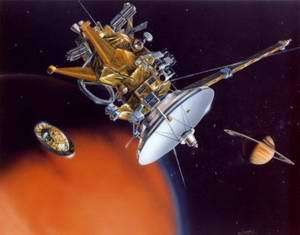
Huygens probe separating to enter Titan's atmosphere

As Huygens parachuted to the surface of Titan in January 2005, a battery of telescopes around the world were watching or listening. The results of those observations are now being collected together and published for the first time.

The work gives valuable additional context within which to interpret the 'ground truth' returned by Huygens. Hundreds of scientists, working at 25 radio and optical telescopes situated mainly around the Pacific, from where Titan would be visible at the time of Huygens descent, observed the moon before, during and after the Huygens descent. It was one of the largest ground-based observational campaigns ever to take place in support of a space mission.

The first observations began well over a year before Huygens entered the alien world's atmosphere, when scientists used the fact that Titan would pass directly in front of two distant stars. By watching the way the light faded from the stars, scientists analysed the density, wind and temperature of Titan's atmosphere. It helped to build confidence by confirming that the atmosphere was similar to their expectations.

A year later, telescopes monitored Titan's atmosphere and its surface at infrared wavelengths for the days and weeks around the Huygens descent. Even now, those observations are of critical importance to the scientists as they continue to interpret the data returned by the probe. "We wanted to know whether the day of the descent was a special day or not on Titan, so that we can place the Huygens data in the correct context," says Olivier Witasse, a Huygens scientist at ESA's European Space Research and Technology Centre (ESTEC) in The Netherlands.

Radio telescopes were used to track Huygens. Both Single-Dish Doppler-tracking, and a Very Long Baseline Interferometry (VLBI) observation that included 17 telescopes, were planned. Doppler-tracking was expected to complement the radio experiment onboard Huygens that used the probe-orbiter link. The VLBI project was initiated about two years before the Huygens entry as a test experiment. No one could predict for certain that the Huygens signal would be detectable but, if it were detected, it would provide unique information.

"One goal of the VLBI observation was to reconstruct the probe's descent trajectory to an accuracy of ten kilometres. At Titan's distance of more than 1 billion kilometres, this is the equivalent of determining positions with an accuracy of just three metres on our own Moon. Another goal was to demonstrate this as a new technique for future missions," says Jean-Pierre Lebreton, Huygens Project Scientist.

The radio experiments worked beyond expectations and even proved to be a 'safety net' when the reception of Huygens' second communications channel failed during the descent. The data from several of Huygens' six experiments was lost, including that required for the Huygens radio experiment to track the winds during the whole descent. The Doppler-tracking data from the Green Bank Telescope (West Virginia, America) and from Parkes (Australia) provided real-time information about the probe's drift in the winds. The processing of the VLBI data set is not yet completed but initial results look very promising.

The combined analysis of the Huygens data with that acquired by the Cassini orbiter in the past two years allowed scientists to reconstruct the movement of the probe precisely. They pinpointed its landing to 10.33 degrees south and 192.32 degrees west. The VLBI data set will provide an independent reconstruction of the trajectory. It should help to confirm and most likely refine the whole descent trajectory and the coordinates of the landing site.

Source: European Space Agency

4.5 /5 (2 votes)  

Rank 4.5 /5 (2 votes)
Tags

Related Stories
Relevant PhysicsForums posts
  • Never ending outer space.....
    created4 hours ago
  • Neutron Star fragments?
    created6 hours ago
  • stationary or not?
    created10 hours ago
  • Scale of the Universe
    createdFeb 10, 2012
  • Titan's lack of impact craters
    createdFeb 09, 2012
  • Real pictures of black hole eating a star?
    createdFeb 08, 2012
  • More from Physics Forums - General Astronomy

More news stories

Europe stakes billion-dollar bet on new rocket

A pencil-slim rocket is scheduled to lift into space from South America on Monday, carrying a billion-dollar bet that Europe can grab a juicy slice of the market to place satellites in low orbit.

Space & Earth / Space Exploration

created 17 hours ago | popularity 3.5 / 5 (2) | comments 0

Political leaders play key role in how worried Americans are by climate change: study

More than extreme weather events and the work of scientists, it is national political leaders who influence how much Americans worry about the threat of climate change, new research finds.

Space & Earth / Environment

created Feb 06, 2012 | popularity 5 / 5 (6) | comments 72

NASA budget will axe Mars deal with Europe: scientists

US President Barack Obama's budget proposal to be submitted next week for 2013 will cut NASA's budget by 20 percent and eliminate a major partnership with Europe on Mars exploration, scientists said Thursday.

Space & Earth / Space Exploration

created Feb 10, 2012 | popularity 5 / 5 (3) | comments 48

Humans may have helped the decline of African rainforests 3000 years ago

(PhysOrg.com) -- Large areas of rainforests in Central Africa mysteriously disappeared over three thousand years ago, to be replaced by savannas. The prevailing theory has been that the cause was a change ...

Space & Earth / Environment

created Feb 10, 2012 | popularity 4.1 / 5 (14) | comments 19 | with audio podcast report

High planetary tilt lowers odds for life?

Highly-tilted worlds would have extreme seasons, subjecting life to alternating periods of scorching and subzero temperatures. This could make the development of all but hardiest, simplest creatures a long ...

Space & Earth / Space Exploration

created Feb 06, 2012 | popularity 4.8 / 5 (12) | comments 14 | with audio podcast


Walney offshore wind farm is world's biggest (for now)

(PhysOrg.com) -- The Walney wind farm on the Irish Sea--characterized by high tides, waves and windy weather--officially opened this week. The farm is treated in the press as a very big deal as the Walney ...

GPS court ruling leaves US phone tracking unclear

A US Supreme Court decision requiring a warrant to place a GPS device on the car of a criminal suspect leaves unresolved the bigger issue of police tracking using mobile phones, legal experts say.

Europeans protest controversial Internet pact

Tens of thousands of people marched in protests in more than a dozen European cities Saturday against a controversial anti-online piracy pact that critics say could curtail Internet freedom.

Study finds that anti-diabetic medication can prevent the long-term effects of maternal obesity

In a study to be presented today at the Society for Maternal-Fetal Medicine's annual meeting, The Pregnancy Meeting, in Dallas, Texas, researchers will report findings that show that short therapy with the anti-diabetic medication ...

Netflix settlement trims 14 pct off 4Q earnings

(AP) -- Netflix pressed the rewind button on its fourth-quarter earnings after settling allegations that the video subscription service violated a consumer-privacy law.

Navy to begin tests on electromagnetic railgun prototype launcher

The Office of Naval Research (ONR)'s Electromagnetic (EM) Railgun program will take an important step forward in the coming weeks when the first industry railgun prototype launcher is tested at a facility ...