Archaeologists Hot on the Trail of Columbus' Sunken Ships
As luck would have it, time ran short, and the silt and mud in La Isabela Bay on the north coast of the Dominican Republic ran deep. Despite these setbacks, Indiana University archaeologists are confident they are closer to discovering some of Christopher Columbus' lost ships -- and the answer to a 500-year-old mystery, "What was on those ships?"
"The discovery of a Columbus shipwreck, let alone the finding of the flagship Mariagalante, would be a tremendous contribution to maritime archaeology," said Charles Beeker, director of Academic Diving and Underwater Science Programs in IU Bloomington's School of Health, Physical Education and Recreation. "Perhaps more important would be the cargo. Were the ships laden with native Taino Indian artifacts heading to Spain? Such a find would shed new light on the nature of the contact period between the Old and the New Worlds."
Earlier this summer, Beeker and Geoffrey Conrad, director of IUB's Mathers Museum of World Cultures, took a team of faculty and graduate students to the Dominican Republic to explore intriguing magnetometer anomalies the IU researchers had discovered 10 years ago. The readings suggest large objects buried under silt and mud, and within coral colonies. The readings indicate also that the objects are scattered -- similar to how a shipwreck, or several for that matter, would appear -- in a 75-square-meter area.
In the years since the anomalies were discovered and mapped, Beeker, Conrad and their graduate students have returned yearly to the Dominican Republic to complete a variety of projects related to tourism, conservation and the archaeological exploration of village sites and ceremonial wells related to the Taino Indians.
La Isabela Bay was the site of the first permanent Spanish settlement established by Columbus, and the Taino were the first indigenous people to interact with Europeans. Beeker said much of the history of this period is based on speculation, something he and Conrad are trying to change.
Their research teams are multinational and multidisciplinary, tapping such resources as the Anglo~Danish Maritime Archaeological Team (ADMAT) -- a nonprofit educational organization -- and the Genetic Anthropology Laboratory in IUB's Department of Anthropology. The latest research team included ADMAT as well as four professors and 10 graduate students from HPER, the School of Public and Environmental Affairs and the IU departments of anthropology, biology and mathematics.
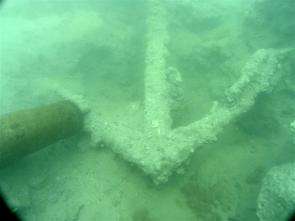
Among their latest efforts, they retrieved a 300-pound kedge anchor that could be from the Columbus era. The anchor, which is being conserved at the laboratory of the Oficina Nacional De Patrimonio Cultural Subacuàtico (ONPCS), was encrusted with dead as well as live coral within the area of interesting magnetometer anomalies. The live coral was removed from the anchor and cemented onto nearby coral colonies.
"We're strong advocates that you need to respect the biology when you excavate," Beeker said.
Beeker and Conrad's team used a water dredge to dig down to the most prominent magnetometer anomaly pinpointed. The pump, which acted like a vacuum cleaner, was able to dig an 8-foot hole through the silt and mud, with the magnetometer reading getting stronger as they went deeper. The team ran out of time, however, and had to postpone the search until later this summer. They are optimistic. When they return, they plan to determine which shipwreck they found, not whether one actually is buried in the bay.
Beeker said that several ships sank in La Isabela Bay during a hurricane in 1495. Researchers estimate that eight or nine vessels were lost in the bay, including smaller caravels and one or two larger store ships, or naos. One of the lost naos is believed to be the Mariagalante, Columbus' flagship on his second voyage to the New World. Documents indicate some of the ships carried cargo when they left for Spain, but Beeker said the contents are unknown.
Conrad and Beeker described the La Isabela Bay research project as a long-term investment by IU, which has funded much of the research. They also believe it is a project for which the land excavations and exploration of Taino village sites are as important as the underwater explorations.
"Everyone knows the name 'Columbus,'" Beeker said. "We want people to know Taino, too."
Source: Indiana University


