Researchers show how the brain turns on innate behavior
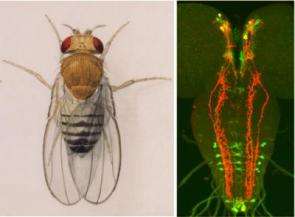
UCR researchers have made a major leap forward in understanding how the brain programs innate behavior. The discovery could have future applications in engineering new behaviors in animals and intelligent robots.
Innate or "instinctive" behaviors are inborn and do not require learning or prior experience to be performed. Examples include courtship and sexual behaviors, escape and defensive maneuvers, and aggression.
Using the common fruit fly as a model organism, the researchers found through laboratory experiments that the innate behavior is initiated by a "command" hormone that orchestrates activities in discrete groups of peptide neurons in the brain. Peptide neurons are brain cells that release small proteins to communicate with other brain cells and the body.
The researchers report that the command hormone, called ecdysis-triggering hormone or ETH, activates discrete groups of brain peptide neurons in a stepwise manner, making the fruit fly perform a well-defined sequence of behaviors. The researchers propose that similar mechanisms could account for innate behaviors in other animals and even humans.
Study results appear as the cover article in this week's issue of Current Biology.
"To our knowledge, we are the first to describe how a circulating hormone turns on sequential steps of an innate behavior by inducing programmed release of brain chemicals," said Young-Joon Kim, a postgraduate researcher in UCR's Department of Entomology working with Michael Adams, professor of cell biology and neuroscience and professor of entomology, and the first author of the paper. "It is well known that such behaviors – for example, sexual behavior or those related to aggression, escape or defense – are programmed in the brain, and all are laid down in the genome. We found that not only do steps involved in innate behavior match exactly with discrete activities of the neurons in the brain but also that specific groups of peptide neurons are activated at very precise times, leading to each successive step of the behavioral sequence."
In their experiments, which involved state of the art imaging techniques that helped the researchers see activated neurons light up in the fruit fly brain, the researchers specifically focused on arthropods, such as insects. Insects pass through multiple developmental stages during their life history. Each transition requires molting, a process in which a new exoskeleton (or cuticle) is produced and the old is shed. Insects shed the old cuticle by performing an innate behavior consisting of three distinct steps lasting about 100 minutes in total.
First, the researchers described the ecdysis sequence, an innate behavior that insects perform to escape their old cuticle, and showed that the insect initiates behavior shortly after appearance of ETH in the blood. The researchers then demonstrated that injection of the hormone into an animal generates the same behavior. To investigate mechanisms underlying this hormone-induced behavior, they used real-time imaging techniques to reveal activities in discrete sets of peptide neurons at very precise times, which corresponded to each successive step of the behavioral sequence. The researchers confirmed the results by showing that behavioral steps disappear or are altered upon killing certain groups of brain neurons with genetic tools.
"Our results apply not only to insects; they also may provide insights into how, in general, the mammalian brain programs behavior, and how it and the body schedule events," said Adams, who led the research team. "By understanding how innate behavior is wired in the brain, it becomes possible to manipulate behavior – change its order, delay it or even eliminate it altogether – all of which opens up ethical questions as to whether scientists should, or would want to, engineer behavior in this way in the future."
The fruit fly is a powerful tool and a classic laboratory model for understanding human diseases and genetics because it shares many genes and biochemical pathways with humans.
Source: University of California - Riverside


