Efficient Parking Guidance System – Networked via GPRS
July 28, 2006
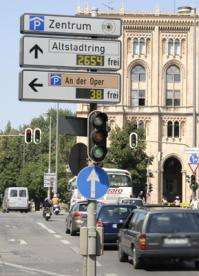
The world’s first parking guidance system to dispense with wires and underground connections turned in a stellar performance during its first 100 days of operation. In service in Munich (Germany), the system uses GPRS transmission to transfer data and control signals among all of the inner city’s 25 parking garages.
Siemens developed the system in cooperation with Setrix, and also operates the technology. The system has improved capacity utilization at the Munich parking garages by notifying motorists of unoccupied parking spaces well in advance. And because it is relatively inexpensive, the system has sparked the interest of other cities.
In the past, parking guidance systems were always difficult and expensive to install because of the numerous cables that had to be laid to transmit signals to roadside information panels and link the parking garages. In contrast, the new system in Munich uses transceivers from Setrix, a company that receives financing from Siemens Venture Capital. The transceivers use the mobile radio standard GPRS to send data via the Internet to the control center, where a PC manages the entire system. The parking garages transmit information on occupied spaces directly to the transceivers, which then forward the data to digital information panels installed along the city’s thoroughfares. The data is transmitted via radio, so the panels can be set up wherever desired.
In addition to the integration of all the parking guidance system’s components, Siemens is also responsible for the system’s operation. The system is very cost-efficient, and the elimination of underground work alone saved the city of Munich about €500,000. The solution is also inexpensive to run, because it requires fewer computers than a system with wires and cables and because the data transmission fees can be invoiced on a flat-rate basis.
What’s more, using the Internet to transmit data means the operator and public agencies can quickly and easily make adjustments to the system. As a result, the city could ensure that part of a parking garage remains unoccupied for an event, without having to change any settings directly at the control center. And the police can use the display panels to guide traffic around accident sites. The Net connection also makes it possible to link the system to the Bavarian Traffic Management Center (BayernInfo).
Source: Siemens AG
-
Engineers build first sub-10-nm carbon nanotube transistor
Feb 01, 2012 |
4.9 / 5 (31) |
30
-
Something old, something new: Evolution and the structural divergence of duplicate genes
Jan 31, 2012 |
4.6 / 5 (7) |
1
-
The hidden nanoworld of ice crystals: Revealing the dynamic behavior of quasi-liquid layers
Jan 30, 2012 |
5 / 5 (3) |
1
-
Stock market network reveals investor clustering
Jan 27, 2012 |
3.9 / 5 (23) |
8
-
Of microchemistry and molecules: Electronic microfluidic device synthesizes biocompatible probes
Jan 26, 2012 |
5 / 5 (1) |
0
-
Calling function with no input argument
14 hours ago
-
Force free body diagram problem on gym equipment
15 hours ago
-
Empirical data regarding shower heads and water
23 hours ago
-
feed hold button on CNC lathe
Feb 09, 2012
-
RFAC in Fortran
Feb 09, 2012
-
dynamics 2/32
Feb 08, 2012
- More from Physics Forums - General Engineering
More news stories
Anonymous knocks CIA website offline (Update)
The website of the Central Intelligence Agency was inaccessible on Friday after the hacker group Anonymous claimed to have knocked it offline.
9 hours ago |
5 / 5 (9) |
14
Google users warned of threat to smartphone wallets
Users of Google smartphone wallets were being warned on Friday that there is a way to crack pass codes intended to thwart thieves from going on illicit shopping sprees.
7 hours ago |
5 / 5 (2) |
0
New error-correcting codes guarantee the fastest possible rate of data transmission
Error-correcting codes are one of the triumphs of the digital age. Theyre a way of encoding information so that it can be transmitted across a communication channel such as an optical fiber o ...
Technology / Computer Sciences
17 hours ago |
4.9 / 5 (8) |
6
|
New power source discovered
(PhysOrg.com) -- Researchers at the Massachusetts Institute of Technology (MIT) and RMIT University have made a breakthrough in energy storage and power generation.
Technology / Energy & Green Tech
16 hours ago |
4.8 / 5 (27) |
8
|
Small modular reactor design could be a 'SUPERSTAR'
(PhysOrg.com) -- Though most of today's nuclear reactors are cooled by water, we've long known that there are alternatives; in fact, the world's first nuclear-powered electricity in 1951 came from a reactor ...
Technology / Energy & Green Tech
17 hours ago |
4.3 / 5 (12) |
22
|
Humans may have helped the decline of African rainforests 3000 years ago
(PhysOrg.com) -- Large areas of rainforests in Central Africa mysteriously disappeared over three thousand years ago, to be replaced by savannas. The prevailing theory has been that the cause was a change ...
The power of estrogen -- male snakes attract other males
A new study has shown that boosting the estrogen levels of male garter snakes causes them to secrete the same pheromones that females use to attract suitors, and turned the males into just about the sexiest ...
Complex wiring of the nervous system may rely on a just a handful of genes and proteins
Researchers at the Salk Institute have discovered a startling feature of early brain development that helps to explain how complex neuron wiring patterns are programmed using just a handful of critical genes. ...
Could Venus be shifting gear?
(PhysOrg.com) -- ESAs Venus Express spacecraft has discovered that our cloud-covered neighbour spins a little slower than previously measured. Peering through the dense atmosphere in the infrared, the ...
Putting the squeeze on planets outside our solar system
(PhysOrg.com) -- Using high-powered lasers, scientists at Lawrence Livermore National Laboratory and collaborators discovered that molten magnesium silicate undergoes a phase change in the liquid state, abruptly ...
Advanced power-grid model finds low-cost, low-carbon future in West
(PhysOrg.com) -- The least expensive way for the Western U.S. to reduce greenhouse gas emissions enough to help prevent the worst consequences of global warming is to replace coal with renewable and other ...