First Ever World Map of Happiness Produced
July 28, 2006
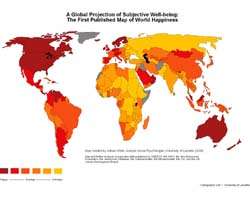
A University of Leicester psychologist has produced the first ever 'world map of happiness.'
Adrian White, an analytic social psychologist at the University’s School of Psychology, analysed data published by UNESCO, the CIA, the New Economics Foundation, the WHO, the Veenhoven Database, the Latinbarometer, the Afrobarometer, and the UNHDR, to create a global projection of subjective well-being: the first world map of happiness.
The projection, which is to be published in a psychology journal this September, will be presented at a conference later in the year. Participants in the various studies were asked questions related to happiness and satisfaction with life. The meta-analysis is based on the findings of over 100 different studies around the world, which questioned 80,000 people worldwide. For this study data has also been analysed in relation to health, wealth and access to education.
Whilst collecting data on subjective well-being is not an exact science, the measures used are very reliable in predicting health and welfare outcomes. It can be argued that whilst these measures are not perfect they are the best we have so far, and these are the measures that politicians are talking of using to measure the relative performance of each country.
The researchers have argued that regular testing as a collaboration between academics in different countries would enable us to track changes in happiness, and what events may cause that. For example what effect would a war, or famine, or national success have on a country's members' happiness. .
Adrian White said: “The concept of happiness, or satisfaction with life, is currently a major area of research in economics and psychology, most closely associated with new developments in positive psychology. It has also become a feature in the current political discourse in the UK.
"There is increasing political interest in using measures of happiness as a national indicator in conjunction with measures of wealth. A recent BBC survey found that 81% of the population think the Government should focus on making us happier rather than wealthier.
“It is worth remembering that the UK is doing relatively well in this area, coming 41st out of 178 nations.
"Further analysis showed that a nation's level of happiness was most closely associated with health levels (correlation of .62), followed by wealth (.52), and then provision of education (.51).
"The three predictor variables of health, wealth and education were also very closely associated with each other, illustrating the interdependence of these factors.
“There is a belief that capitalism leads to unhappy people. However, when people are asked if they are happy with their lives, people in countries with good healthcare, a higher GDP per captia, and access to education were much more likely to report being happy.
“We were surprised to see countries in Asia scoring so low, with China 82nd, Japan 90th and India 125th. These are countries that are thought as having a strong sense of collective identity which other researchers have associated with well-being.
"It is also notable that many of the largest countries in terms of population do quite badly. With China 82nd, India 125th and Russia 167th it is interesting to note that larger populations are not associated with happy countries."
“The frustrations of modern life, and the anxieties of the age, seem to be much less significant compared to the health, financial and educational needs in other parts of the World. The current concern with happiness levels in the UK may well be a case of the 'worried well'."
The 20 happiest nations in the World are:
1 - Denmark
2 - Switzerland
3 - Austria
4 - Iceland
5 - The Bahamas
6 - Finland
7 - Sweden
8 - Bhutan
9 - Brunei
10 - Canada
11 - Ireland
12 - Luxembourg
13 - Costa Rica
14 - Malta
15 - The Netherlands
16 - Antigua and Barbuda
17 - Malaysia
18 - New Zealand
19 - Norway
20 - The Seychelles
Other notable results include:
23 - USA
35 - Germany
41 - UK
62 - France
82 - China
90 - Japan
125 - India
167 - Russia
The three least happy countries were:
176 - Democratic Republic of the Congo
177 - Zimbabwe
178 - Burundi
Source: University of Leicester
-
New Cambridge study measures countries' well-being
Dec 22, 2011 |
5 / 5 (1) |
0
-
Q&A: Paul Ehrlich fears the worst for a planet with 7 billion residents
Oct 27, 2011 |
2 / 5 (4) |
4
-
'Happy' Bhutan alarmed by Himalayan climate change
Aug 24, 2011 |
3.7 / 5 (6) |
4
-
World survey links religion and happiness -- for some
Aug 09, 2011 |
3.5 / 5 (2) |
4
-
Study shows how we spend our time
Aug 01, 2011 |
2.5 / 5 (2) |
0
-
Engineers build first sub-10-nm carbon nanotube transistor
Feb 01, 2012 |
5 / 5 (21) |
19
-
Something old, something new: Evolution and the structural divergence of duplicate genes
Jan 31, 2012 |
4.6 / 5 (7) |
1
-
The hidden nanoworld of ice crystals: Revealing the dynamic behavior of quasi-liquid layers
Jan 30, 2012 |
5 / 5 (2) |
1
-
Stock market network reveals investor clustering
Jan 27, 2012 |
4.1 / 5 (21) |
8
-
Of microchemistry and molecules: Electronic microfluidic device synthesizes biocompatible probes
Jan 26, 2012 |
not rated yet |
0
-
Best/Worst U.S. Presidents
Jan 31, 2012
-
The authencity of Joan of Arc
Jan 06, 2012
- More from Physics Forums - History & Humanities
More news stories
Unlike Patriots, NFL slow to embrace 'Moneyball'
(AP) -- It's advice that sounds like heresy on the gridiron: Go for it on fourth down. Try more onside kicks. Running backs don't matter much.
8 hours ago |
not rated yet |
0
Media portrayal of race in sports reveals biases in corporate world
The U.S. may have its first black president and the Fortune 500 its first black female chief executive, but African American CEOs account for a mere one percent of the chiefs of those 500 largest companies.
Other Sciences / Economics & Business
10 hours ago |
not rated yet |
0
Firms' own social networks better for business than Facebook
(PhysOrg.com) -- Using Facebook and Twitter may be good for a company's bottom line, but firms can rake in even bigger profits if they have their own virtual brand community, says a University of Michigan ...
Other Sciences / Economics & Business
14 hours ago |
1 / 5 (1) |
0
Marriage therapist says high-conflict couples have work to do before saying 'I do'
(PhysOrg.com) -- A Kansas State University marriage therapist has Valentine's Day advice for couples contemplating commitments and engagement rings: Mix romance with a generous portion of reality.
Other Sciences / Social Sciences
13 hours ago |
not rated yet |
0
Class size matters to those who struggle most
Research shows that class size does matter; and that it matters most for socio-economically disadvantaged learners, the very groups that the Government says it is most concerned about, says Massey University Professor of ...
Other Sciences / Social Sciences
14 hours ago |
5 / 5 (1) |
0
Amazon fungi found that eat polyurethane, even without oxygen
(PhysOrg.com) -- Until now polyurethane has been considered non-biodegradable, but a group of students from Yale University in the US has found fungi that will not only eat and digest it, they will do so even in the absence ...
Scientists chart high-precision map of Milky Way's magnetic fields
(PhysOrg.com) -- Scientists at the Naval Research Laboratory (NRL) are part of an international team that has pooled their radio observations into a database, producing the highest precision map to date of ...
Whole exome sequencing identifies cause of metabolic disease
Sequencing a patient's entire genome to discover the source of his or her disease is not routine yet. But geneticists are getting close.
Hearing metaphors activates brain regions involved in sensory experience
When a friend tells you she had a rough day, do you feel sandpaper under your fingers? The brain may be replaying sensory experiences to help understand common metaphors, new research suggests.
Renowned physicist invents microscope that can peer at living brain cells
(PhysOrg.com) -- Ever since scientists began studying the brain, theyve wanted to get a better look at what was going on. Researchers have poked and prodded and looked at dead cells under electron microscopes, ...
New kind of high-temperature photonic crystal could someday power everything from smartphones to spacecraft
A team of MIT researchers has developed a way of making a high-temperature version of a kind of materials called photonic crystals, using metals such as tungsten or tantalum. The new materials which ...