Mice learn tasks that may help treat human psychiatric disorders
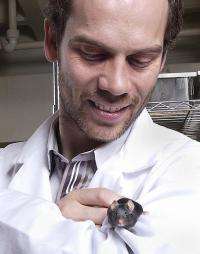
Mice that couldn't be dissuaded from the object of their attention by a piece of sweet, crunchy cereal may help researchers find new treatments and cures for human disorders like autism and Parkinson's disease.
For the first time, a psychiatric test for monitoring many human mental abnormalities has been adapted for use in mice, according to researchers at Purdue University, University of California-Davis and Justus-Liebig University in Giessen, Germany. The test involves the ability to switch attention from one task to another, a skill often impaired in people with autism and similar illnesses.
"Without a measure of cognitive deficit in mice that is relevant to such disorders in humans, research into new diagnostic methods, treatments and cures is severely hindered," said Joseph Garner, a Purdue assistant professor of animal sciences and the study's lead author. "The level of complexity at which we assess mouse behavior is often very rudimentary, and it just does not match up with subtleties of the cognitive deficits in human mental dysfunction or with the tools we use to study the mechanisms that underlie disorders in people."
Garner and his colleagues designed a task to measure a process called set shifting in which a focus on one object must be abandoned in favor of another object or task. This test long has been used to monitor brain processes involved in human psychiatric disorders and also has been tailored to a few other animals. However, researchers previously had not adapted it to the most-used of research mammals, the common laboratory mouse.
"Set shifting underlies our ability to use categories in day-to-day life and our ability to do many things including execute complex plans," Garner said.
Garner's team reports its findings in the journal Behavioural Brain Research, which is currently online.
Set shifting as an important neuropsychological skill applies to more human mental disorders than any other measure, Garner said. Mechanisms in the brain that enable people to shift their focus from one task to another also seem to be present in most other mammals and probably also in birds.
"Set shifting occurs when you've learned to pay attention to one thing and then need to concentrate on something different," he said. "For instance, I could ask you to name the suit on playing cards as I turn them over, and then I'd ask you to tell me the numbers on the next cards I turn over.
"But you might fail to tell me the numbers because you are continuing to pay attention to the previous set - the card suits. You've both learned to pay attention to the suits and that the numbers are irrelevant so you should ignore them."
Mice compose the majority of medical research animals, but since no test existed to monitor them for such skills as set shifting, their usefulness in studying autism, other similar diseases and traumatic brain injuries was limited, Garner said.
The Garner team's mice were tested in a maze with rewards of one-quarter of a piece of sweetened cereal hidden in two-inch diameter metal bowls. The scientists varied the material inside the bowls where the cereal piece was hidden and also varied the outer texture and smell of the bowls.
The rodents learned to find the cereal by using a cue such as the bowl's outer texture. After experience solving a number of tasks with this cue, the animals were given a new cue for finding the cereal, such as the bowl's smell.
"Like people performing a series of similar tasks over and over and then having to change their focus to a new problem, the mice continued to look for the bowl with the same outer texture to find the cereal," Garner said. "The more times they had used the bowl texture as a cue, the more difficult it was for the animals to change to the new food-finding cue."
Almost all people have a little difficulty set-shifting in a task like this, he said. However certain patient groups find it very difficult. Therefore, similar tests are used to measure brain function in people.
"The data collected in this study begin to solve the problem of not having a way of measuring these neurological mechanisms in mice," Garner said. "Previously we were not able to measure this fundamental disease process in autism, trichotillomania (hair pulling), obsessive-compulsive disorder, Parkinson's disease, schizophrenia, Tourette's syndrome, traumatic frontal brain lobe injury and a host of other human mental disorders for which set shifting is an important monitoring tool."
According to the Centers for Disease Control and Prevention (CDC), 3.4 per 1,000 children have autism or another autism spectrum disorder, making these disorders about as common as Type I juvenile diabetes. This rate is higher than for other childhood disabilities, including Down's syndrome, cancer, cerebral palsy, hearing loss and vision impairment.
Although the number of children diagnosed with autism has increased dramatically over the past 12 years, the upward spiral may be due to better, more widespread understanding and diagnosis of the mental impairment, CDC experts said. Trichotillomania, which affects 3.4 percent of women, and some other disorders are even more prevalent.
Source: Purdue University


