Three from MIT envision grow-your-own home
August 1, 2006 Three from MIT envision grow-your-own home

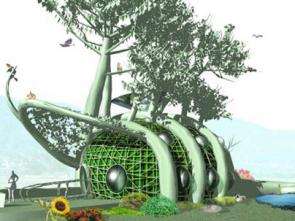
This artist's rendering shows the Fab Tree Hab, a home made of living plants. Photo / Mitchell Joachim, courtesy Technology Review

In the future, homeowners may grow their houses instead of building them. That's the vision of MIT architect Mitchell Joachim of the Media Lab's Smart Cities group.

He and his colleagues -- environmental engineer Lara Greden (S.M. 2001, Ph.D. 2005) and architect Javier Arbona-Homar (S.M. 2004) -- have conceived a home that doesn't just use "green" design but is itself a living ecosystem. They call it the Fab Tree Hab.

The basic framework of the house would be created using a gardening method known as pleaching, in which young trees are woven together into a shape such as an archway, lattice, or screen and then encouraged to maintain that form over the years.

As the framework matured -- which might take a few years in tropical climates and several decades in more temperate locations -- the home grower would weave a dense layer of protective vines onto the exterior walls. Any gaps could be filled in with soil and growing plants to create miniature gardens. On the interior walls, a mixture of clay and straw beneath a final layer of smooth clay would provide insulation and block moisture. On south-facing walls, windows made of soy-based plastics would absorb warmth in the winter; ground-floor windows on the shady side could draw in cool breezes during hot months. Water collected on the roof would flow through the house for use by people and plants; wastewater would be purified in an outdoor pond with bacteria, fish and plants that consume organic waste.

"The concept of a living house is really incredibly exciting when you think that people in tropical and semitropical locations have fast-growing trees available," said Richard Reames, an Oregon-based "arborsculptor" who uses grafting techniques to grow living furniture.

For now, Joachim is working on MATscape, a house project in California incorporating about half recycled materials and half living materials, such as grasses, plants and soil. But Joachim and his team hope to plan a Fab Tree Hab community someday, creating homes that don't interrupt the surrounding ecosystem but become integrated with it. "Design intervention only guides the growth," he said. "Nature -- life -- does the rest."

Source: MIT


print this article email this article download pdf blog this article bookmark this article     Stumble it Digg this share on Facebook retweet share on Reddit add to delicious
Rate this story - 4.2 /5 (55 votes)


August 1, 2006 all stories

Comments: 0

4.2 /5 (55 votes)
  • Stumble this up

  • Digg this

  • share this

  • hide
  • Related Stories


  • hide
  • Relevant PhysicsForums posts

Other News

70 million-year-old dinosaur footprints have been found in various locations in New Zealand

Dinosaur prints found on NZealand's South Island

Other Sciences / Archaeology & Fossils

created 22 hours ago | popularity 4 / 5 (2) | comments 0

Scientists have discovered the first evidence that dinosaurs roamed the South Island of New Zealand with 70-million-year-old footprints found in six locations.


Growth in secular attitudes leaves Americans room for belief in God

Other Sciences / Social Sciences

created Oct 31, 2009 | popularity 4 / 5 (5) | comments 111

(PhysOrg.com) -- The nature of the American religious experience is changing as a rising number of people report having no formal religious affiliation, even though the number of Americans who say they pray is increasing, ...


Forest clearances sealed ancient civilisation's downfall

Forest clearances sealed ancient civilisation's downfall

Other Sciences / Archaeology & Fossils

created Nov 02, 2009 | popularity 4.9 / 5 (8) | comments 5

(PhysOrg.com) -- An ancient South American civilisation which disappeared around 1,500 years ago helped to cause its own demise by damaging the fragile ecosystem that held it in place, a study has found. ...


Oscar Pistorius

New study further disputes notion that amputee runners gain advantage from protheses

Other Sciences / Other

created Nov 04, 2009 | popularity 5 / 5 (4) | comments 5

A study by six researchers, including a University of Colorado at Boulder associate professor and his former doctoral student, shows that amputees who use running-specific prosthetic legs have no performance ...


New theory on fairness in economics targets CEO pay

Other Sciences / Economics

created Nov 03, 2009 | popularity 4.3 / 5 (11) | comments 2

(PhysOrg.com) -- Chief executives in 35 of the top Fortune 500 companies were overpaid by about 129 times their "ideal salaries" in 2008, according to a new type of theoretical analysis proposed by a Purdue University researcher ...