New Report Says Human Tampering Threatens Planet's Life-Sustaining Surface
August 1, 2006
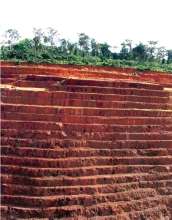
Some areas of the Earth's critical zone include deep layers of soil that represent millions of years of erosion and new earth formation. Scientists say they need to better understand this and other processes to sustain food production. Credit: Bill Deitrich, University of California-Berkeley
In a report released today, scientists call for a new systematic study of the Earth's "critical zone"--the life-sustaining outermost surface of the planet, from the vegetation canopy to groundwater and everything in between.Understanding and predicting responses to global and regional change is necessary, they say, to mitigate the impacts of humans on complex ecosystems and ultimately sustain food production.
"Development is having a great effect on the critical zone," said soil scientist Donald Sparks of the University of Delaware and co-chair of the NSF workshop that led to the report, entitled Frontiers in Exploration of the Critical Zone. "Converting some of the best land around the world into buildings, roads and concrete has implications for air and water quality and biodiversity, and over time could put pressure on our ability to produce food.
Critical zone sites include an extraordinary diversity of soils and ecosystems ranging from the tropics to the poles, from deserts to wetlands, and from rock-bound uplands to delta sediments.
"Because the critical zone includes air, water and soil and is the focal point of food production, it has a major effect on human life," Sparks said. "It is imperative that we better understand the interactions that occur there."
The report calls for an international Critical Zone Exploration Network, as well as a systematic approach across a broad array of sciences--including geology, soil science, biology, ecology, chemistry, geochemistry, geomorphology and hydrology--to study critical-zone processes.
"We need to understand how living organisms interact with the solid earth at the scale of a billionth-of-a-meter as well as the scale of landscapes, how these effects have changed over geologic time, and how they will change into the future as humans continue to drastically alter the earth's surface," said Sue Brantley, a Penn State University geoscientist who co-chaired the workshop.
Scientists need to determine "how the physical, chemical and biological components of Earth's weathering transforms mineral and organic matter, sculpts terrestrial landscapes, and controls the exchange of greenhouse gases and dust with the global atmosphere," said Enriqueta Barrera, program director in the National Science Foundation's Division of Earth Sciences, which funded the workshop that led to the report.
Scientists believe four key questions surround activity of the atmosphere, landforms, ecosystems and water.
• What processes control fluxes of carbon, particulate and reactive gases in the atmosphere?
• How do variations in, and changes to, chemical and physical weathering processes impact the critical zone?
• How do weathering processes nourish ecosystems?
• How do biogeochemical processes govern long-term sustainability of water and soil resources?
Funding for the critical zone workshop and associated activities was provided by grants from NSF's Division of Earth Sciences to the University of Delaware and Penn State, and by the NSF Experimental Program to Stimulate Competitive Research (EPSCoR) program in Delaware.
Source: NSF
-
Engineers build first sub-10-nm carbon nanotube transistor
Feb 01, 2012 |
4.9 / 5 (31) |
30
-
Something old, something new: Evolution and the structural divergence of duplicate genes
Jan 31, 2012 |
4.6 / 5 (7) |
1
-
The hidden nanoworld of ice crystals: Revealing the dynamic behavior of quasi-liquid layers
Jan 30, 2012 |
5 / 5 (3) |
1
-
Stock market network reveals investor clustering
Jan 27, 2012 |
3.9 / 5 (23) |
8
-
Of microchemistry and molecules: Electronic microfluidic device synthesizes biocompatible probes
Jan 26, 2012 |
5 / 5 (1) |
0
-
Do some geologists actually act a lot like Randy Marsh?
19 hours ago
-
Discrepancy between oxygen and carbon-dioxide levels
Feb 09, 2012
-
where gems are found in the world
Feb 09, 2012
-
Wind Waves in Reservoir ~ Wind run-up and Wind set-up
Feb 08, 2012
-
Balance of oxygen in the atmosphere
Feb 01, 2012
-
The case for a methanol-based economy
Jan 30, 2012
- More from Physics Forums - Earth
More news stories
Europe stakes billion-dollar bet on new rocket
A pencil-slim rocket is scheduled to lift into space from South America on Monday, carrying a billion-dollar bet that Europe can grab a juicy slice of the market to place satellites in low orbit.
Space & Earth / Space Exploration
18 hours ago |
3.5 / 5 (2) |
0
Political leaders play key role in how worried Americans are by climate change: study
More than extreme weather events and the work of scientists, it is national political leaders who influence how much Americans worry about the threat of climate change, new research finds.
Feb 06, 2012 |
5 / 5 (6) |
72
NASA budget will axe Mars deal with Europe: scientists
US President Barack Obama's budget proposal to be submitted next week for 2013 will cut NASA's budget by 20 percent and eliminate a major partnership with Europe on Mars exploration, scientists said Thursday.
Space & Earth / Space Exploration
Feb 10, 2012 |
5 / 5 (3) |
48
Humans may have helped the decline of African rainforests 3000 years ago
(PhysOrg.com) -- Large areas of rainforests in Central Africa mysteriously disappeared over three thousand years ago, to be replaced by savannas. The prevailing theory has been that the cause was a change ...
High planetary tilt lowers odds for life?
Highly-tilted worlds would have extreme seasons, subjecting life to alternating periods of scorching and subzero temperatures. This could make the development of all but hardiest, simplest creatures a long ...
Space & Earth / Space Exploration
Feb 06, 2012 |
4.8 / 5 (12) |
14
|
Walney offshore wind farm is world's biggest (for now)
(PhysOrg.com) -- The Walney wind farm on the Irish Sea--characterized by high tides, waves and windy weather--officially opened this week. The farm is treated in the press as a very big deal as the Walney ...
GPS court ruling leaves US phone tracking unclear
A US Supreme Court decision requiring a warrant to place a GPS device on the car of a criminal suspect leaves unresolved the bigger issue of police tracking using mobile phones, legal experts say.
Europeans protest controversial Internet pact
Tens of thousands of people marched in protests in more than a dozen European cities Saturday against a controversial anti-online piracy pact that critics say could curtail Internet freedom.
Study finds that anti-diabetic medication can prevent the long-term effects of maternal obesity
In a study to be presented today at the Society for Maternal-Fetal Medicine's annual meeting, The Pregnancy Meeting, in Dallas, Texas, researchers will report findings that show that short therapy with the anti-diabetic medication ...
Netflix settlement trims 14 pct off 4Q earnings
(AP) -- Netflix pressed the rewind button on its fourth-quarter earnings after settling allegations that the video subscription service violated a consumer-privacy law.
Navy to begin tests on electromagnetic railgun prototype launcher
The Office of Naval Research (ONR)'s Electromagnetic (EM) Railgun program will take an important step forward in the coming weeks when the first industry railgun prototype launcher is tested at a facility ...