Forecast: Showers and Thunderstorms
August 1, 2006 Forecast: Showers and Thunderstorms

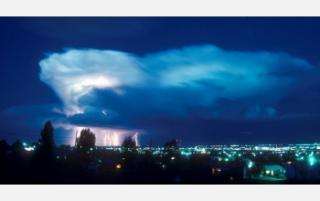
Measuring low-level moisture is expected to help forecasters pin down the location and timing of storms that might rage from a few minutes to a few hours later. Credit: University Corporation for Atmospheric Research

People planning baseball games, picnics, and other outdoor events may have more precise short-term forecasts of rainfall in the next few years, thanks to an observing strategy now being tested by atmospheric scientists at the National Center for Atmospheric Research (NCAR) in Boulder, Colo.

The effort, nicknamed REFRACTT (refractivity experiment for H2O research and collaborative operational technology transfer), is for the first time using multiple Doppler weather radars to track water vapor in the lower atmosphere. Measuring the low-level moisture is expected to help forecasters pin down the location and timing of storms that might rage a few minutes to a few hours later.

Along with the four radars, the project is using computer models, satellites, special launches of weather balloons known as radiosondes, and moisture sensors that intercept Global Positioning System (GPS) signals.

"REFRACTT extends the application of refraction of radio waves, and has the potential for completely transforming the accuracy of short-term weather forecasts," said Cliff Jacobs of NSF's Division of Atmospheric Sciences, which funded the project that began on June 5 and wraps up on Aug. 11.

Scientists are measuring how refraction--the bending of light as it passes through different substances, in this case, air and water--changes the speed of radar signals. That in turn reveals the presence or absence of atmospheric moisture.If it proves successful, the technique could be added in the next few years to the national network of Doppler radars operated by the National Weather Service (NWS), the researchers say.

"Nobody's ever seen such high-resolution data on moisture before. We believe this could greatly help forecasters predict where heavy rains might develop," said Rita Roberts, NCAR's lead scientist on REFRACTT.

Currently, NWS radars detect rainfall and winds but not water vapor.And because weather stations and weather-balloon launches are often separated by 50-100 miles or more, there is no regular monitoring of low-level moisture between surface stations. Strong contrasts in the amount of moisture often help to spawn intense storms, but the exact location of these differences is often hard to identify before storms develop.

When meteorologists use Doppler radar to track storms, they normally monitor signals that strike raindrops, hailstones, or snowflakes and bounce back toward the radar. The strength of the returning signals indicate the intensity of rain, hail, or snow, while the change in signal frequency reveals information about wind speed.

REFRACTT scientists are using fixed targets such as power lines and silos to see how much the radar signal is sped up or slowed down by variations in water vapor.

Forecasters at the Denver NWS office have used REFRACTT data this summer to monitor weather across northeast Colorado, including the risk of weak tornadoes that often spin up east of the Front Range.

Source: NSF


print this article email this article download pdf blog this article bookmark this article     Stumble it Digg this share on Facebook retweet share on Reddit add to delicious
Rate this story - 3.3 /5 (3 votes)


August 1, 2006 all stories

Comments: 0

3.3 /5 (3 votes)
  • Stumble this up

  • Digg this

  • share this

  • hide
  • Related Stories

  • This could be an awesome year for fall foliage, expert says
    created Sep 29, 2009 | popularity not rated yet | comments 0
  • Dry autumns and winters may lead to fewer tornadoes in the spring
    created Jun 24, 2009 | popularity not rated yet | comments 0
  • QuikScat Sees Santa Barbara 'Quick Dry'
    created May 12, 2009 | popularity not rated yet | comments 0
  • A glimpse of future GMES Sentinel-1 radar images
    created Apr 23, 2009 | popularity not rated yet | comments 0
  • Probing Question: Can humans control the weather?
    created Apr 16, 2009 | popularity not rated yet | comments 0


  • hide
  • Relevant PhysicsForums posts

  • Climate Science Update
    created 4 hours ago
  • The IPCC and the term "most"
    created Nov 23, 2009
  • Is global warming a fact?
    created Nov 23, 2009
  • Random variability of wind patterns
    created Nov 23, 2009
  • More from Physics Forums - Earth

Other News

Fermi Telescope Peers Deep into Microquasar

Fermi Telescope Peers Deep into Microquasar (w/ Video)

Space & Earth / Astronomy

created 53 minutes ago | popularity 5 / 5 (1) | comments 0

(PhysOrg.com) -- NASA's Fermi Gamma-ray Space Telescope has made the first unambiguous detection of high-energy gamma-rays from an enigmatic binary system known as Cygnus X-3. The system pairs a hot, massive ...


New radar helps monitor site of century-old tragedy

New radar helps monitor site of century-old tragedy

Space & Earth / Earth Sciences

created 1hour ago | popularity not rated yet | comments 0

(PhysOrg.com) -- A University of Alberta researcher has turned the site of a southern Alberta rockslide tragedy into the proving ground for new equipment meant to avert such a disaster in the future.


The Energy Sources of Ultraluminous Galaxies

The Energy Sources of Ultraluminous Galaxies

Space & Earth / Astronomy

created 1hour ago | popularity 5 / 5 (1) | comments 0

(PhysOrg.com) -- Ultraluminous infrared galaxies ((ULIRGs) are galaxies whose luminosity exceeds that of a trillion suns; for comparison, the Milky Way galaxy has a typical (and much more modest) luminosity ...


Space shuttle Atlantis, 7 astronauts back on Earth

Space & Earth / Space Exploration

created 2 hours ago | popularity not rated yet | comments 0

(AP) -- Space shuttle Atlantis and its seven astronauts returned to Earth with a smooth touchdown Friday to end an 11-day flight that resupplied the International Space Station.


China is set to launch its second moon orbiter next October, state media have reported

China to launch second lunar probe: state media

Space & Earth / Space Exploration

created 6 hours ago | popularity 5 / 5 (3) | comments 0

China will launch its second moon orbiter next October, state media reported Friday, as it powers ahead with a space programme that has sparked concerns abroad.