Search for Rare Particle Decay Comes Up Short
August 1, 2006 feature
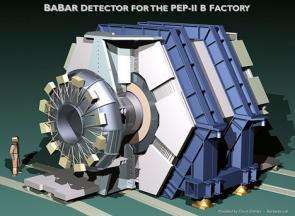
BaBar detector image

BaBar detector image. Credit: Berkeley Lab

Based on work performed at a large particle detector known as the BaBaR experiment, scientists announced recently that they do not see evidence to support theoretical predictions that an extremely rare particle decay — the decay of the neutral “B” particle into a negative “tau” particle and its antiparticle, the positive tau — occurs often enough to be measured.

The search was initiated based on additions to the “Standard Model,” the broad physics theory that describes fundamental particles, how they interact, and how they bind together to form composite particles. The B particle, for example, is a member of a class of composite particles known as “mesons,” which consist of one quark — the “building block” of all other particles — and one antiquark. The tau, a fundamental, non-composite particle, can be thought of as a very heavy electron.

The original Standard Model allows the B meson to decay into the tau pair, but at a rate so low as to be extremely difficult to measure. However, recent proposed extensions to the model predict that the decay should occur at a measurable rate, perhaps through the addition of unknown forces or particles. Enter the BaBaR experiment.

Located at the Stanford Linear Accelerator Center (SLAC) near Stanford University, BaBaR was built, ultimately, to determine why matter dominates the present-day universe, with very little antimatter leftover from the Big Bang. The detector is positioned around one section of a very large particle accelerator, where a beam of electrons and a beam of anti-electrons — i.e. positrons — are directed in opposite circular paths at nearly the speed of light by a large ring of very powerful magnets.

The collisions produce B and anti-B mesons, which in turn decay into a shower of other particles. These particles pass into the BABAR detector, which records their trajectories, energies, and electric charge. From this data, scientists in the BABAR collaboration (about 600 physicists from more than 70 institutions worldwide) can work backward to determine how the B mesons decay.

“Our results show, at the 90 percent confidence level, that this decay occurs so infrequently as to be undetectable by BaBar. Our result is important because of what we did not find, since this places limits of possible new physics beyond the Standard Model,” said the experiment’s spokesperson, SLAC physicist David MacFarlane, to PhysOrg.com.

BaBar physicists analyzed the collisions by calculating the “branching ratio” for this particular decay. In essence, the size of this number tells them how often the decay occurs versus other possible decay paths for the B meson. The branching ratio for the neutral B-to-tau/anti-tau decay was determined to be — at the largest — 0.0041.

This research was published in the June 23, 2006, online edition of Physical Review Letters.

On the Net: http://www.slac.st … .edu/BFROOT/

By Laura Mgrdichian, Copyright 2006 PhysOrg.com

4.3 /5 (25 votes)  

Rank 4.3 /5 (25 votes)
Tags

Relevant PhysicsForums posts
  • Strength of induced magnetic field inside an inductor
    created3 hours ago
  • increasing time of daylight
    created4 hours ago
  • Light & Sight
    created4 hours ago
  • Wind Turbine Power
    created7 hours ago
  • Steam Table issues
    created9 hours ago
  • electrostatic induction in a conductor should be immpossible
    created13 hours ago
  • More from Physics Forums - General Physics

More news stories

Putting the squeeze on planets outside our solar system

(PhysOrg.com) -- Using high-powered lasers, scientists at Lawrence Livermore National Laboratory and collaborators discovered that molten magnesium silicate undergoes a phase change in the liquid state, abruptly ...

Physics / Condensed Matter

created 3 hours ago | popularity 5 / 5 (1) | comments 0 | with audio podcast

Hovering not hard if you're top-heavy, researchers find

Top-heavy structures are more likely to maintain their balance while hovering in the air than are those that bear a lower center of gravity, researchers at New York University's Courant Institute of Mathematical Sciences ...

Physics / General Physics

created 4 hours ago | popularity 5 / 5 (1) | comments 1 | with audio podcast

SLAC, Stanford team focuses on high-energy electrons to treat cancer

Accelerator physicists at SLAC and cancer specialists from Stanford are working on a new technology that could dramatically reduce the time needed for cancer radiation treatments. The team ran an initial experiment ...

Physics / General Physics

created 7 hours ago | popularity 5 / 5 (1) | comments 0

Measurements from high-energy collisions lead to better understanding of why meson particles disappear

For several years, physicists at the Relativistic Heavy Ion Collider (RHIC) at Brookhaven National Laboratory (BNL), USA, have studied an unusual state of matter called the quark–gluon plasma, which they ...

Physics / General Physics

created 7 hours ago | popularity 5 / 5 (1) | comments 0

Quantum physicist explains $100K offer for proof scaled-up quantum computing is impossible

(PhysOrg.com) -- MIT researcher Scott Aaronson has certainly riled the physics community with his offer this past Friday, of $100,000 to anyone who can prove that scaled-up quantum computing is impossible. ...

Physics / Quantum Physics

created Feb 08, 2012 | popularity 4.1 / 5 (11) | comments 32 | with audio podcast weblog


Complex wiring of the nervous system may rely on a just a handful of genes and proteins

Researchers at the Salk Institute have discovered a startling feature of early brain development that helps to explain how complex neuron wiring patterns are programmed using just a handful of critical genes. ...

CIA website offline, Anonymous takes credit

The website of the Central Intelligence Agency was unresponsive on Friday after the hacker group Anonymous claimed to have knocked it offline.

Q&A: Obama and the birth control controversy

(AP) -- What birth control debate? A half-century after the introduction of the pill, acceptance of birth control by American women is virtually universal.

The power of estrogen -- male snakes attract other males

A new study has shown that boosting the estrogen levels of male garter snakes causes them to secrete the same pheromones that females use to attract suitors, and turned the males into just about the sexiest ...

New error-correcting codes guarantee the fastest possible rate of data transmission

Error-correcting codes are one of the triumphs of the digital age. They’re a way of encoding information so that it can be transmitted across a communication channel — such as an optical fiber o ...

Humans may have helped the decline of African rainforests 3000 years ago

(PhysOrg.com) -- Large areas of rainforests in Central Africa mysteriously disappeared over three thousand years ago, to be replaced by savannas. The prevailing theory has been that the cause was a change ...