Evidence of rapid evolution is found at the tips of chromosomes
August 2, 2006
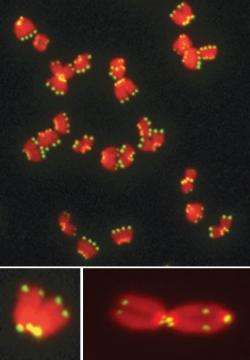
Chromosomes gone to POT. When the genes for the two POT proteins, POT1a and POT1b, are removed from mice, telomeres don’t function properly, frequently resulting in endoreduplication, when chromosomes are doubled at inappropriate times (left), and, more rarely, chromosome fusions (right).
In terms of their telomeres, mice are more complicated than humans. That’s the finding from a recent Rockefeller University study, which shows that mice have two proteins working together to do the job of a single protein in human cells. The findings, published recently in Cell, suggest that the protein complex that protects chromosome ends may have evolved far more rapidly than previously believed.
Acting as caps on the ends of each chromosome, telomeres are composed of repetitive DNA and shelterin, a protective protein complex. Titia de Lange’s lab has identified many of the components of shelterin and studies how its components work together to ensure that chromosome ends are not recognized as DNA breaks.
Previous work from the de Lange lab showed that TRF2, a shelterin protein that binds to the duplex part of the telomere, is crucial for telomere protection. Without TRF2, telomeres activate a DNA damage signal and are repaired by the same pathways that act on DNA breaks. TRF2 brings a second shelterin protein, POT1, to the telomeres. Because POT1 binds to single-stranded telomeric DNA present at the very end of the chromosomes, the de Lange lab asked how POT1 contributes to the protection of telomeres.
“We had previously removed TRF2 from mouse cells and seen many dramatic phenotypes,” says de Lange, “all of the telomeres ligate together; there is a massive DNA damage response and the cells basically die. We argued that if the function of TRF2 was to bring POT1 to the DNA, then we should observe the same phenotype if we removed POT1.”
To determine if this was the case, graduate student Dirk Hockemeyer, the first author of the paper, decided to remove the POT1 gene from mice. Humans have one POT1 gene, so de Lange and Hockemeyer were more than a bit surprised when they found two POT1 genes in the mouse genome. “Both genes are ubiquitously expressed and both are at telomeres,” says de Lange. “Nothing prepared us for the possibility that these two genes, which we called POT1a and POT1b, were doing different things at the telomere.”
But the mice showed that POT1a and POT1b did indeed serve different functions. Without POT1a, the cells showed a massive DNA damage response, which did not happen in cells missing POT1b. In contrast, cells without POT1b had strangely altered telomere structures, something that didn’t occur when POT1a was removed. “Wherever we looked, the two phenotypes were different,” de Lange says. “To make it more extreme, the POT1b knockout mouse was alive and well, but the POT1a knockout mouse was embryonic lethal at a very early stage.”
The other surprise came from the POT1a/b double knockout mouse. While it had a very strong DNA damage response, similar to cells missing TRF2, there was hardly any chromosome end fusion. This result led de Lange and Hockemeyer to realize that while POT1a and b are required for the protection of the telomeres from the DNA damage response, TRF2 is what is needed to protect against the repair pathway.
But this leaves an interesting dilemma for human telomere biology, which only has one POT1 gene. Does the human POT1 gene serve the functions of both POT1a and POT1b? How does the presence of the second POT1 protein affect the rest of the complex? “I’ve gone through hundreds of genes involved in chromosome biology and the genes from mouse to human are always there one to one,” says de Lange. “We know that the telomeric complex evolves rapidly, but I had no idea that it was this rapid, that even within the mammalian lineage you can see big changes in evolution. We will have to be very careful now how we use rodent systems, bearing in mind this difference and the possibility that there might be others.”
Citation: Cell 126: 63-77 (July 14, 2006)
Source: Rockefeller University
-
Two proteins found on telomeres control DNA damage response pathways
Aug 10, 2007 |
4.3 / 5 (27) |
0
-
Engineers build first sub-10-nm carbon nanotube transistor
Feb 01, 2012 |
4.9 / 5 (31) |
30
-
Something old, something new: Evolution and the structural divergence of duplicate genes
Jan 31, 2012 |
4.6 / 5 (7) |
1
-
The hidden nanoworld of ice crystals: Revealing the dynamic behavior of quasi-liquid layers
Jan 30, 2012 |
5 / 5 (3) |
1
-
Stock market network reveals investor clustering
Jan 27, 2012 |
3.9 / 5 (23) |
8
-
Of microchemistry and molecules: Electronic microfluidic device synthesizes biocompatible probes
Jan 26, 2012 |
5 / 5 (1) |
0
More news stories
Study finds that anti-diabetic medication can prevent the long-term effects of maternal obesity
In a study to be presented today at the Society for Maternal-Fetal Medicine's annual meeting, The Pregnancy Meeting, in Dallas, Texas, researchers will report findings that show that short therapy with the anti-diabetic medication ...
18 hours ago |
5 / 5 (1) |
1
FDA-approved drug rapidly clears amyloid from the brain, reverses Alzheimer's symptoms in mice
Neuroscientists at Case Western Reserve University School of Medicine have made a dramatic breakthrough in their efforts to find a cure for Alzheimer's disease. The researchers' findings, published in the journal Science, show t ...
Medicine & Health / Neuroscience
Feb 09, 2012 |
4.9 / 5 (51) |
20
|
Steroid injections prove effective in treatment of lumbar disc herniations
The use of epidural steroid injections may be a more efficient treatment option for lumbar disc herniations, according to research presented today at the American Orthopaedic Society for Sports Medicine's Specialty Day in ...
18 hours ago |
5 / 5 (1) |
0
Amateur football players not always keen on returning to play after ACL injuries
Despite the known success rates of reconstructive Anterior Cruciate Ligament (ACL) surgery, the number of high school and collegiate football players returning to play may not be as high as anticipated, say researchers presenting ...
18 hours ago |
not rated yet |
0
PRP treatment aids healing of elbow injuries say researchers
As elbow injuries continue to rise, especially in pitchers, procedures to help treat and get players back in the game quickly have been difficult to come by. However, a newer treatment called platelet rich plasma (PRP) may ...
18 hours ago |
5 / 5 (1) |
0
Walney offshore wind farm is world's biggest (for now)
(PhysOrg.com) -- The Walney wind farm on the Irish Sea--characterized by high tides, waves and windy weather--officially opened this week. The farm is treated in the press as a very big deal as the Walney ...
GPS court ruling leaves US phone tracking unclear
A US Supreme Court decision requiring a warrant to place a GPS device on the car of a criminal suspect leaves unresolved the bigger issue of police tracking using mobile phones, legal experts say.
Europeans protest controversial Internet pact
Tens of thousands of people marched in protests in more than a dozen European cities Saturday against a controversial anti-online piracy pact that critics say could curtail Internet freedom.
Europe stakes billion-dollar bet on new rocket
A pencil-slim rocket is scheduled to lift into space from South America on Monday, carrying a billion-dollar bet that Europe can grab a juicy slice of the market to place satellites in low orbit.
Netflix settlement trims 14 pct off 4Q earnings
(AP) -- Netflix pressed the rewind button on its fourth-quarter earnings after settling allegations that the video subscription service violated a consumer-privacy law.
Navy to begin tests on electromagnetic railgun prototype launcher
The Office of Naval Research (ONR)'s Electromagnetic (EM) Railgun program will take an important step forward in the coming weeks when the first industry railgun prototype launcher is tested at a facility ...