Researchers solve mystery of attractive surfaces
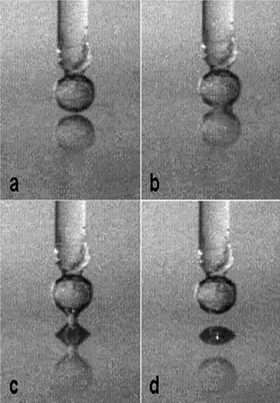
When smooth surfaces that hate water approach each other underwater, scientists have observed that they snap into contact. This is apparently due to attractive forces that extend for tens to hundreds of nanometers.
But action over these distances — though small to us — are unexplainable by conventional theories, which find no standard force sufficiently long-ranged to accomplish this task.
The action is of considerable possible importance. Long-range attractions between hydrophobic surfaces might help guide the complex folding of proteins, for example, from their initial passive clothesline-like shape into the active fist-like formations upon which life depends.
In a paper published this Thursday in the journal Nature, Sandia National Laboratories researchers were able to increase the long-ranged attraction from nanometers to microns by inserting rough hydrophobic surfaces in place of smooth ones. They also were able to slow the reaction down, enabling them to measure the attraction and visually observe its origin — a cavitation called a vapor bubble that bridges the gap between the submerged surfaces.
These experiments offer new insight into the long-range attractions that encourage hydrophobic surfaces to snap together under water. The improved observation led the group to conclude that cavitation may be responsible in general for the hydrophobic interactions that exceed the known range of van der Waals or electrostatic forces.
The new test conditions were effected, first, by using rough, so-called superhydrophobic surfaces rather than conventional smooth hydrophobic surfaces.
Superhydrophobic surfaces, on which water droplets roll like marbles, can be formed simply by evaporating liquid from a silica solution in an assembly process developed by Sandia Fellow Jeff Brinker.
The interactions of superhydrophobic materials underwater have not been studied.
“Previous experimentalists had always used smooth materials — but the common materials of nature are rough, and roughness greatly influences the interaction with water,” says Brinker.
In addition, a microscope that resists the ‘snap-together’ effect enabled the Sandia team to measure the forces involved as the surfaces closed upon each other.
The microscope, called an Interfacial Force Microscope, is similar to an Atomic Force Microscope, but a teeter-totter end piece allows the tip to maintain its distance and measure the forces acting on it rather than succumbing to them. The IFM was developed and patented under the direction of Sandia researcher Jack Houston and is now available at some universities.
Through IFM resistance, the group slowed the ‘snap’ into a longer time frame that allowed step-by-step observation of what exactly was happening in the formerly indecipherable moment.
“When force becomes overwhelming for an AFM, surfaces snap together uncontrollably,” says Houston. “The IFM just measures the force without caving in to it. We can move in as slowly as we want until we reach the point of contact.”
“There’s no other instrument that can do that,” says first author Seema Singh, who did the experimental work under direction of Brinker and Houston.
The group observed that two superhydrophobic surfaces approaching each other force the water between them to change state to a vapor, creating a cavity. This cavitation has less internal pressure, so external water pressure forces the two hydrophobic surfaces at each end of the cavity closer.
This very long-range attractive interaction may be a longer scale version of the unexplained interactions seen to-date for smooth surfaces.
The superhydrophobic material was self-assembled by simply drying a slurry of hydrophobically modified silica in a technique originally developed to create super low-density silica aerogels. During drying, the silica gel shrinks and re-expands to create a rough, rather than smooth, surface. The roughness creates a spike-like effect, causing a water drop to adopt an almost spherical shape.
“This greater hydrophobicity apparently increased the distance over which cavitation could occur, allowing it to be visually imaged for the first time,” says Sandia researcher Frank Van Swol, who calculated the theoretical cavitation distance and the energy and forces associated with cavitation.
Asked whether the observed reaction might offer some insight into the mechanisms by which proteins fold, Brinker said, “The only evidence so far for things snapping together comes from the measurements of interactions between flat smooth hydrophobic surfaces underwater. The longer-range interactions for rough surfaces may more closely represent how proteins fold, since proteins are certainly not flat surfaces.”
Rough superhydrophobic surfaces have been of much recent interest for their self-cleaning properties — the so-called Lotus effect, where rolling drops of water cleanse such surfaces of particles and parasites.
The work was sponsored by Sandia’s Laboratory-Directed Research and Development (LDRD) program, and then by DOE’s Office of Science and by the Air Force.
Source: Sandia National Laboratories


