Modern Technology Reveals Ancient Science
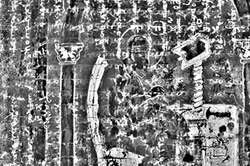
Finally, after more than 1000 years in obscurity, the last unreadable pages of the works of ancient mathematician Archimedes are being deciphered, thanks to the x-ray vision at the Department of Energy’s Stanford Linear Accelerator Center (SLAC). This discovery gives us the most complete record of Archimedes’ works since the middle ages.
A team of scientists used a special x-ray imaging technique, called x-ray fluorescence (XRF) imaging, to finally unlock these scientific secrets, hidden from view since antiquity on a goatskin parchment manuscript. The manuscript uniquely records several of the works of the legendary 3rd century B.C. mathematician, who famously exclaimed “Eureka!” upon discovering how to measure the volume of a solid while sitting in his bathtub. Archimedes’ work is considered to be the foundation of modern mathematics.
The text of the Archimedes Palimpsest presented a monumental challenge for imagers to reveal and scholars to decode. In the 10th century, an anonymous scribe copied Archimedes’ treatises in the original Greek onto the parchment. But three centuries later, a monk “palimpsested” the parchment: he scraped away the Archimedes text, cut the pages in half, turned them sideways, and copied Greek Orthodox prayers onto the recycled pages. Adding further injury, forgers in the early 20th century painted religious imagery on several pages in an attempt to elevate the manuscript’s value. The result was the near obliteration of Archimedes’ work, except for the faintest traces of ink still embedded in the parchment.
In 1998, this unique manuscript was purchased by an anonymous collector at international auction, who then entrusted it to the care of The Walters Art Museum in Baltimore, Md., for conservation and study. Using modern imaging techniques that rely on visible and ultraviolet light, the faint traces of remaining original ink yielded up most of the hidden text and brought to light stunning discoveries about Archimedes.
But certain pages resisted even the most intensive attempts at deciphering. Paint and stains completely obscured a few remaining parts of the original text, making it impossible to read using multispectral imaging. It was here that the intense x-ray beam produced at SLAC’s Stanford Synchrotron Radiation Laboratory (SSRL) proved invaluable. The x-rays pass right through the grime and paint, like a child’s magic pen that reveals invisible ink.
“We’re getting a vastly better understanding of one of the greatest minds of all times,” said SSRL scientist Uwe Bergmann. “We are also showing it is possible to read completely hidden texts in ancient documents without harming them.”
In March of this year, experiments at SSRL revealed a previously indecipherable page of Archimedes' On Floating Bodies for the first time. The same experiments also brought to light the identity of the priest who erased the Archimedes texts. His name was Johannes Myronas, and he finished transcribing the prayers on April 14, 1229 in Jerusalem.
“We have already discovered an astonishing amount of new information using x-ray fluorescence, and eagerly hope for more,” said William Noel of The Walters Art Museum and director of the Archimedes Palimpsest collaboration.
For 11 days, from July 28 to August 7, 2006, a team of academics—x-ray scientists, rare document conservators and scholars of ancient mathematics—will return to the experimental station at SLAC, scrutinizing more of the ancient Greek characters, unseen for centuries, scrolling across computer screens as the x-ray beam carefully scans the parchment. The team will pay special attention to seeing through the forged gold paintings that coat several pages, including previously unread sections of Archimedes’ greatest treatise, The Method.
To learn more about the Archimedes Palimpsest Project, go to www.archimedespalimpsest.org
Source: Stanford Linear Accelerator Center


