New System Provides Power, Water, Refrigeration from One Source
August 2, 2006
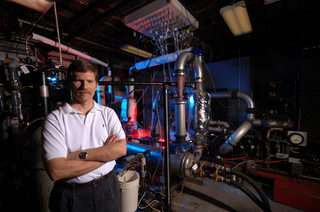
Bill Lear, a UF associate professor of mechanical and aerospace engineering, stands in front of a prototype system that provides power, water and refrigeration on July 28, 2006. The system, which is intended to be compact enough to fit inside a military jet or large truck, is designed for use in war zones, hurricanes or other emergencies. The U.S. Army provided research grant funds to develop the system, which the University of Florida is in the process of patenting. Credit: Kristen Bartlett/University of Florida
When hurricanes, wars or other emergencies force authorities to respond, three essentials top their list of must-haves: water, electricity and refrigeration.
Now, in a project funded by the U.S. Army, two University of Florida engineers have designed, built and successfully tested a combined power-refrigeration system that can provide all three – and, with further development, be made compact enough to fit inside a military jet or large truck.
“If you’re in a forward base in Iraq, it costs you the same per gallon of water as it does per gallon of fuel,” said William Lear, a UF associate professor of mechanical and aerospace engineering. “It would be better to just have to send fuel out there, especially if you could get refrigeration and water out of it – which is what our system achieves.”
Lear and UF mechanical engineering professor S.A. Sherif have published several academic papers on various aspects of the system, which is being patented by UF. In November, they will present a paper discussing the system’s experimental results at the International Mechanical Engineering Congress & Exposition in Chicago.
Both the Federal Emergency Management Agency and the military now rely on large generators to produce electricity in hazard zones. For cooling, they either haul in ice or electricity-hogging refrigerators. Depending on the location and emergency, imported fresh water may be another major logistical challenge and expense.
Hoping to cut costs and simplify the process, the Army has provided a $750,000 grant to a small Gainesville company funding Lear and Sherif’s research on an alternative.
The engineering researchers’ solution: a small system that ties a novel gas turbine power plant to a heat-operated refrigeration system. The refrigeration makes the gas turbine more efficient, while also producing cool air and potable water. The turbine can run on conventional fossil fuels as well as biomass-produced fuels or hydrogen.
Lear said gas turbines are a common power generator used in everything from jet engines to electricity plants. The problem with traditional versions is that they lose efficiency both when not operated at full power and in warm temperatures, he said.
Seeking to erase this loss, he rerouted the path of gases passing through the turbine, cooling them via heat exchangers. Sherif, an expert in refrigeration, then tied the system to absorption units, cooling the gases still more.
Users can either tap all the cooling power to obtain peak efficiency for the turbine, or divert some for refrigeration or air conditioning. “You can decide how much of one you want versus how much of the other, depending on your needs,” Sherif said.
Lear said his experiments and computer models suggest that with all the cooling devoted to the turbine, it will be 5 percent to 8 percent more efficient than traditional turbines. With some cooling siphoned for other purposes, it was still 3 percent to 5 percent more efficient than the turbines. Contrasting traditional gas turbines, the system maintains its efficiency whether operated at peak or partial power.
A few percentage points might not seem like much, but it makes a big difference when fuel is scarce or expensive, particularly if refrigeration and water are added bonuses, Lear said. “Power companies would kill for a 1 percent gain,” he said.
The system, which makes water by condensing the turbine’s combustion gases, is capable of producing about one gallon of water for every gallon of fuel burned, Sherif said. The water would need to be treated to be potable, but even if untreated it could be used for cleaning or other purposes. Because the plant reuses gases so extensively, the power plant also has very low polluting emissions, Lear added.
Sherif, Lear and colleagues have built a working prototype of the plant for experiment and testing purposes. Housed in an engineering college laboratory, it appears at first as a maze of tubes and pipes reminiscent of a Dr. Seuss drawing. But a closer inspection reveals a carefully designed “flow pattern” routing gases through and around a small gas turbine, with dozens of electronic and pneumatic monitoring probes. Operators run the test plant from an adjacent control room.
Lear said further research is required to make the plant more compact and otherwise enhance its performance. That’s one of the goals of the Army’s Small Business Innovation Research Grant to the Gainesville company, Triad Research. He added that larger versions could be used in fixed locations as part of the normal power grid. For example, utilities could build the plant nearby a grocery store warehouse that required both electricity and cooling.
Source: University of Florida
-
U.S. to lease waters off Mid-Atlantic for wind farms
Feb 07, 2012 |
1 / 5 (1) |
1
-
Study of Maryland demonstrates Mid-Atlantic offshore wind capacity
Jan 30, 2012 |
5 / 5 (3) |
7
-
Scorpions inspire scientists in making tougher surfaces for machinery
Jan 25, 2012 |
4.6 / 5 (8) |
3
-
Project to pour water into volcano to make power
Jan 14, 2012 |
3.5 / 5 (18) |
27
-
NREL helping Virgin Islands cut fuel use
Jan 12, 2012 |
not rated yet |
0
-
Engineers build first sub-10-nm carbon nanotube transistor
Feb 01, 2012 |
4.9 / 5 (31) |
30
-
Something old, something new: Evolution and the structural divergence of duplicate genes
Jan 31, 2012 |
4.6 / 5 (7) |
1
-
The hidden nanoworld of ice crystals: Revealing the dynamic behavior of quasi-liquid layers
Jan 30, 2012 |
5 / 5 (3) |
1
-
Stock market network reveals investor clustering
Jan 27, 2012 |
3.9 / 5 (23) |
8
-
Of microchemistry and molecules: Electronic microfluidic device synthesizes biocompatible probes
Jan 26, 2012 |
5 / 5 (1) |
0
-
Need help reading 3-D
5 hours ago
-
A way to send and receive wireless data
11 hours ago
-
Tabletop Cold Fusion Reactor
13 hours ago
-
Calling function with no input argument
Feb 10, 2012
-
Force free body diagram problem on gym equipment
Feb 10, 2012
-
Empirical data regarding shower heads and water
Feb 10, 2012
- More from Physics Forums - General Engineering
More news stories
Walney offshore wind farm is world's biggest (for now)
(PhysOrg.com) -- The Walney wind farm on the Irish Sea--characterized by high tides, waves and windy weather--officially opened this week. The farm is treated in the press as a very big deal as the Walney ...
GPS court ruling leaves US phone tracking unclear
A US Supreme Court decision requiring a warrant to place a GPS device on the car of a criminal suspect leaves unresolved the bigger issue of police tracking using mobile phones, legal experts say.
15 hours ago |
4 / 5 (2) |
0
Europeans protest controversial Internet pact
Tens of thousands of people marched in protests in more than a dozen European cities Saturday against a controversial anti-online piracy pact that critics say could curtail Internet freedom.
11 hours ago |
5 / 5 (6) |
0
Netflix settlement trims 14 pct off 4Q earnings
(AP) -- Netflix pressed the rewind button on its fourth-quarter earnings after settling allegations that the video subscription service violated a consumer-privacy law.
15 hours ago |
not rated yet |
0
Navy to begin tests on electromagnetic railgun prototype launcher
The Office of Naval Research (ONR)'s Electromagnetic (EM) Railgun program will take an important step forward in the coming weeks when the first industry railgun prototype launcher is tested at a facility ...
Feb 06, 2012 |
4.7 / 5 (15) |
91
|
Europe stakes billion-dollar bet on new rocket
A pencil-slim rocket is scheduled to lift into space from South America on Monday, carrying a billion-dollar bet that Europe can grab a juicy slice of the market to place satellites in low orbit.
Study finds that anti-diabetic medication can prevent the long-term effects of maternal obesity
In a study to be presented today at the Society for Maternal-Fetal Medicine's annual meeting, The Pregnancy Meeting, in Dallas, Texas, researchers will report findings that show that short therapy with the anti-diabetic medication ...
Steroid injections prove effective in treatment of lumbar disc herniations
The use of epidural steroid injections may be a more efficient treatment option for lumbar disc herniations, according to research presented today at the American Orthopaedic Society for Sports Medicine's Specialty Day in ...
Amateur football players not always keen on returning to play after ACL injuries
Despite the known success rates of reconstructive Anterior Cruciate Ligament (ACL) surgery, the number of high school and collegiate football players returning to play may not be as high as anticipated, say researchers presenting ...
Explained: Sigma
It's a question that arises with virtually every major new finding in science or medicine: What makes a result reliable enough to be taken seriously? The answer has to do with statistical significance -- but ...
Political leaders play key role in how worried Americans are by climate change: study
More than extreme weather events and the work of scientists, it is national political leaders who influence how much Americans worry about the threat of climate change, new research finds.