Scientists develop artwork that changes to suit your mood
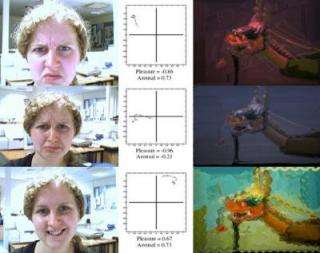
Computer scientists from Bath and Boston have developed electronic artwork that changes to match the mood of the person who is looking at it. Using images collected through a web cam, special software recognises eight key facial features that characterise the emotional state of the person viewing the artwork.
It then adapts the colours and brush strokes of the digital artwork to suit the changing mood of the viewer.
For example, when the viewer is angry the colours are dark and appear to have been applied to the canvas with more violent brush strokes.
If their expression changes to happy, the artwork adapts so that the colours are vibrant and more subtly applied.
The project forms part of on-going research looking to develop a range of advanced artwork tools for use in the computer graphics industry.
This has already resulted in software which produces highly-detailed artistic versions of photographs, and allows designers to create animations directly from digital footage.
"The programme analyses the image for eight facial expressions, such as the position and shape of the mouth, the openness of the eyes, and the angle of the brows, to work out the emotional state of the viewer," said Dr John Collomosse from the Department of Computer Science at the University of Bath.
"It does all of this in real time, meaning that as the viewer's emotions change the artwork responds accordingly.
"This results in a digital canvas that smoothly varies its colours and style, and provides a novel interactive artistic experience.
"This kind of empathic painting only needs a desk top computer and a webcam to work, so once you have the programme and have calibrated it for the individual viewer, you are ready to start creating personalised art based on your mood.
"The empathic painting is really an experiment into the feasibility of using high level control parameters, such as emotional state, to replace the many low-level tools that users currently have at their disposal to affect the output of artistic rendering."
The empathic painting project was carried out with Maria Shugrina and Margrit Betke from the University of Boston.
The images used in the project were created by the researchers using advanced artistic rendering techniques which give the computer-generated artwork the appearance of having been painted onto canvas.
More information on the empathic painting project, including a video demonstration, is available at: www.cs.bath.ac.uk/~vision/empaint/
Source: University of Bath


