Sequencing the Genome of a New Kind of Methane Producer
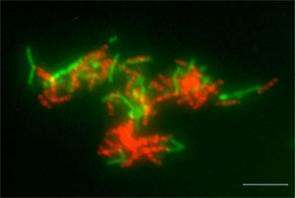
About 10 to 25 percent of the world's methane emissions come from flooded rice paddies. Methane is a greenhouse gas produced by various groups of microorganisms (methanogenic Archaea). Oxygen is usually highly toxic for these microorganisms. The major producer of methane in the roots of rice plants is what is known as "Rice Cluster I" (RC-I) Archaea.
The mechanisms that give these Archaea a competitive advantage remained unexplained, because it was impossible to get a pure culture of them. Now, scientists from the Max Planck Institute for Terrestrial Microbiology in Marburg, Germany and the Max Planck Institute for Molecular Genetics in Berlin have fully sequenced the genome of an RC-I archaeon from a methane-producing microbial mixed culture. From the genome sequence, the researchers were able to deduce the existence of a number of enzymatic mechanisms, unknown in methanogenic Archaea until now. The mechanisms help the RC-I Archaea to survive when oxygen is present. They allow the RC-I Archaea to adapt specifically to the oxygen-rich area around the roots of the rice plant. The results explain why RC-I Archaea have a selective survival advantage (Science, July 21, 2006).
In the current study, Max Planck researchers from Marburg and Berlin investigated the complete genome sequence of an RC-I archaeon that appears frequently in the mixed culture MRE50. As a rule, the starting point for analysis of a complete microbial genome is a pure culture - and its corresponding homogeneous component of genetic information. But in the case of RC-I Archaea, no pure culture was available.
So all the genetic information of the mixed culture MRE 50 served as the starting point for sequencing the complete RC-I genome. Such heterogeneous genetic information, stemming from various microorganisms in the mixed culture, is called a metagenome. One particular analytical challenge was filtering out the complete, homogeneous genome of a defined RC-I archaeon from the metagenome. The researchers were able to do this using a specific bio-informatics analytical methodology.
The genome of the RC-I archaeon is made from 3.2 million base pairs, and codes for 3,103 proteins. The proteins can, among other things, be organized according to their methanogenic metabolism - that is, how they create methane simply by reducing carbon dioxide with hydrogen. Enzymes for the analysis of alternative methanogenic nutrients are not encoded by the RC-I genome. The RC-I archaeon can thus be categorised as hydrogenotroph Methanogenic Archaea can only produce methane, and the energy that comes from it, when oxygen is completely absent. The presence of oxygen is normally very hostile to them.
However, this is not the case for RC-I Archaea - the RC-I genome codes for enzymatic mechanisms which are unique for methanogenic Archaea and make it possible for them to survive in an oxygenated environment. A whole group of enzymes belongs to this mechanism. These enzymes quickly detoxify highly reactive oxygen species, such as superoxide anion or hydrogen peroxide. These oxygen species are extremely toxic for living cells. When oxygen is present, RC-I Archaea quickly switch to a zymoma fermentative.
Sequencing the RC-I genome offers the groundwork for developing a means of monitoring the activity of RC-I Archaea in their natural environments, using molecular biological methods. It is uncertain, however, how long it will take before we can actually reduce the methane production of RC-I Archaea - and methane emissions from places like rice paddies.
Citation: Christoph Erkel, Michael Kube, Richard Reinhardt, Werner Liesack
Genome of Rice Cluster I Archaea - the Key Methane Producers in the Rice Rhizosphere
Science, July 21, 2006
Source: Max-Planck-Institute


