IBM researchers look beyond silicon technology
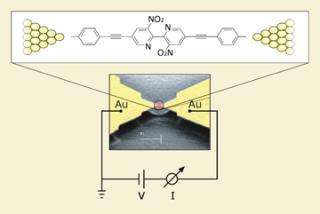
Scientists at the IBM Zurich Research Laboratory have demonstrated how a single molecule can be switched between two distinct conductive states, which allows it to store data.
As published in SMALL, these experiments show that certain types of molecules reveal intrinsic molecular functionalities that are comparable to devices used in today's semiconductor technology. This finding is yet another promising result to emerge from IBM's research labs in their efforts to explore and develop novel technologies for the post-CMOS era.
In the August 4 issue of SMALL, IBM researchers Heike Riel and Emanuel Lörtscher report on a single-molecule switch and memory element. Using a sophisticated mechanical method, they were able to establish electrical contact with an individual molecule to demonstrate reversible and controllable switching between two distinct conductive states. This investigation is part of their work to explore and characterize molecules to become possible building blocks for future memory and logic applications. With dimensions of a single molecule on the order of one nanometer (one millionth of a millimeter), molecular electronics redefines the ultimate limit of miniaturization far beyond that of today's silicon-based technology.
The results show that these molecules exhibit properties that can be utilized to perform the same logic operations as used in today's information technology. Namely, by applying voltage pulses to the molecule, it can be controllably switched between two distinct "on" and "off" states. These correspond to the "0" and "1" states on which data storage is based. Moreover, both conductive states are stable and enable non-destructive read-out of the bit state—a prerequisite for nonvolatile memory operation—which the IBM researchers demonstrated by performing repeated write-read-erase-read cycles. With this single-molecule memory element, Riel and Lörtscher have documented more than 500 switching cycles and switching times in the microsecond range.

Crucial for investigating the inherent properties of molecules is the ability to deal with them individually. To do this, Riel and Lörtscher extended a method called the mechanically controllable break-junction (MCBJ). With this technique, a metallic bridge on an insulating substrate is carefully stretched by mechanical bending. Ultimately the bridge breaks, creating two separate electrodes that possess atomic-sized tips. The gap between the electrodes can be controlled with picometer (one thousandth of a nanometer) accuracy due to the very high transmission ratio of the bending mechanism. In a next step, a solution of the organic molecules is deposited on top of the electrodes. As the junction closes, a molecule capable of chemically bonding to both metallic electrodes can bridge the gap. In this way, an individual molecule is "caught" between the electrodes, and measurements can be performed.
The molecules investigated are specially designed organic molecules measuring only about 1.5 nanometers in length, approximately one hundredth of a state-of-the-art CMOS element. The molecule was designed and synthesized by Professor James M. Tour and co-workers of Rice University, Houston, USA.
"The main advantage of exploiting transport capabilities at the molecular scale is that the fundamental building blocks are much smaller than today's CMOS elements," explains lead researcher Heike Riel of the IBM Zurich Lab. "Furthermore, chemical synthesis produces completely identical molecules, which, in principle, are building blocks with no variability. This allows us to avoid a known problem that CMOS devices face as they are scaled to ever smaller dimensions. In addition, we hope to discover possibly novel, yet unknown properties that silicon and related materials do not have."
Promising nanotechnologies for the post-CMOS era
The single-molecule switch is the most recent success in a series of groundbreaking results achieved by IBM researchers in their efforts to explore and develop novel technologies that will surpass conventional CMOS technology. Miniaturizing the basic building blocks of microprocessors, thereby achieving more functionality on the same area, is also referred to as scaling, which is the main principle driving the semiconductor industry. Known as "Moore's Law", which states that the transistor density of semiconductor chips will double roughly every 18 months, this principle has governed the chip industry for the past 40 years. The result has been the most dramatic and unequaled increase in performance ever known.
However, CMOS technology will reach its ultimate limits in 10 to 15 years. As chip structures, which currently have dimensions of about 40 nm, continue to shrink below the 20 nm mark, ever more complex challenges arise and scaling appears not to be economically feasible any more. And below 10 nm, the fundamental physical limits of CMOS technology will be reached. Therefore, novel concepts are needed.
In order to enhance computing performance beyond that of CMOS, fundamentally different device concepts and architectures are being investigated at IBM. Among the technologies closest to realization are carbon nanotubes and semiconducting nanowires. Further research is also being conducted in the field of spintronics. By introducing this single-molecule memory element, IBM researchers have demonstrated that molecular electronics is also a valid post-CMOS candidate and made another big leap toward reaching the ultimate limits in miniaturization.
The scientific paper entitled "Reversible and Controllable Switching of a Single-Molecule Junction" by E. Lörtscher, J. W. Ciszek, J. Tour, and H. Riel, was published in Small, Volume 2, Issue 8-9 , pp. 973-977 (04 August 2006).
Source: IBM


