Quantum dots that produce white light could be the light bulb's successor
Take an LED that produces intense, blue light. Coat it with a thin layer of special microscopic beads called quantum dots. And you have what could become the successor to the venerable light bulb.
The resulting hybrid LED gives off a warm white light with a slightly yellow cast, similar to that of the incandescent lamp.
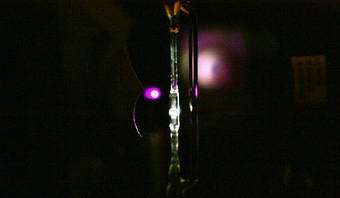
Image above: Magic-sized quantum dots in a glass flow tube produce white light when stimulated by an ultraviolet laser beam. Photo by Daniel Dubois
Until now quantum dots have been known primarily for their ability to produce a dozen different distinct colors of light simply by varying the size of the individual nanocrystals: a capability particularly suited to fluorescent labeling in biomedical applications. But chemists at Vanderbilt University discovered a way to make quantum dots spontaneously produce broad-spectrum white light. The report of their discovery, which happened by accident, appears in the communication “White-light Emission from Magic-Sized Cadmium Selenide Nanocrystals” published online October 18 by the Journal of the American Chemical Society.
In the last few years, LEDs (short for light emitting diodes) have begun replacing incandescent and fluorescent lights in a number of niche applications. Although these solid-state lights have been used for decades in consumer electronics, recent technological advances have allowed them to spread into areas like architectural lighting, traffic lights, flashlights and reading lights. Although they are considerably more expensive than ordinary lights, they are capable of producing about twice as much light per watt as incandescent bulbs; they last up to 50,000 hours or 50 times as long as a 60-watt bulb; and, they are very tough and hard to break. Because they are made in a fashion similar to computer chips, the cost of LEDs has been dropping steadily. The Department of Energy has estimated that LED lighting could reduce U.S. energy consumption for lighting by 29 percent by 2025, saving the nation’s households about $125 million in the process.
Until 1993 LEDs could only produce red, green and yellow light. But then Nichia Chemical of Japan figured out how to produce blue LEDs. By combining blue LEDs with red and green LEDs – or adding a yellow phosphor to blue LEDs – manufacturers were able create white light, which opened up a number of new applications. However, these LEDs tend to produce white light with a cool, bluish tinge.
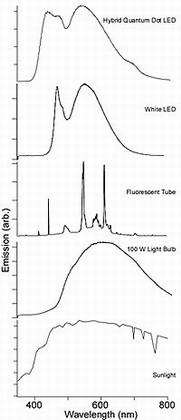
The white-light quantum dots, by contrast, produce a smoother distribution of wavelengths in the visible spectrum with a slightly warmer, slightly more yellow tint, reports Michael Bowers, the graduate student who made the quantum dots and discovered their unusual property. As a result, the light produced by the quantum dots looks more nearly like the “full spectrum” reading lights now on the market which produce a light spectrum closer to that of sunlight than normal fluorescent tubes or light bulbs. Of course, quantum dots, like white LEDs, have the advantage of not giving off large amounts of invisible infrared radiation unlike the light bulb. This invisible radiation produces large amounts of heat and largely accounts for the light bulb’s low energy efficiency.
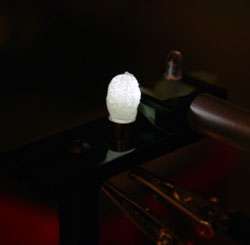
Image left: The crude hybrid white-light LED that Bowers made by mixing magic-sized quantum dots with Minwax and using the mixture to coat a blue LED. Photo by Daniel Dubois
Bowers works in the laboratory of Associate professor of Chemistry Sandra Rosenthal. The accidental discovery was the result of the request of one of his coworkers, post-doctoral student and electron microscopist James McBride, who is interested in the way in which quantum dots grow. He thought that the structure of small-sized dots might provide him with new insights into the growth process, so he asked Bowers to make him a batch of small-sized quantum dots that he could study.
“I made him a batch and he came back to me and asked if I could make them any smaller,” says Bowers. So he made a second batch of even smaller nanocrystals. But once again, McBride asked him for something smaller. So Bowers made a batch of the smallest quantum dots he knew how to make. It turns out that these were crystals of cadmium and selenium that contain either 33 or 34 pairs of atoms, which happens to be a “magic size” that the crystals form preferentially. As a result, the magic-sized quantum dots were relatively easy to make even though they are less than half the size of normal quantum dots.
After Bowers cleaned up the batch, he pumped a solution containing the nanocrystals into a small glass cell and illuminated it with a laser. “I was surprised when a white glow covered the table,” Bowers says. “The quantum dots were supposed to emit blue light, but instead they were giving off a beautiful white glow.”
“The exciting thing about this is that it is a nano-nanoscience phenomenon,” Rosenthal comments. In the larger nanocrystals, which produce light in narrow spectral bands, the light originates in the center of the crystal. But, as the size of the crystal shrinks down to the magic size, the light emission region appears to move to the surface of the crystal and broadens out into a full spectrum.
Another student in the lab got the idea of using polyurethane wood finish for thin film research while working on his parent’s summer cabin. He had even brought some Minwax into the lab. That gave Bowers the idea of mixing the magic-sized quantum dots with the polyurethane and coating an LED. The result was a bit lumpy, but it proved that the magic-sized quantum dots could be used to make a white light source.
The Vanderbilt researchers are the first to report making quantum dots that spontaneously emit white light, but they aren’t the first to report using quantum dots to produce hybrid, white-light LEDs. The other reports – one by a group at the University of St. Andrews in Scotland and one by a group at Sandia National Laboratories – describe achieving this effect by adding additional compounds that interact with the tiny crystals to produce a white-light spectrum. The magic-sized quantum dots, by contrast, produce white light without any extra chemical treatment: The full spectrum emission is an intrinsic effect.
One difference between the Vanderbilt approach and the others is the process they used to make the quantum dots, Bowers observes. They use synthesis methods that take between a week and a month to complete; whereas, the Vanderbilt method takes less than an hour.
A second significant difference, according to Rosenthal, is that it should be considerably easier to use the magic-sized quantum dots to make an “electroluminescent device” – a light source powered directly by electricity – because they can be used with a wider selection of binding compounds without affecting their emissions characteristics. Other research groups have reported stimulating quantum dots to produce light by applying an electrical current. Of course, those produced colored light. So, one of the projects at the top of Rosenthal’s list is to duplicate that feat with magic-sized nanocrystals to see if they will produce white light when electrically stimulated.
The light bulb is made out of metal and glass using primarily mechanical processes. Current LEDs are made using semiconductor manufacturing techniques developed in the last 50 years. But, if the quantum dot approach pans out, it could transform lighting production into a primarily chemical process. Such a fundamental change could open up a wide range of new possibilities, such as making almost any object into a light source by coating it with luminescent paint capable of producing light in a rainbow of different shades, including white.
Source: Vanderbilt University (By David F. Salisbury)


