Stretching DNA Yields Surprise
Most of us are familiar with the winding staircase image of DNA, the repository of a biological cell's genetic information. But few of us realize just how tightly that famous double helix is wound.
Stretched to its full length, a single molecule of human DNA extends more than three feet, but, when wound up inside the nucleus of a cell, that same molecule measures about one millionth of an inch across. Biologists have long believed that as a molecule of DNA is stretched, its double helix starts to unwind. As much sense as this makes from an intuitive standpoint, a recent experiment proved it not to be the case.
Researchers with the U.S. Department of Energy's Lawrence Berkeley National Laboratory and the University of California at Berkeley used a combination of microscopic beads and magnetic tweezers to observe that when a DNA molecule is stretched, it actually begins to overwind. This overwinding continues until the force being applied to stretch the DNA exceeds about 30 picoNewtons. (One picoNewton is about a trillionth the force required to hold an apple against Earth's gravity.) Beyond the 30 picoNewton threshold, the DNA double helix did begin to unwind in accordance with predictions.
"DNA's helical structure implies that twisting and stretching should be coupled, hence the prediction that DNA should unwind when stretched," said biophysicist Carlos Bustamante, who led this experiment. "That is why it was such surprise when we directly measured twist-stretch coupling to find instead DNA overwinds when stretched. The DNA molecule, when studied at close range, continues to surprise us!"
Bustamante is a leading authority on the use of single-molecule visualization and manipulation techniques to study the dynamics, structure and kinetics of molecular motors and nucleo-protein assemblies. He holds joint appointments with Berkeley Lab's Physical Biosciences Division and UC Berkeley's Departments of Molecular & Cell Biology, Physics, and Chemistry. He is also a Howard Hughes Medical Institute (HHMI) investigator.
The results of this study are reported in the journal Nature, in a letter entitled DNA Overwinds When Stretched, which is now available on-line. Coauthoring this letter with Bustamante were Jeff Gore, Zev Bryant, Marcelo Nöllmann, Mai Le and Nicholas Cozzarelli.
The magic of DNA replication and the transcription of genetic information into the production of proteins depends upon the mechanical properties of the double helix. This is why understanding these mechanical properties has been a scientific priority since the double-helix was first discovered by Watson and Crick more than 50 years ago. Bustamante has been one of the foremost pioneers in this area of research. More than a decade ago, he and his research group tethered DNA molecules to tiny beads and measured their elasticity. Among the many breakthroughs he and his group have achieved is the development of the technique called "rotor bead tracking."
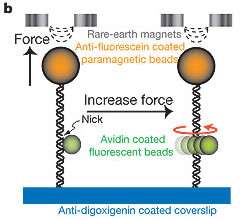
In rotor bead tracking, a single DNA molecule is anchored to a surface and a magnetized bead is attached to the free end. A point along the double-helix is then biochemically "nicked" to create a single strand of DNA that acts as a free swivel. Immediately below this nick, a plastic bead is attached to the DNA to serve as a "rotor" that will spin in response to torque. Magnets are used to manipulate the magnetized bead, providing a measured and highly controlled amount of tension to stretch the DNA molecule. With the use of a fluorescent coating, the subsequent spinning of the rotor bead in response to the stretching can be recorded.
"When we apply tension to the DNA molecule, changes in the rotor bead angle reflect changes in the twist of the lower DNA segment," Bustamante said. "The overwinding observed upon stretching, implies that contrary to the held belief, the stretch-torsion coupling constant of DNA is a negative value. This observation also implies that if we overwind the DNA, the molecule should get longer. Indeed, we found that Overwinding caused the DNA molecule to extend by about 0.5 nanometers per turn."
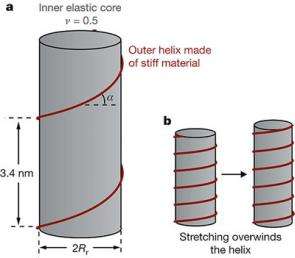
To explain the overwinding, Bustamante and his coauthors have proposed a simple "toy" model in which the radius of the DNA double-helix is allowed to shrink as the molecule is stretched. The model consists of an elastic rod that is wrapped around its outer surface by a stiff wire, analogous to DNA's sugar-phosphate backbone. The elastic rod is constructed from a material that conserves volume under stress.
"As this system is stretched, the elastic rod decreases in diameter," said Bustamante. "This enables the outer wire to wrap a larger number of times over the length of the rod."
The twist-stretch coupling results demonstrated by Bustamante and his collaborators holds important implications for how DNA-binding proteins are able to recognize their target sites along the helix. These proteins are known to bend, wrap, loop and twist DNA. Now it has been shown that they can achieve their goals by simultaneously stretching and overwinding a DNA molecule, or by compressing and underwinding it.
"We believe that our work sheds new light on an old and important problem," said Bustamante, "and that, in addition to improving our understanding of DNA/protein interactions, it will also have implications in nanotechnology. For example, the DNA molecule might provide the energy to power future nanomotors."
Source: Lawrence Berkeley National Laboratory


