Rewiring the mammalian brain -- neurons make fickle friends
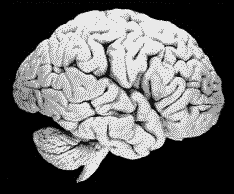
A new discovery from the Brain Mind Institute of the EPFL (Ecole Polytechnique Federale de Lausanne) shows that the brain rewires itself following an experience. The research further shows that this process of creation, testing, and reconfiguring of brain circuits takes place on a scale of just hours, suggesting that the brain is evolving considerably even during the course of a single day.
Scientists know that the strength of the connections between neurons changes to shape memories. They also know that the developing brain has a high level of plasticity as neurons forge connections with other neurons.
This new research, published in the August 7, 2006 early online edition of the Proceedings of the National Academy of Sciences, goes further, investigating how neurons choose their connections with neighboring neurons. Researchers Henry Markram and Jean-Vincent Le Bé found that connections between neurons switch rapidly on and off, leading to a form of adaptive rewiring in which the brain is engaged in a continuous process of changing, strengthening and pruning its circuitry.
Studying neuron clusters from the neocortex of neonatal rats, Markram and Le Bé found that instead of growing preferentially towards specific receivers, neurons actually have no particular affinity for any other neuron, but instead remain in a state of perpetual readiness to reconfigure circuits. They found that over the course of just a few hours, connections are formed and re-formed many times.
"The circuitry of the brain is like a social network where neurons are like people, directly linked to only a few other people," explains Markram. "This finding indicates that the brain is constantly switching alliances and linking with new circles of "friends" to better process information."
In their samples, the rewiring process was occurring continuously at a slow pace. By exciting the sample with glutamate, they found that the rate increased markedly. This suggests that with a strong new experience, the brain accelerates its reconfiguration process, allowing new connections to be made, tested, and strengthened, and weaker ones removed so that the brain is quickly better adapted to the new situation.
"This continual rewiring of the microcircuitry of the brain is like a Darwinian evolutionary process," notes Markram, "where a new experience triggers a burst of new connections between neurons, and only the fittest connections survive."
Markram emphasizes that these findings may have important implications for brain research, even at a practical level. "This discovery opens up a whole new frontier for researchers as we now try to understand the evolutionary process that sets the brain on a particular course. Perhaps it could even reveal ways to steer the brain around particular circuitry pathologies such as epilepsy."
Source: Ecole Polytechnique Fédérale de Lausanne


