Chandra independently determines Hubble constant
August 8, 2006
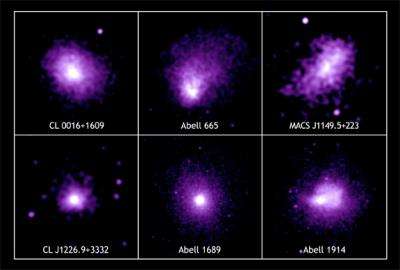
These six galaxy clusters are a subset of the 38 that scientists observed with Chandra, with distances ranging from 1.4 to 9.3 million light years from Earth, to help determine the Hubble constant. The Hubble constant, or the Hubble parameter, is a critically important number that sets the expansion rate of the Universe, and is derived by measuring the speeds that the clusters are moving away from us and dividing by the cluster distances. Credit: NASA/CXC/MSFC/M.Bonamente et al.
A critically important number that specifies the expansion rate of the Universe, the so-called Hubble constant, has been independently determined using NASA's Chandra X-ray Observatory. This new value matches recent measurements using other methods and extends their validity to greater distances, thus allowing astronomers to probe earlier epochs in the evolution of the Universe.
"The reason this result is so significant is that we need the Hubble constant to tell us the size of the Universe, its age, and how much matter it contains," said Max Bonamente from NASA's Marshall Space Flight Center (MSFC) in Huntsville, Ala., lead author on the paper describing the results. "Astronomers absolutely need to trust this number because we use it for countless calculations."
The Hubble constant is calculated by measuring the speed at which objects are moving away from us and dividing by their distance. Most of the previous attempts to determine the Hubble constant have involved using a multi-step, or distance ladder, approach in which the distance to nearby galaxies is used as the basis for determining greater distances.
The most common approach has been to use a well-studied type of pulsating star known as a Cepheid variable, in conjunction with more distant supernovae to trace distances across the Universe. Scientists using this method and observations from the Hubble Space Telescope were able to measure the Hubble constant to within 10%. However, only independent checks would give them the confidence they desired, considering that much of our understanding of the Universe hangs in the balance.
By combining X-ray data from Chandra with radio observations of galaxy clusters, the team determined the distances to 38 galaxy clusters ranging from 1.4 billion to 9.3 billion light years from Earth. These results do not rely on the traditional distance ladder. Bonamente and his colleagues find the Hubble constant to be 77 kilometers per second per megaparsec (a megaparsec is equal to 3.26 million light years), with an uncertainty of about 15%.
This result agrees with the values determined using other techniques. The Hubble constant had previously been found to be 72, give or take 8 kilometers per second per kiloparsec based on Hubble Space Telescope observations. The new Chandra result is important because it offers the independent confirmation that scientists have been seeking and fixes the age of the Universe between 12 and 14 billion years.
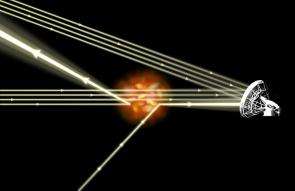
The astronomers in this study used a phenomenon known as the Sunyaev-Zeldovich effect, where photons in the cosmic microwave background interact with electrons in the hot gas that pervades the enormous galaxy clusters. The photons acquire energy from this interaction, which distorts the signal from the microwave background in the direction of the clusters. This illustration depicts this concept graphically by the broad bright beams emanating from the cluster. Illustration of Sunyaev-Zeldovich Effect. Illustration: NASA/CXC/M.Weiss
"These new results are entirely independent of all previous methods of measuring the Hubble constant," said team member Marshall Joy also of MSFC.
The astronomers used a phenomenon known as the Sunyaev-Zeldovich effect, where photons in the cosmic microwave background (CMB) interact with electrons in the hot gas that pervades the enormous galaxy clusters. The photons acquire energy from this interaction, which distorts the signal from the microwave background in the direction of the clusters. The magnitude of this distortion depends on the density and temperature of the hot electrons and the physical size of the cluster.
Using radio telescopes to measure the distortion of the microwave background and Chandra to measure the properties of the hot gas, the physical size of the cluster can be determined. From this physical size and a simple measurement of the angle subtended by the cluster, the rules of geometry can be used to derive its distance. The Hubble constant is determined by dividing previously measured cluster speeds by these newly derived distances.
This project was championed by Chandra's telescope mirror designer, Leon Van Speybroeck, who passed away in 2002. The foundation was laid when team members John Carlstrom (University of Chicago) and Marshall Joy obtained careful radio measurements of the distortions in the CMB radiation using radio telescopes at the Berkeley-Illinois-Maryland Array and the Caltech Owens Valley Radio Observatory. In order to measure the precise X-ray properties of the gas in these distant clusters, a space-based X-ray telescope with the resolution and sensitivity of Chandra was required.
"It was one of Leon's goals to see this project happen, and it makes me very proud to see this come to fruition," said Chandra Project Scientist Martin Weisskopf of MSFC.
The results are described in a paper appearing in the August 10th issue of The Astrophysical Journal.
Source: Chandra X-ray Center
-
Surprise: Dwarf galaxy harbors supermassive black hole
Jan 09, 2011 |
4.9 / 5 (15) |
9
-
Weak Lensing Gains Strength
Jan 19, 2010 |
4.7 / 5 (7) |
8
-
Spitzer Telescope Warms Up to New Career
May 06, 2009 |
5 / 5 (6) |
2
-
Scientists question our understanding of the universe
Mar 22, 2007 |
4.4 / 5 (42) |
0
-
The Hitchhiker's Guide to Galaxy Formation
Jun 12, 2006 |
4.4 / 5 (31) |
0
-
Engineers build first sub-10-nm carbon nanotube transistor
Feb 01, 2012 |
4.9 / 5 (31) |
30
-
Something old, something new: Evolution and the structural divergence of duplicate genes
Jan 31, 2012 |
4.6 / 5 (7) |
1
-
The hidden nanoworld of ice crystals: Revealing the dynamic behavior of quasi-liquid layers
Jan 30, 2012 |
5 / 5 (3) |
1
-
Stock market network reveals investor clustering
Jan 27, 2012 |
3.9 / 5 (23) |
8
-
Of microchemistry and molecules: Electronic microfluidic device synthesizes biocompatible probes
Jan 26, 2012 |
5 / 5 (1) |
0
-
Understanding induced emfs
32 minutes ago
-
What is the precise definition of a year?
1 hour ago
-
Universe as a cellular automaton
3 hours ago
-
Question about Newton's laws
3 hours ago
-
Gravity Question (I think) with mass and speed
6 hours ago
-
Can you manipulate any formula in Physics?
6 hours ago
- More from Physics Forums - General Physics
More news stories
Explained: Sigma
It's a question that arises with virtually every major new finding in science or medicine: What makes a result reliable enough to be taken seriously? The answer has to do with statistical significance -- but ...
Feb 09, 2012 |
5 / 5 (19) |
65
Quantum physicist explains $100K offer for proof scaled-up quantum computing is impossible
(PhysOrg.com) -- MIT researcher Scott Aaronson has certainly riled the physics community with his offer this past Friday, of $100,000 to anyone who can prove that scaled-up quantum computing is impossible. ...
Diamond light, brighter than the sun
Its the size of five football pitches and generates light 10 billion times brighter than the sun. As the Diamond Light Source celebrates its tenth anniversary this year, Penny Bailey visits one of the ...
Feb 07, 2012 |
4.3 / 5 (7) |
15
|
Physicists 'record' magnetic breakthrough
An international team of scientists has demonstrated a revolutionary new way of magnetic recording which will allow information to be processed hundreds of times faster than by current hard drive technology.
Feb 07, 2012 |
4.5 / 5 (41) |
14
|
Hints of the Higgs - papers are submitted
Back in December 2011, the ATLAS and CMS experiments at CERN presented some exciting results that provided tantalising hints of the Higgs boson.
Feb 08, 2012 |
4.1 / 5 (7) |
10
Walney offshore wind farm is world's biggest (for now)
(PhysOrg.com) -- The Walney wind farm on the Irish Sea--characterized by high tides, waves and windy weather--officially opened this week. The farm is treated in the press as a very big deal as the Walney ...
GPS court ruling leaves US phone tracking unclear
A US Supreme Court decision requiring a warrant to place a GPS device on the car of a criminal suspect leaves unresolved the bigger issue of police tracking using mobile phones, legal experts say.
Europeans protest controversial Internet pact
Tens of thousands of people marched in protests in more than a dozen European cities Saturday against a controversial anti-online piracy pact that critics say could curtail Internet freedom.
Europe stakes billion-dollar bet on new rocket
A pencil-slim rocket is scheduled to lift into space from South America on Monday, carrying a billion-dollar bet that Europe can grab a juicy slice of the market to place satellites in low orbit.
Study finds that anti-diabetic medication can prevent the long-term effects of maternal obesity
In a study to be presented today at the Society for Maternal-Fetal Medicine's annual meeting, The Pregnancy Meeting, in Dallas, Texas, researchers will report findings that show that short therapy with the anti-diabetic medication ...
Netflix settlement trims 14 pct off 4Q earnings
(AP) -- Netflix pressed the rewind button on its fourth-quarter earnings after settling allegations that the video subscription service violated a consumer-privacy law.