Finding paves way for better treatment of autoimmune disease
August 8, 2006
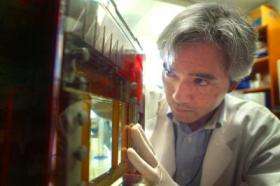
Dr. Makio Iwashima, MCG immunologist. Credit: Medical College of Georgia
A signaling molecule with an affinity for alcohol has yielded a rapid, inexpensive way to make large numbers of immune cells that work like beat cops keeping misguided cells from attacking the body.
The ability to easily make large numbers of these cells opens the door to improved treatment and a better understanding of autoimmune diseases such as type 1 diabetes and arthritis, Medical College of Georgia researchers say.
T cells are components of the immune system designed to attack invaders such as bacteria and viruses; regulatory T cells are a small subset that prevents the cells from also attacking body tissue.
Research published in the August issue of Nature Methods shows that, given the option, phospholipase D, which typically mixes with water, prefers alcohol. It's an apparently lethal choice for the signaling molecule that, in turn, also kills T cells that need phospholipase D to survive. Previously, it was unknown whether regulatory T cells required the molecule.
"What we have found is that if you block this enzyme, almost all T cells die after three days but the regulatory T cells can survive," says Dr. Makio Iwashima, MCG immunologist and the study's corresponding author. "After three days, we give them some food to grow and, in one week, you get about 90 percent pure regulatory cells."
The approach worked with laboratory-grade alcohol, called butanol, as well as beverage-grade ethanol.
Normally, regulatory T cells constitute about 5 percent of the T cell compartment, Dr. Iwashima says. Isolating them is doable but a long, expensive process.
When researchers gave some of the regulatory T cells to a mouse model of inflammatory bowel disease, the symptoms, including dramatic weight loss, went away. Animals showed no classic signs of inflammation, just a significant increase in regulatory cells.
MCG researchers have obtained funding from the Arthritis Foundation and the Juvenile Diabetes Research Foundation to see if the cell therapy will work as well in animal models for arthritis and type 1diabetes.
"Our prediction and our hope is that we can restore balance," says Dr. Iwashima. The usual 5- to 95-percent ratio of regulatory cells to non-regulatory T cells is lost in those with autoimmune disease, he says. However, too many regulatory cells also can be a problem, he says, noting that cancer patients have higher levels of regulatory cells.
Regulatory T cell therapy also resolved symptoms in a model of graft versus host disease, a problem for some bone marrow transplant patients when immune cells from the donor start attacking. This finding indicates a potential role for helping transplant patients keep new organs, the researchers say.
Dr. Iwashima has an Alcoholic Beverage Medical Research Foundation grant to pursue alcohol's potential for helping isolate desirous regulatory cells. However, he cautions that his research findings are not a green light for patients with autoimmune disease to drink because of the negative health effects of regular alcohol consumption.
Dr. Iwashima and his colleagues believe the best way to optimize cell percentages is to do what the body does. In fact, they already are searching for an endogenous substance that interferes with phospholipase D.
"Ultimately, that is the most natural way, if we can find the compound in our bodies that can do the job," Dr. Iwashima says. He theorizes that this natural substance helps destroy non-regulatory T cells when the body gets too many, say after fighting a big infection, and that it may not work well enough in people with autoimmune disease.
Source: Medical College of Georgia
-
Engineers build first sub-10-nm carbon nanotube transistor
Feb 01, 2012 |
4.9 / 5 (30) |
30
-
Something old, something new: Evolution and the structural divergence of duplicate genes
Jan 31, 2012 |
4.6 / 5 (7) |
1
-
The hidden nanoworld of ice crystals: Revealing the dynamic behavior of quasi-liquid layers
Jan 30, 2012 |
5 / 5 (3) |
1
-
Stock market network reveals investor clustering
Jan 27, 2012 |
3.9 / 5 (23) |
8
-
Of microchemistry and molecules: Electronic microfluidic device synthesizes biocompatible probes
Jan 26, 2012 |
5 / 5 (1) |
0
More news stories
First prospective clinical trial of adaptive radiotherapy for head and neck cancer patients
Researchers led by a senior investigator at Hofstra-North Shore LIJ School of Medicine and The Feinstein Institute for Medical Research have released initial findings from a first-of-a-kind clinical trial in adaptive radiotherapy ...
1 hour ago |
not rated yet |
0
Shorter hospital stay for knee replacement linked with greater revision, mortality risks
No previous research has quantified and compared the costs and outcomes between total knee replacement (TKR) patients who have differing lengths of hospital stay following surgery.
1 hour ago |
not rated yet |
0
Researchers weigh in on ethics of H5N1 research
(Medical Xpress) -- In a commentary on the biosecurity controversy surrounding publication of bird flu research details, a bioethicist and a vaccine expert at Johns Hopkins reaffirm that "all scientists have an affirmativ ...
1 hour ago |
not rated yet |
0
|
FDA-approved drug rapidly clears amyloid from the brain, reverses Alzheimer's symptoms in mice
Neuroscientists at Case Western Reserve University School of Medicine have made a dramatic breakthrough in their efforts to find a cure for Alzheimer's disease. The researchers' findings, published in the journal Science, show t ...
Medicine & Health / Neuroscience
2 hours ago |
5 / 5 (20) |
0
|
Scientists identify most lethal known species of prion protein
Scientists from the Florida campus of The Scripps Research Institute have identified a single prion protein that causes neuronal death similar to that seen in "mad cow" disease, but is at least 10 times more ...
1 hour ago |
5 / 5 (3) |
0
|
Ultraviolet protection molecule in plants yields its secrets
Lying around in the sun all day is hazardous not just for humans but also for plants, which have no means of escape. Ultraviolet (UV) radiation from the sun can damage proteins and DNA inside cells, leading ...
Deconstructing a mystery: What caused Snowmaggedon?
In the quiet after the storms, streets and cars had all but disappeared under piles of snow. The U.S. Postal Service suspended service for the first time in 30 years. Snow plows struggled to push the evidence ...
NASA sees Tropical Storm 12S - a possible threat to Madagascar
The twelfth tropical depression formed in the Southern Indian Ocean today and quickly became a tropical storm, dubbed Tropical Storm 12S. NASA's Aqua satellite passed over the storm and captured infrared data that revealed ...
Materials that shrink when heated
One common reason that people with fillings experience toothache is that their fillings expand at a different rate to the original tooth when, for example, drinking a hot drink. Contrary to intuition, however, ...
Hydrogen from acidic water: Researchers develop potential low cost alternative to platinum for splitting water
A technique for creating a new molecule that structurally and chemically replicates the active part of the widely used industrial catalyst molybdenite has been developed by researchers with the Lawrence Berkeley ...
To perform with less effort, practice beyond perfection
Whether you are an athlete, a musician or a stroke patient learning to walk again, practice can make perfect, but more practice may make you more efficient, according to a surprising new University of Colorado Boulder study.