Perseid Earthgrazers
August 8, 2006 Perseid Earthgrazers

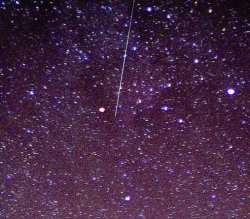
A Perseid meteor photographed by Paul Evans on July 30, 2006--before the Moon got too bright.

Blame it on the Moon: The 2006 Perseid meteor shower is going to be a dud. Oh, Earth will pass through the Perseid meteoroid stream, as usual. And meteors will flit across the sky. But when the shower peaks on Saturday morning, August 12th, the glare of the 87%-full Moon will overwhelm most Perseids, making them impossible to see.

That sounds like the end of the story—but don't stop reading.

You might see some Perseids, after all. The trick is to look before the Moon rises. Plan your meteor watch for 8:30 p.m. to 10 p.m. on Friday, August 11. The Moon won't be up yet and, in the darkness just after sunset, a special kind of meteor may appear: the Perseid Earthgrazer.

Earthgrazers are meteors that skim the top of Earth's atmosphere like a stone skipping across the surface of a pond. They appear when the radiant of a meteor shower is near the horizon, spewing meteoroids not down, but horizontally overhead. Such will be the case on Friday evening after sunset when Perseus (the radiant of the Perseids) first peeks over the northern horizon.
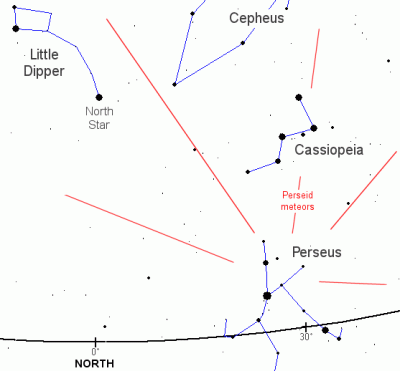
Sky map, looking north after sunset, Friday evening, Aug. 11, 2006.

Sky map, looking north after sunset, Friday evening, Aug. 11, 2006.

Don't expect a storm. Earthgrazers are rare. An hour's watching might net no more than one or two, but that's plenty. Earthgrazers are colorful and gracefully slow. People who see one talk about it for years.

Looking for Earthgrazers is simple: Spread a blanket on the ground, lie down and look up. A reclining lawn chair facing north works just as well. Perseid Earthgrazers streak overhead, flying generally north to south.

If you haven't spotted an Earthgrazer by 10 p.m., you probably won't. By 10 p.m., Perseus will have risen too high in the sky for grazing meteoroids. (Try skipping a stone by throwing it down into a pond and you'll see the problem.) Plus, the Moon itself rises around 10 p.m. to put a real damper on things.

The rest of the night is for contrarians, people who stay up until dawn in spite of the moonlight. They'll see some Perseids, a small fraction of the norm, to be sure, but not zero. Occasionally, a really bright fireball might streak across the sky, making the long night worthwhile. It pays to resist!

Next year will be better. The 2007 Perseids peak with no Moon in sight. Until then, watch out for Earthgrazers.

Note: All times in this story are local to the reader. So, "plan your meteor watch for 8:30 and 10 p.m." means go outside between 8:30 and 10:00 p.m. local time, no matter where you live. Perseid meteors are best seen from Earth's northern hemisphere.

Source: by Dr. Tony Phillips, Science@NASA


print this article email this article download pdf blog this article bookmark this article     Stumble it Digg this share on Facebook retweet share on Reddit add to delicious
Rate this story - 4.5 /5 (8 votes)


August 8, 2006 all stories

Comments: 0

4.5 /5 (8 votes)
  • Stumble this up

  • Digg this

  • share this

  • hide
  • Related Stories

  • The Perseids are Coming
    created Aug 10, 2009 | popularity not rated yet | comments 0
  • The Perseids are Coming
    created Jul 31, 2009 | popularity not rated yet | comments 0
  • Amateur Astronomers See Perseids Hit the Moon
    created Sep 03, 2008 | popularity not rated yet | comments 0
  • August brings the Perseid meteors and a cluster of planets
    created Aug 01, 2008 | popularity not rated yet | comments 0
  • The 2008 Perseid Meteor Shower
    created Jul 22, 2008 | popularity not rated yet | comments 0


  • hide
  • Relevant PhysicsForums posts

  • The shape of our solar system's orbits.
    created Nov 07, 2009
  • Above or Below the Line of Nodes
    created Nov 07, 2009
  • Supernova vs. Nova?
    created Nov 07, 2009
  • Supernova's Gamma Rays and Comets
    created Nov 06, 2009
  • More from Physics Forums - General Astronomy

Other News

Making Climate Forecasts More Useful to Farmers

Making Climate Forecasts More Useful to Farmers

Space & Earth / Environment

created 1hour ago | popularity not rated yet | comments 0

(PhysOrg.com) -- Climate forecasts are becoming more useful to farmers and ranchers, thanks to research by Agricultural Research Service (ARS) scientists and their cooperators.


L-R: Chiwetel Ejiofor, Amanda Peet and John Cusack at the premiere of "2012"

NASA on crusade to debunk 2012 apocalypse myths

Space & Earth / Space Exploration

created 3 hours ago | popularity not rated yet | comments 0

The world is not coming to an end on December 21, 2012, the US space agency insisted Monday in a rare campaign to dispel widespread rumors fueled by the Internet and a new Hollywood movie.


NASA satellites make a movie and get rainfall, wind info on Ida

NASA satellites make a movie and get rainfall, wind info on Ida (w/ Video)

Space & Earth / Earth Sciences

created 3 hours ago | popularity not rated yet | comments 0

NASA satellites are amazing examples of technology. The TRMM satellite peers into tropical cyclones and can tell how much rain is falling per hour and where. QuikScat uses microwave technology to measure Ida's ...


Antarctica glacier retreat creates new carbon dioxide store

Antarctica glacier retreat creates new carbon dioxide store

Space & Earth / Earth Sciences

created 8 hours ago | popularity 4.3 / 5 (3) | comments 0

Large blooms of tiny marine plants called phytoplankton are flourishing in areas of open water left exposed by the recent and rapid melting of ice shelves and glaciers around the Antarctic Peninsula. This ...


NASA's TRMM Satellite sees most of Ida's heaviest rain stayed off coasts

NASA's TRMM Satellite sees most of Ida's heaviest rain stayed off coasts

Space & Earth / Earth Sciences

created 4 hours ago | popularity not rated yet | comments 0

NASA and the Japanese Space Agency's Tropical Rainfall Measuring Mission (TRMM) satellite flew over Ida and captured her rainfall when she passed by Nicaragua, Honduras and Belize this weekend. TRMM data revealed ...