Ultrafast lasers take 'snapshots' as atoms collide
October 20, 2005
Using laser pulses that last just 70 femtoseconds (quadrillionths of a second), physicists have observed in greater detail than ever before what happens when atoms collide. The experiments at JILA, a joint institute of the National Institute of Standards and Technology (NIST) and the University of Colorado at Boulder, confirm a decades-old theory of how atoms--like tennis balls--briefly lose form and energy when they hit something. The results will help scientists study other atomic-scale processes and better understand the laws of physics.
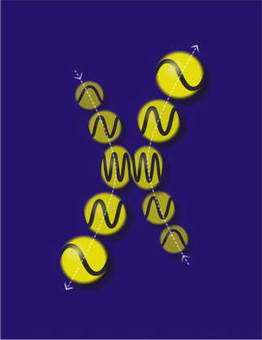
Image: JILA scientists used brief flashes of laser light to reveal how atoms, like tennis balls, briefly lose form and energy when they collide. Image credit: V. Lorenz, JILA
The new data, reported in the Oct. 14 issue of Physical Review Letters,* provide the equivalent of missing frames in movies of colliding atoms (see simulated images in accompanying graphic). As is the case when a tennis ball is hit by a racquet, the motion is too quick for the eye but can be detected using short flashes of light. The JILA scientists collected data on atoms' properties before, during and after collisions lasting just half a picosecond (trillionth of a second) using laser "flashes" that were even faster.
In the JILA experiments, about 10 quintillion potassium atoms in a dense gas were packed into a titanium container just 1 square centimeter in size and heated to 700 degrees C (almost 1,300 degrees F). With such high temperatures and large numbers of atoms, the experiment is designed to maximize the number of atom collisions. Rapidly alternating pulses of laser light then are used to "freeze frame" the action.
Energy from the first laser pulse is absorbed by the atoms, placing them in a uniform state, emitting electromagnetic waves in identical patterns. A second laser then quickly hits the mass of atoms, and a detector captures a signal beam formed by the interaction of the beams. Light from the second pulse is absorbed and re-emitted by atoms that are "in synch" but not by atoms that are colliding and losing energy. The intensity of this signal beam, measured as a function of the delay between the two pulses, provides a "snapshot" of how many atoms are colliding at any one time, as well as details about changes in their wave patterns.
*V.O. Lorenz and S.T. Cundiff. 2005. Non-Markovian dynamics in a dense potassium vapor. Physical Review Letters. Oct. 14.
Source: NIST
-
Physicists create first 'frequency comb' to probe ultraviolet wavelengths
Feb 01, 2012 |
5 / 5 (6) |
4
-
Mechanical micro-drum cooled to quantum ground state
Jul 06, 2011 |
4.5 / 5 (6) |
0
-
Quantum quirk: Scientists pack atoms together to prevent collisions in atomic clock
Feb 03, 2011 |
4.6 / 5 (8) |
4
-
AFM positioning: Shining light on a needle in a haystack
Nov 10, 2010 |
5 / 5 (4) |
0
-
JILA frequency comb system detects gas impurities to aid semiconductor manufacturing
Aug 04, 2010 |
5 / 5 (3) |
0
-
Engineers build first sub-10-nm carbon nanotube transistor
Feb 01, 2012 |
4.9 / 5 (30) |
30
-
Something old, something new: Evolution and the structural divergence of duplicate genes
Jan 31, 2012 |
4.6 / 5 (7) |
1
-
The hidden nanoworld of ice crystals: Revealing the dynamic behavior of quasi-liquid layers
Jan 30, 2012 |
5 / 5 (3) |
1
-
Stock market network reveals investor clustering
Jan 27, 2012 |
3.9 / 5 (23) |
8
-
Of microchemistry and molecules: Electronic microfluidic device synthesizes biocompatible probes
Jan 26, 2012 |
5 / 5 (1) |
0
More news stories
Hovering not hard if you're top-heavy, researchers find
Top-heavy structures are more likely to maintain their balance while hovering in the air than are those that bear a lower center of gravity, researchers at New York University's Courant Institute of Mathematical Sciences ...
just added |
not rated yet |
0
|
SLAC, Stanford team focuses on high-energy electrons to treat cancer
Accelerator physicists at SLAC and cancer specialists from Stanford are working on a new technology that could dramatically reduce the time needed for cancer radiation treatments. The team ran an initial experiment ...
3 hours ago |
not rated yet |
0
Measurements from high-energy collisions lead to better understanding of why meson particles disappear
For several years, physicists at the Relativistic Heavy Ion Collider (RHIC) at Brookhaven National Laboratory (BNL), USA, have studied an unusual state of matter called the quarkgluon plasma, which they ...
3 hours ago |
not rated yet |
0
Quantum physicist explains $100K offer for proof scaled-up quantum computing is impossible
(PhysOrg.com) -- MIT researcher Scott Aaronson has certainly riled the physics community with his offer this past Friday, of $100,000 to anyone who can prove that scaled-up quantum computing is impossible. ...
Explained: Sigma
It's a question that arises with virtually every major new finding in science or medicine: What makes a result reliable enough to be taken seriously? The answer has to do with statistical significance -- but ...
Feb 09, 2012 |
5 / 5 (14) |
26
New understanding of DNA repair could eventually lead to cancer therapy
A research group in the Faculty of Medicine & Dentistry at the University of Alberta is hoping its latest discovery could one day be used to develop new therapies that target certain types of cancers.
Zuckerberg's focus drives Facebook's ascent
When Mark Zuckerberg showed up to rent Judy Fusco's Los Altos, Calif., house in the fall of 2004, soon after he'd arrived in Silicon Valley, the landlord was immediately struck by his confidence.
Both maternal and paternal age linked to autism
Older maternal and paternal age are jointly associated with having a child with autism, according to a recently published study led by researchers at The University of Texas Health Science Center at Houston (UTHealth).
Night, weekend delivery OK for babies with birth defects
Weekday delivery is no better than night or weekend delivery for infants with birth defects, according to a new study presented today at The Pregnancy Meeting, the Society for Maternal-Fetal Medicine's annual conference. ...
Sonic Cradle lands spot in TED exhibition
A Simon Fraser University graduate student project that melds music, meditation and modern technology has landed a rare spot as an exhibit at TEDActive 2012 in Palm Springs, California this month.
Drug halts organ damage in inflammatory genetic disorder
A new study shows that Kineret (anakinra), a medication approved for the treatment of rheumatoid arthritis, is effective in stopping the progression of organ damage in people with neonatal-onset multisystem inflammatory disease ...