Climate Change Threatens Pollination Timing
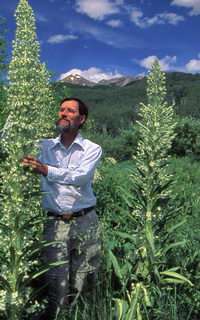
In addition to the more obvious effects of climate change, such as rising sea levels and increasing storm activity, there is the potential to dramatically alter ecological communities. Dr. David Inouye, director of University of Maryland’s graduate program in Sustainable Development and Conservation Biology, reports that global warming could disrupt the timing of pollination in alpine environments, with serious negative impacts to both plants and pollinators.
Inouye presented more than three decades of data on pollination ecology in the Rocky Mountains, supported in part by Earthwatch Institute, at a session at this week’s Ecological Society of America (ESA) meeting titled “Climate change and timing in ecological communities.” The August 8 session, which Inouye helped organize, drew attention to many climate-dependent changes in the timing of ecological events that will disrupt ecological communities.
“High altitudes are one of the habitats where it seems that climate change is having dramatic effects,” said Inouye, one of the pioneers in this area. “The long-term research that I have carried out at the Rocky Mountain Biological Laboratory (RMBL) since 1973, with the assistance of Earthwatch volunteers for many of those years, has allowed me to document some of the changes going on in flowering. The timing of flowering has become earlier, particularly since 1998, the abundance of some flowers has changed, and the synchrony of plants and pollinators may be changing.”
Inouye reports that flowering time for plants in the Colorado Rocky Mountains is determined by when the snow melts, which is likely to change in response to regional and global climate change. There is some evidence that plants and pollinators are responding differently to climate change, potentially resulting in reduced reproductive success for both groups and possible extinctions.
“Earthwatch volunteers contributed the financial assistance and labor that made it possible to continue this long-term project,” said Inouye, who had support from Earthwatch Institute teams from 1982 through 1998. “They helped to monitor flowering and the population biology of wildflowers, and also assisted many of my graduate students in their dissertation research.”
The ESA session Inouye co-organized focused on the impact of global warming on “phenology,” or the timing of climate-sensitive ecological events, including leaf-out, insect emergence, and bird feeding behavior. Scientists presented the latest evidence of ecological impacts of climate change as well as new techniques for monitoring these changes, such as remote sensing and networks of ground observers. They also reported predictions of how time-sensitive ecological relationships will change in response to global warming.
“Climate change is already affecting ecological systems and will continue to do so over the coming years, providing a particularly relevant topic for this session,” said Inouye.
For instance, Earthwatch volunteers in the Rocky Mountains helped Inouye document that global warming affects lower altitudes differently than higher ones. As a result, animals exposed to earlier warm weather may exit hibernation earlier and birds responding to earlier spring weather in their wintering grounds may flock north while there are several feet of snow on the ground, risking starvation.
“Already the difference in timing between seasonal events at low and high altitudes has negatively influenced migratory pollinators, such as hummingbirds, which overwinter at lower altitudes and latitudes,” said Inouye. “If climate change disturbs the timing between flowering and pollinators that overwinter in place, such as butterflies, bumblebees, flies, and even mosquitoes, the intimate relationships between plants and pollinators that have co-evolved over the past thousands of years will be irrevocably altered.”
Scientists at the session reported that this kind of ecological disruption from climate change has become commonplace in ecosystems around the world. Only through long-term monitoring, such as that supported by Earthwatch, and advances in monitoring technology can these conservation managers be more proactive about these changes.
Source: Earthwatch Institute


