Overall Antarctic snowfall hasn't changed in 50 years
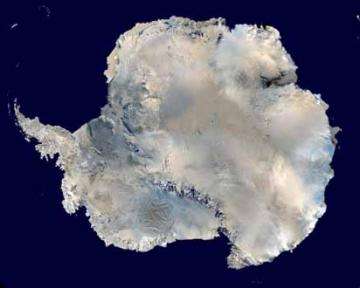
An international effort to determine the variability of recent snowfall over Antarctica shows that there has been no real increase in precipitation over the southernmost continent in the last half-century. The results are important since most accepted computer models assessing global climate change call for an increase in Antarctic precipitation as atmospheric temperatures rise.
The findings also suggest that the slow-but-steady rise in global sea levels isn't being slowed by a thickening of Antarctica 's massive ice sheets, as some climate-change critics have argued.
The conclusions were part of a paper published today in the latest issue of the journal Science. Sixteen researchers from nine institutions in seven countries took part in the study.
Andrew Monaghan, a research associate and meteorologist with Ohio State University's Byrd Polar Research Center and lead author on the paper, wrote that “there were no statistically significant trends in snowfall accumulation over the past five decades, including recent years for which global mean temperatures have been warmest.”
The study looked at both the West Antarctic Ice Sheet (WAIS), a marine ice sheet with a base below sea level, and the much thicker East Antarctic Ice Sheet (EAIS) that sits atop dry land. In recent years, large volumes of ice along the coast of the WAIS have melted at a rate previously unseen. Some observers have blamed global warming for this and for the increased calving of icebergs along the continent's margin.
The researchers wanted to assemble a half-century-long record of snowfall back to the International Geophysical Year, or IGY. Work during the IGY began the first real modern study of the Antarctic continent and substantive research has continued there ever since.
The research team coupled data from existing ice cores in the region, snow pits and networks of snow stakes, and meteorological observations. To these they added numerous new ice core records obtained by the International Transantarctic Scientific Expedition (ITASE), a 12-nation research program begun in 1990 and tasked with reconstructing the continent's climate history.
Lastly, the researchers relied on snowfall data from the European Centre for Medium-Range Weather Forecasts 40-Year Reanalysis (ERA-40), a project that uses a popular weather forecast model to re-evaluate global weather in recent years.
They were able to use the ERA-40 data to fill in the gaps between the ice core records. Since ERA-40 covers the entire continent, it increased the researchers' confidence in their conclusions.
“We're certain that our results are representative of the entire Antarctic continent and that the trends we do see are correct,” Monaghan said.
When they were finished, they had generated the most precise record of Antarctic snowfall yet, and doubled its length by 25 years. The reconstruction provided a picture of precipitation on both an annual and decadal scale that showed wide variations across the continent.
“This approach is quite a bit more reliable than a global climate model,” Monaghan said, adding that this method gives them snapshots of the Antarctic snowfall changes on a grid, something that wasn't possible with other methods.
Monaghan and his colleagues are cautious about their findings. They point to the short 50-year length of the record as a limitation of the study and long for at least a century of data before they can give a definitive answer about precipitation trends over Antarctica .
“The year-to-year and decadal variability of the snowfall is so large that it makes it nearly impossible to distinguish trends that might be related to climate change from even a 50-year record”, says Monaghan.
“This means that new, highly accurate satellite measurements of the amount of Antarctic ice must continue for several decades to determine whether Antarctica is gaining or losing water to the ocean.”
But as to whether warming in the atmosphere over the Antarctic and the surrounding oceans has brought more precipitation to balance the ice lost from edges of the continent during that latter part of the 20th Century, Monaghan points to the conclusion “that global sea level has not been mitigated by recently increased Antarctic snowfall as expected.”
The key issues now are how snowfall will change as the atmosphere continues to warm and whether climate model predictions of increased snowfall can be trusted, he said.
Other Ohio State researchers on the National Science Foundation-funded project included David Bromwich, professor of atmospheric sciences in the Department of Geography; and graduate student Ryan Fogt; Sheng-Hung Wang, a research associate with the Byrd Center; and Cornelius van der Veen, a Byrd Center glaciologist. Additional researchers from Russia, Italy, Australia, Norway, Germany and China were also co-authors on the paper.


