Antifreeze protein found in snow fleas may allow longer storage of transplant organs
October 21, 2005 New antifreeze protein may allow longer storage of transplant organs

A new antifreeze protein discovered in tiny snow fleas by Queen’s University researchers may lengthen the shelf life of human organs for transplantation.

Drs. Laurie Graham and Peter Davies, from the Department of Biochemistry, found that the potent protein produced by the fleas to protect themselves against freezing is capable of inhibiting ice growth by about six Celsius degrees. This would allow organs to be stored at lower temperatures, expanding the time allowed between removal and transplant.

The results of the Queen’s study, funded by the Canadian Institutes for Health Research (CIHR), are published today in the international journal Science.

“Transplant organs must now be kept at the freezing point or slightly warmer,” says Dr. Graham. “If we can drop the temperature at which the organ is safely stored, there will be a longer preservation period.”

The hyperactive antifreeze protein produced by snow fleas is different from two other insect proteins discovered earlier at Queen’s, the researchers say.

“Unlike the antifreeze proteins in beetles and moths, AFPs in snow fleas break down and lose their structure at higher temperatures,” explains Dr Davies, Canada Research Chair in Protein Engineering. “This means that if used to store organs for transplants, they will be cleared from a person’s system very quickly, reducing the possibility of harmful antibodies forming.”

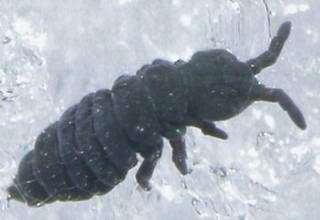
An ancient species related to modern insects, snow fleas are also known as “springtails” because of the distinctive springing organ under their abdomen which allows them to leap hundreds of times their one-millimeter length. Dr. Graham first noticed them while cross-country skiing, and brought several samples into the lab. “It was serendipity,” she says now. “They looked like dots of pepper sprinkled on the snow. Later we were able to collect large numbers for testing at the Queen’s University Biological Station.”

Using a process called ice affinity purification, the team isolated the new protein, which is rich in an amino acid called glycine. “When you grow a ‘popsicle’ of ice in the presence of these proteins, the AFPs bind to the ice and become included, while other proteins are excluded,” says Dr. Davies. “We use their affinity for ice as a tool to purify the protein.”

The antifreeze mechanism of snow fleas has been reported in other parts of the world, including Antarctica, but until now no one has isolated the protein. As well as its potential for use in organ transplants, the researchers suggest it could help to increase frost resistance in plants, and inhibit crystallization in frozen foods.

Source: Queen's University


print this article email this article download pdf blog this article bookmark this article     Stumble it Digg this share on Facebook retweet share on Reddit add to delicious
Rate this story - 4.1 /5 (8 votes)


October 21, 2005 all stories

Comments: 0

4.1 /5 (8 votes)
  • Stumble this up

  • Digg this

  • share this

  • hide
  • Related Stories

  • 'Snow flea antifreeze protein' could help improve organ preservation
    created Jul 21, 2008 | popularity not rated yet | comments 0
  • Beer Here
    created Nov 25, 2009 | popularity not rated yet | comments 0
  • First former college football player diagnosed with CTE
    created Oct 22, 2009 | popularity not rated yet | comments 0
  • Toxins in Lake Michigan fish linked to diabetes
    created Aug 31, 2009 | popularity not rated yet | comments 0
  • Genes that let creepy-crawlies survive a deep freeze
    created Jul 21, 2009 | popularity not rated yet | comments 0


Other News

Financial instruments could be spiked with unfindable risks

Financial instruments could be spiked with unfindable risks

Other Sciences / Economics

created Dec 21, 2009 | popularity 4.6 / 5 (15) | comments 37

(PhysOrg.com) -- In a result that may have implications for financial regulation, researchers from computer science and economics have revealed potentially impenetrable problems with the pricing of financial ...


Mystery of golden ratio explained

Researcher explains mystery of golden ratio

Other Sciences / Mathematics

created Dec 21, 2009 | popularity 2.6 / 5 (21) | comments 7

The Egyptians supposedly used it to guide the construction the Pyramids. The architecture of ancient Athens is thought to have been based on it. Fictional Harvard symbologist Robert Langdon tried to unravel ...


First Jesus-era house discovered in Nazareth (AP)

First Jesus-era house discovered in Nazareth

Other Sciences / Archaeology & Fossils

created Dec 21, 2009 | popularity 2.7 / 5 (6) | comments 5

(AP) -- Just in time for Christmas, archaeologists on Monday unveiled what may have been the home of one of Jesus' childhood neighbors. The humble dwelling is the first dating to the era of Jesus to be discovered ...


Fossil shelved for a century reworks carnivore family tree

Fossil shelved for a century reworks carnivore family tree

Other Sciences / Archaeology & Fossils

created Dec 22, 2009 | popularity 4.5 / 5 (8) | comments 4

More than a hundred years after its discovery, the limbs and vertebrae of a fossil have been pulled off the shelf at the American Museum of Natural History to revise the view of early carnivore lifestyles. ...


Nobel Physics laureates undeserving, colleagues say: report

Other Sciences / Other

created Dec 22, 2009 | popularity 3.5 / 5 (8) | comments 4

Former colleagues of two American scientists who won the 2009 Nobel physics prize say the winners, Willard Boyle and George Smith, did not deserve the award, Canada's Globe and Mail reported Tuesday.