New multilayer thin-film sensors enable fast, efficient monitoring of aircraft defects
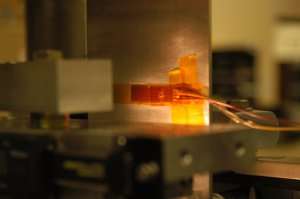
August 14, 2006Engineers at Southwest Research Institute have developed new multi-layer thin films and combined them with magnetostrictive sensors to nondestructively detect and monitor defects in aircraft components. The probe and sensor were evaluated on an A-10 aircraft test article and successfully detected a crack and monitored its growth. Unlike MsS methods that evaluate flaws in pipeline, the MsS method for aircraft does not require the use of external magnets. Credit: Southwest Research Institute
As aircraft reach or exceed their design lifetimes, the U.S. Air Force is turning to advanced nondestructive evaluation methods to determine their fitness for continued duty. Southwest Research Institute has developed a flexible thin-film deposition process (as a follow-on effort to a recent project funded by the Defense Advanced Research Projects Agency) that will enable the fabrication of thin magnetostrictive sensors that can efficiently detect and monitor defects in aircraft without the need for costly teardowns or unnecessary inspections.
SwRI pioneered the use of magnetostrictive sensor (MsS) technology as a nondestructive evaluation tool for the pipeline industry. The method uses guided waves to rapidly detect corrosion and defects for assessing overall pipeline integrity. A magnetic field around the pipe generates the guided waves with a ferromagnetic strip and coil; however, this external magnet is impractical for the small components and confined spaces aboard aircraft.
"What we needed was an improved, lightweight, low-profile evaluation sensor that could maintain a residual magnetic field without the need for an external magnet," says Senior Research Engineer Clint J. Thwing of SwRI's Sensor Systems and Nondestructive Evaluation Technology Department.
Using internal research funds, the SwRI team developed a process for manufacturing thin films that, when combined with magnetostrictive sensor technology, effectively detect flaws without the need for an external magnet.
Deposited in an ultra-high vacuum environment, the thin films are layered with iron cobalt and iron terbium, then heat-treated. SwRI applied the multilayer deposition process to low-oxidation aluminum foil so that the thin film would be pliable and easy to apply. The technique for manufacturing multilayer thin-film magnetostrictive sensors is reproducible, and the resulting sensors have been shown to effectively monitor crack growth and determine the approximate size (cross section) of defects on a simulated A-10 aircraft structure.
Magnetostrictive sensors used by the pipeline industry are also limited by a "dead zone" - the distance associated with the time required for the excitation pulses to saturate the receiver. At 32 kHz, the dead zone extends 2 to 3 feet. This distance is inconsequential when testing a miles-long pipeline, but in aircraft bulkheads and fuselage components, the region to be inspected is usually only a few inches from the site of the monitoring probe. The new method minimizes the dead zone by using a much shorter wavelength or higher frequency signal.
"This new MsS technology is also ideal as a health and usage monitoring system, or HUMS," says Thwing. "Installed as onboard sensors and data acquisition systems, HUMS can help reduce costs, improve readiness and increase safety by identifying mechanical problems or maintenance issues while the aircraft remains in service."
With additional development, the new MsS technology will address the need for monitoring the structural components of today's high-cycle aircraft, such as T-37 and T-38 trainers, as well as A-10, F-16, F-15 and other military combat aircraft. It also has potential for commercial fleets.
Source: Southwest Research Institute
-
Remote sensing places nature at our fingertips
Jan 30, 2012 |
not rated yet |
0
-
Send in the supplies: RoboCopters in Marines' future
Jan 10, 2012 |
5 / 5 (2) |
0
-
'Smart Connector' could save millions in lost revenue
Dec 15, 2011 |
4.2 / 5 (6) |
3
-
Giant piezoelectric effect to improve MEMS devices
Dec 02, 2011 |
5 / 5 (3) |
0
-
NASA develops new game-changing technology
Nov 18, 2011 |
4.9 / 5 (10) |
15
-
Engineers build first sub-10-nm carbon nanotube transistor
Feb 01, 2012 |
4.9 / 5 (31) |
30
-
Something old, something new: Evolution and the structural divergence of duplicate genes
Jan 31, 2012 |
4.6 / 5 (7) |
1
-
The hidden nanoworld of ice crystals: Revealing the dynamic behavior of quasi-liquid layers
Jan 30, 2012 |
5 / 5 (3) |
1
-
Stock market network reveals investor clustering
Jan 27, 2012 |
3.9 / 5 (23) |
8
-
Of microchemistry and molecules: Electronic microfluidic device synthesizes biocompatible probes
Jan 26, 2012 |
5 / 5 (1) |
0
-
Need help reading 3-D
9 hours ago
-
A way to send and receive wireless data
15 hours ago
-
Tabletop Cold Fusion Reactor
16 hours ago
-
Calling function with no input argument
Feb 10, 2012
-
Force free body diagram problem on gym equipment
Feb 10, 2012
-
Empirical data regarding shower heads and water
Feb 10, 2012
- More from Physics Forums - General Engineering
More news stories
Walney offshore wind farm is world's biggest (for now)
(PhysOrg.com) -- The Walney wind farm on the Irish Sea--characterized by high tides, waves and windy weather--officially opened this week. The farm is treated in the press as a very big deal as the Walney ...
GPS court ruling leaves US phone tracking unclear
A US Supreme Court decision requiring a warrant to place a GPS device on the car of a criminal suspect leaves unresolved the bigger issue of police tracking using mobile phones, legal experts say.
18 hours ago |
4 / 5 (2) |
0
Europeans protest controversial Internet pact
Tens of thousands of people marched in protests in more than a dozen European cities Saturday against a controversial anti-online piracy pact that critics say could curtail Internet freedom.
14 hours ago |
4.5 / 5 (8) |
0
Netflix settlement trims 14 pct off 4Q earnings
(AP) -- Netflix pressed the rewind button on its fourth-quarter earnings after settling allegations that the video subscription service violated a consumer-privacy law.
18 hours ago |
not rated yet |
0
Navy to begin tests on electromagnetic railgun prototype launcher
The Office of Naval Research (ONR)'s Electromagnetic (EM) Railgun program will take an important step forward in the coming weeks when the first industry railgun prototype launcher is tested at a facility ...
Feb 06, 2012 |
4.7 / 5 (15) |
92
|
Europe stakes billion-dollar bet on new rocket
A pencil-slim rocket is scheduled to lift into space from South America on Monday, carrying a billion-dollar bet that Europe can grab a juicy slice of the market to place satellites in low orbit.
Study finds that anti-diabetic medication can prevent the long-term effects of maternal obesity
In a study to be presented today at the Society for Maternal-Fetal Medicine's annual meeting, The Pregnancy Meeting, in Dallas, Texas, researchers will report findings that show that short therapy with the anti-diabetic medication ...
Explained: Sigma
It's a question that arises with virtually every major new finding in science or medicine: What makes a result reliable enough to be taken seriously? The answer has to do with statistical significance -- but ...
Political leaders play key role in how worried Americans are by climate change: study
More than extreme weather events and the work of scientists, it is national political leaders who influence how much Americans worry about the threat of climate change, new research finds.
New power source discovered
(PhysOrg.com) -- Researchers at the Massachusetts Institute of Technology (MIT) and RMIT University have made a breakthrough in energy storage and power generation.
NASA budget will axe Mars deal with Europe: scientists
US President Barack Obama's budget proposal to be submitted next week for 2013 will cut NASA's budget by 20 percent and eliminate a major partnership with Europe on Mars exploration, scientists said Thursday.